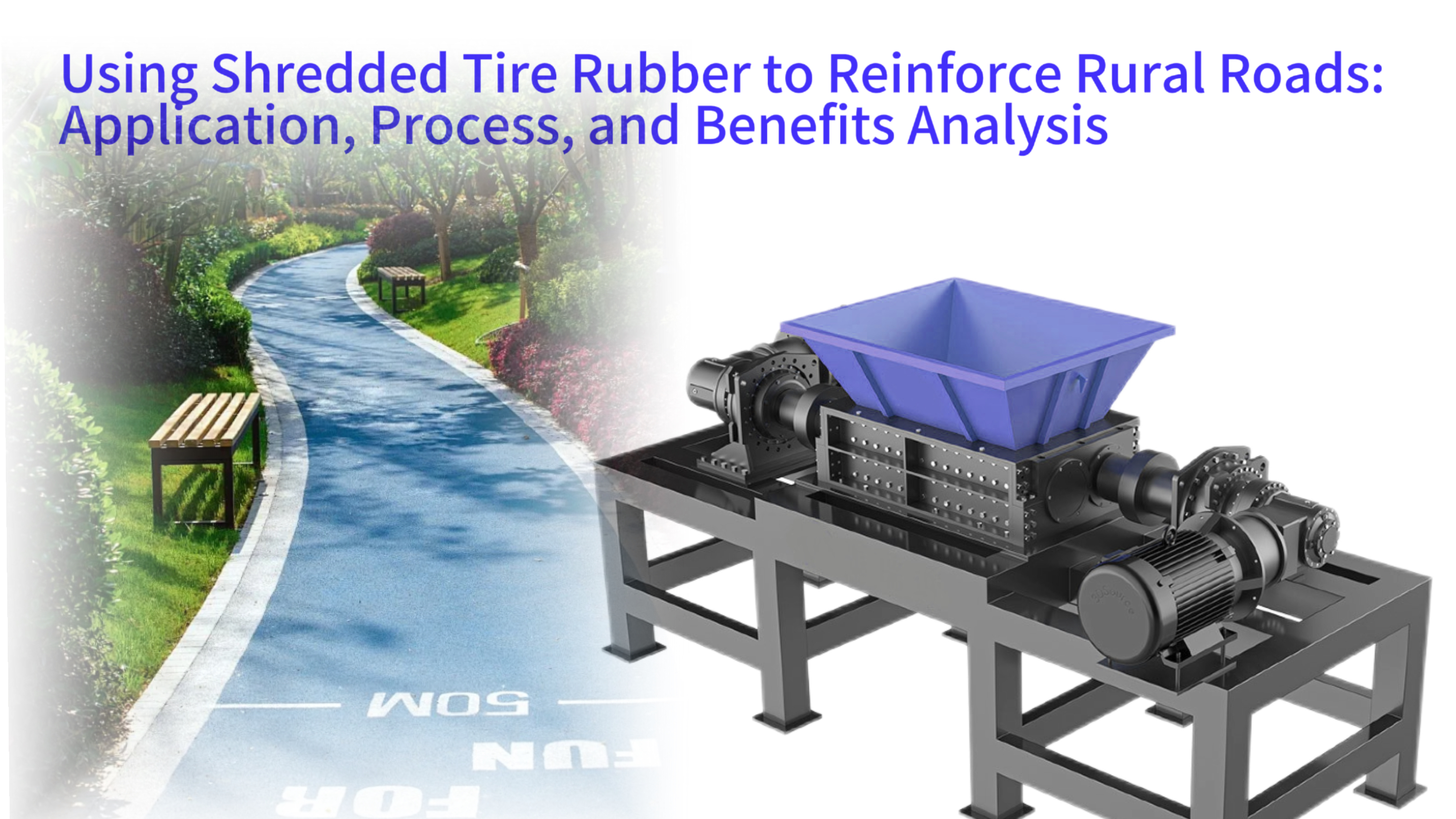
Tire Rubber to Rural Road Reinforcement - Core Process
The degradation of rural road infrastructure represents a widespread global challenge, evident in surface cracking, rutting, and structural failure. These roads typically support agricultural machinery and heavy transport vehicles yet are often constructed to lower standards with limited maintenance budgets. Conventional repair methods are costly and offer only temporary solutions, failing to provide long-term durability. Simultaneously, the accumulation of end-of-life tires poses significant environmental problems, including fire hazards and land contamination. This article examines the process of transforming waste tires into rubber granules using industrial tire shredders for application in rural road renovation. This approach enhances road durability and performance while offering a sustainable waste management solution. A detailed exploration of the technical principles, processing methods, construction applications, cost-effectiveness, and implementation challenges provides a comprehensive reference for engineering and practical application, supported by factual data on material performance and lifecycle analysis.
The Current State of Rural Roads and the Need for Material Innovation
Rural Road Damage & Performance Comparison
Rural road networks are extensive but frequently suffer from low design standards, utilizing native materials like gravel and soil for their base layers. These materials lack sufficient compressive strength, leading to rapid deterioration under repetitive loading and environmental stress. Seasonal rainfall softens the subgrade, winter freeze-thaw cycles induce cracking, and heavy agricultural equipment accelerates pavement wear. Constrained financial resources restrict high-quality maintenance, creating a cycle of worsening road conditions. A clear need exists for an innovative material that can strengthen road structures while remaining economically viable and environmentally sound. Shredded tire rubber granules, employed as a modifier, possess elastic, crack-resistant, and durable properties that can meet this demand. Utilizing this material integrates waste management with infrastructure improvement, achieving dual benefits for communities and the environment, a principle applicable to broader hard material shredding solutions.
The search for improved road materials is driven by the economic burden of constant repair. Each maintenance cycle disrupts local transport, increases long-term expenditure, and consumes virgin resources. Rubber granules derived from tires present an alternative. Their application addresses both the mechanical weaknesses of traditional pavements and the pressing issue of tire disposal. This synergy transforms a waste product into a valuable construction component, aligning with circular economy goals. The potential of this material is not merely theoretical; it is grounded in decades of research and practical trials demonstrating measurable improvements in pavement life and resilience.
Analysis of Road Damage Mechanisms
Damage to rural roads primarily stems from mechanical stress and environmental factors. Heavy vehicle loads induce plastic deformation, forming ruts. Temperature variations cause material contraction, leading to cracks. Water infiltration weakens the subgrade, resulting in potholes and surface ravelling. These damage modes interact, accelerating overall pavement degradation. A thorough understanding of these mechanisms is essential for designing effective reinforcement strategies. Incorporating rubber granules can alter the material's response to stress. The elastic nature of rubber allows it to absorb and dissipate energy from traffic loads, reducing permanent deformation and slowing the progression of damage throughout the pavement structure.
Scientific studies on pavement mechanics quantify these interactions. Load-induced stress concentrations at the surface propagate downwards, fatiguing the base materials. Environmental moisture reduces the binding capacity of asphalt and weakens unbound granular layers. The addition of rubber modifies the composite material's properties, increasing its tolerance to these stresses. This modification is not a surface treatment but a fundamental enhancement of the material matrix, offering a more robust solution compared to periodic patching of symptomatic failures.
Limitations of Conventional Maintenance Methods
Traditional maintenance typically involves filling potholes and localized repaving. These methods temporarily restore the riding surface but do not address underlying structural weaknesses. The cumulative cost of repeated repairs is high, and such activities frequently disrupt local traffic and commerce. Over the long term, this reactive approach fails to increase the road's load-bearing capacity or extend its service life significantly. A paradigm shift is required, moving from superficial fixes to solutions that improve the intrinsic material properties. Rubber-modified roadways offer this possibility by enhancing the material's elasticity and fatigue resistance, thereby addressing the root causes of premature failure commonly seen in rural settings.
The economic inefficiency of repeated minor repairs becomes apparent over a road's lifecycle. While each individual repair may seem affordable, their frequency leads to a total expenditure that could potentially fund a more durable initial construction or rehabilitation. Furthermore, the quality of patch repairs is often inferior to the original pavement, creating weak points that fail again quickly. Investing in a material upgrade using rubber granules represents a strategic decision to break this cycle, prioritizing long-term performance and lower lifetime costs over short-term, low-cost interventions.
Key Properties of High-Performance Road Materials
An ideal material for rural road enhancement must exhibit high fatigue resistance, elasticity, water resistance, and freeze-thaw durability. It must also be compatible with traditional asphalt and aggregate, allowing for straightforward construction practices. Rubber granules sourced from waste tires inherently possess many of these characteristics. Their low elastic modulus facilitates energy dissipation under load. Their hydrophobic nature contributes to improved moisture resistance. Their thermal stability helps the pavement perform across a wider temperature range, reducing softening in summer and brittleness in winter. These properties collectively make rubber granules a suitable candidate for sustainable road renovation projects where performance and longevity are critical.
Material specifications for road construction are rigorous. Rubber granules must be consistently sized and free from contaminants like steel wire and fabric to ensure proper bonding within the asphalt mix. The granules interact with bitumen on a chemical level, with the rubber swelling and partially dissolving to create a modified, more viscous binder. This modified binder exhibits superior adhesion to aggregate and greater flexibility. The resulting composite material meets the core performance requirements for durable rural roads: it withstands heavy, sporadic loads from farm equipment, resists damage from water penetration, and maintains integrity despite temperature fluctuations, much like materials processed by a double shaft tire shredder ensure consistency.
The Material Science Foundation of Tire Rubber Granules
Physical & Chemical Properties of Rubber Granules
Density: 1.1 - 1.2 g/cm³ (lower than mineral aggregate)
Particle Size: 1-5 mm / 5-10 mm (standard gradations)
Swelling Ratio: 1.5 - 3x (in hot asphalt)
Elastic Modulus: Low (high deformability/energy absorption)
Thermal Stability: Up to 200°C (no melting, only softening)
Main Components: Vulcanized rubber + carbon black
Hydrophobic: Non-absorptive (improves moisture resistance)
Oxidation Rate: Reduced vs conventional asphalt mixes
Viscosity: Increased (improves chip retention)
Elastic Recovery: Greatly enhanced (reduced rutting)
Adhesion: Superior aggregate bonding
Temperature Susceptibility: Reduced (stable in hot/cold)
Tire rubber is a composite material primarily consisting of vulcanized rubber, carbon black, steel cords, and textile fibers. After shredding and metal separation, the resulting rubber granules behave as a polymeric elastomer with distinct physico-chemical properties. When blended with hot asphalt, the surface of the rubber granules interacts with the bitumen through processes of swelling and cross-linking. This interaction alters the rheological properties of the asphalt, enhancing its viscoelasticity and durability. Within the asphalt mixture, the rubber granules act as elastic fillers, dispersing applied stresses and inhibiting the propagation of cracks. Furthermore, the rubber improves the temperature susceptibility of the mix, resulting in a pavement that remains more stable under high temperatures and more flexible in cold conditions. These scientific principles underpin the effective application of rubber granules in road engineering, providing a predictable framework for performance.
The modification process is not merely physical blending but involves complex chemo-physical reactions. The high surface area of the shredded granules allows for significant interaction with the asphalt binder. Components within the rubber, such as extender oils and polymers, migrate into the bitumen, altering its composition and performance grade. This creates a unique composite binder, often referred to as asphalt rubber, which has been proven in numerous studies to extend pavement life by reducing oxidative aging and improving resistance to reflective cracking. The understanding of these mechanisms allows engineers to tailor mix designs for specific climatic and traffic conditions, optimizing the benefits derived from the recycled material.
Physical and Chemical Characteristics of Rubber Granules
The physical properties of rubber granules differ markedly from conventional mineral aggregates. Their density is lower, typically ranging from 1.1 to 1.2 g/cm³. They possess a low elastic modulus, which provides high deformability and energy absorption. The particle size distribution is a critical design factor, with common gradations being 1-5 mm or 5-10 mm for different applications. The surface texture of the granules is rough, which improves mechanical interlock and bonding with the asphalt binder. Chemically, the granules consist of cross-linked polymers and fillers that can react with components in the hot asphalt. These combined characteristics directly determine the reinforcing effect the granules impart to the road construction material, influencing mix design and final pavement performance.
From a chemical perspective, the vulcanization process that gives tires their strength also makes the rubber thermally stable. This stability is crucial when the granules are mixed with hot asphalt at temperatures often exceeding 160°C. The rubber does not melt but softens and swells. The swelling ratio, which can be 1.5 to 3 times the original volume, is a key parameter affecting binder demand and mix workability. The chemical composition also influences the aging characteristics of the final pavement, with rubber-modified mixes often showing reduced oxidation rates compared to conventional hot mix asphalt. This contributes directly to the extended service life observed in field applications.
The Modification Mechanism of Asphalt Rubber
The process begins when rubber granules are mixed with hot asphalt cement. The granules swell by absorbing the lighter aromatic oil fractions from the asphalt. This swelling increases the viscosity and volume of the binder, forming a rubber-asphalt gel network. The modified binder demonstrates significantly improved elasticity, increased ductility, and enhanced adhesion to aggregate particles. This superior binder more effectively coats aggregates and resists stripping in the presence of water. The production of asphalt rubber requires precise control of temperature and mixing duration to ensure a complete and homogenous reaction, which is essential for achieving consistent performance in the field.
Laboratory analysis of asphalt rubber shows distinct rheological differences. Its viscosity is higher, which can improve chip retention in surface treatments and reduce draindown in porous mixes. The elastic recovery of the binder is greatly enhanced, meaning it can better rebound after deformation, reducing permanent rutting. This transformation of the binder's fundamental properties is why rubber-modified asphalt performs well under challenging conditions. It is a material engineered at the microscopic level to meet specific performance criteria that standard asphalt binders cannot achieve, making it particularly suitable for high-stress applications like rural roadways serving heavy but intermittent traffic.
The Structural Role of Granules in Asphalt Mix
Within an asphalt concrete mixture, rubber granules function as an elastic component dispersed throughout the mineral aggregate matrix. They form a three-dimensional network that absorbs and redistributes the energy from traffic loads, thereby reducing stress concentrations at critical points. The granules also act as crack arresters, hindering the propagation of micro-cracks that can lead to major pavement failure. The mix design must carefully consider the rubber content and particle size to optimize performance for specific conditions. For instance, rubber granules can be successfully incorporated into Stone Mastic Asphalt (SMA) for improved durability or into dense-graded asphalt concrete (AC) for general use, similar to how specialized plastic shredders are selected for specific polymer types.
The interaction between the stiff mineral aggregate and the compliant rubber creates a composite with balanced mechanical properties. The aggregate skeleton provides strength and stability, while the rubber inclusions provide toughness and flexibility. This combination is highly effective against fatigue cracking, which is a common failure mode in pavements subjected to repeated loading. Field cores taken from rubber-modified roads often show a different crack pattern than conventional roads, with cracks being finer and more distributed rather than forming large, structural fractures. This demonstrates the granules' effectiveness in modifying the failure mechanism of the pavement, leading to a longer functional life and more graceful degradation.
Processing Technology: From Whole Tires to Construction Material
Tire Shredding & Granulation Process Flow
Transforming end-of-life tires into usable rubber granules requires a multi-stage processing sequence. Initially, tires are collected and sorted to remove contaminants. They then undergo primary shredding, where machines like shear shredders cut whole tires into 50-100 mm pieces called tire derived chips. A subsequent stage involves steel removal, where powerful magnets and air separators extract the bead and belt wire. The chips then proceed to a granulation or fine grinding stage to achieve the target particle size, such as 1-5 mm. Finally, screening ensures uniform gradation, and additional cleaning removes residual textile fiber. This entire process hinges on robust industrial shredding equipment. The selection of this equipment directly impacts throughput, energy consumption, and final product quality, determining the economic viability of a recycling operation serving rural road projects, analogous to systems used in solid waste shredding.
The efficiency of the processing line is paramount for economic and environmental sustainability. Modern tire recycling plants aim for high material recovery rates, often exceeding 99% metal removal and producing rubber granules with minimal contamination. The process is increasingly automated, with sensors and programmable logic controllers (PLCs) managing feed rates, shredder load, and separation efficiency. The energy input is significant, but it is offset by the value of the recovered materials—high-grade steel scrap and clean rubber granules—and by avoiding the environmental costs of landfilling or illegal dumping. For localized rural applications, smaller-scale, modular processing units can be deployed to reduce transportation costs for both incoming tires and outgoing granules, making the solution more adaptable to decentralized waste streams.
Tire Preprocessing and Feed System Design
Effective preprocessing is essential for protecting downstream equipment and ensuring consistent output. It involves inspecting incoming tires, removing non-tire debris, and often washing to eliminate dirt and stones. The feed system, commonly a heavy-duty conveyor or grapple, meters the tires into the primary shredder hopper in a controlled manner. Automated feeding systems enhance safety and optimize the shredder's load, preventing jams and motor overload. For oversized truck and off-road tires, a pre-cutter or guillotine may be used to reduce them to a manageable size before they enter the main shredder, ensuring smooth operation and protecting the cutting tools from excessive shock loads.
The design of the feed hopper is crucial to prevent bridging, where tires interlock and fail to descend into the cutting chamber. Hydraulic pusher rams are frequently employed to actively force material into the shredder's rotors. This positive feed mechanism maintains a steady flow, maximizes throughput, and contributes to uniform particle size in the output. The preprocessing stage, while sometimes overlooked, is a key determinant of overall plant uptime and maintenance intervals. A well-designed feed system minimizes operator intervention, reduces safety risks, and sets the stage for efficient primary size reduction, a principle shared with metal shredding operations handling bulky scrap.
Primary and Secondary Size Reduction Equipment
Primary shredding is typically accomplished using slow-speed, high-torque shear-type shredders. Dual-shaft shredders with intermeshing cutters are common, using a shearing and tearing action to reduce tires to chips. Four-shaft shredders offer increased throughput and more controlled output size but at a higher capital cost. The choice depends on the required capacity and the desired chip characteristics. Following primary shredding and metal separation, the rubber chips may be fed into a secondary granulator or fine grinder. These machines, often using high-speed rotors with cutting knives or grinding plates, reduce the chips down to the specified granular size. The equipment selection for this stage is critical for achieving the precise particle shape and surface texture needed for optimal performance in asphalt mixes.
The operating parameters of these machines are carefully tuned. Rotor speed, screen size, knife clearance, and feed rate all influence the final product. Granulators using a screen-controlled process ensure that no particle exits the chamber until it is small enough to pass through the screen apertures. This results in a closely controlled top size. Cryogenic grinding, which uses liquid nitrogen to embrittle the rubber, is another method for producing very fine rubber powder, though it is more energy-intensive and typically used for higher-value applications. For road construction, ambient grinding is standard, producing granules with a slightly rough, irregular surface that promotes binder adhesion.
Efficient Separation of Steel and Fiber
The liberation and recovery of steel and fiber are essential for producing clean rubber granules. After primary shredding, the material stream passes over powerful overhead magnetic separators which remove ferrous metals. For finer steel wires liberated during granulation, in-line magnetic drums or plates are used. Non-ferrous metals are not typically present in significant quantities in tires. Textile fiber (from the tire's inner liner) is lighter than rubber. Air classifiers or zigzag separators utilize controlled air streams to separate these lightweight fibers from the heavier rubber granules. A combination of screening and air separation ensures the final rubber product meets stringent purity standards, often exceeding 99.5% rubber content, which is vital for consistent performance in asphalt.
The recovered steel is a valuable commodity, sold to steel mills for recycling. The textile fiber, while lower in value, can be used as a fuel or in other composite materials. Efficient separation not only improves the quality of the primary product but also enhances the overall economics of the recycling operation by creating multiple revenue streams. Modern separation systems are highly automated, with sensors monitoring material flows and adjusting air velocities or magnetic field strengths in real time to maintain optimal performance despite variations in the input material, a level of control similar to that found in advanced e-waste processing lines.
Construction Application Techniques for Rural Roads
Rubber-Modified Road Construction Specifications
The application of rubber granules in rural road construction primarily follows two methodologies: rubber-modified asphalt for surface courses and rubber-aggregate mixtures for base or sub-base layers. For surface courses, rubberized asphalt mix is produced at a hot mix asphalt plant. The "wet process" involves pre-blending rubber granules with asphalt cement to produce a modified binder, which is then mixed with heated aggregate. The "dry process" introduces rubber granules directly into the mixer as a portion of the aggregate before adding the plain asphalt binder. For base layer construction, larger rubber chips (10-30 mm) are blended with natural gravel or crushed stone and then laid and compacted to form a resilient, drainage-friendly layer. Construction requires specific adaptations, particularly temperature control, as rubberized mixes often require higher mixing and laydown temperatures. Compaction techniques may also be adjusted to achieve target densities without damaging the elastic rubber particles.
Successful implementation depends on adherence to tailored construction specifications. Contractors and road crews require specific training to handle the different material behavior. For instance, rubberized asphalt may appear stiffer when hauled but must remain within a strict temperature window to be workable. The use of material transfer vehicles can help maintain mix homogeneity and temperature during placement. For base courses, the mixing of rubber chips with soil or aggregate is critical; proper moisture content and thorough blending are necessary to create a uniform, stable layer that performs as designed under traffic loading. These construction nuances highlight that while the fundamental principles are similar to conventional road building, the details require careful attention to harness the full benefits of the rubber-modified materials.
Production of Rubber-Modified Asphalt Mix
In the wet process, rubber granules are combined with hot asphalt cement in a specialized reactor or blending unit. This mixture is agitated and maintained at temperatures between 180°C and 200°C for a period of 30 to 60 minutes to allow for swelling and interaction. The resulting asphalt rubber binder is then pumped to the plant's pugmill or drum mixer and combined with superheated aggregate. The dry process simplifies plant logistics by adding the rubber granules directly into the mixer with the heated aggregate, allowing heat transfer to occur before the liquid asphalt is introduced. Mixing times are generally extended by 10-15 seconds to ensure uniform coating. The choice between wet and dry processes depends on plant configuration, project scale, and specified performance requirements, with the wet process often yielding a more homogeneously modified binder.
Quality control during production is intensified. Regular testing of the binder's viscosity and elasticity ensures consistency. The temperature of the aggregate and the mixed material is monitored closely, as variations can affect workability and final compaction. Job Mix Formulas (JMFs) for rubberized asphalt are developed through extensive laboratory testing to determine the optimal proportions of rubber, asphalt, and aggregate for the local climate and expected traffic. These mixes are designed to meet all standard volumetric and mechanical property requirements for asphalt concrete, such as air voids, Voids in Mineral Aggregate (VMA), and Marshall or Superpave stability, while also delivering the enhanced performance characteristics attributed to the rubber modification.
Construction of Rubber-Modified Aggregate Base Layers
For base layer applications, rubber chips are mixed with conventional aggregate—such as crushed stone or gravel—at a predetermined ratio, typically by volume. This mixing can be performed in a central plant for better control or using travel plants and reclaimers for in-situ mixing. The key is to achieve a homogeneous blend where the rubber chips are evenly distributed among the mineral particles. The mixed material is then spread to the design thickness, typically between 100 mm and 200 mm, and compacted using vibratory rollers. Moisture content is a critical factor; optimal moisture facilitates compaction and helps develop initial stability in the unbound layer. The resulting layer exhibits improved drainage characteristics due to the rubber's non-absorptive nature and provides a cushioning effect that protects the weaker subgrade from stress concentrations.
The performance of a rubber-modified base layer is evaluated based on its modulus (stiffness) and its resistance to permanent deformation. Laboratory tests and field trials indicate that these layers can effectively reduce vertical stress transmission to the subgrade by up to 30% compared to conventional granular bases. This stress reduction is particularly beneficial for roads built over soft or variable subgrades commonly encountered in rural areas. Construction quality is verified through in-place density tests (using nuclear gauges or sand cone methods) and proof rolling to detect any soft spots. Properly constructed, these layers contribute significantly to the overall structural capacity of the pavement system, delaying the onset of surface distress and extending the time before major rehabilitation is needed.