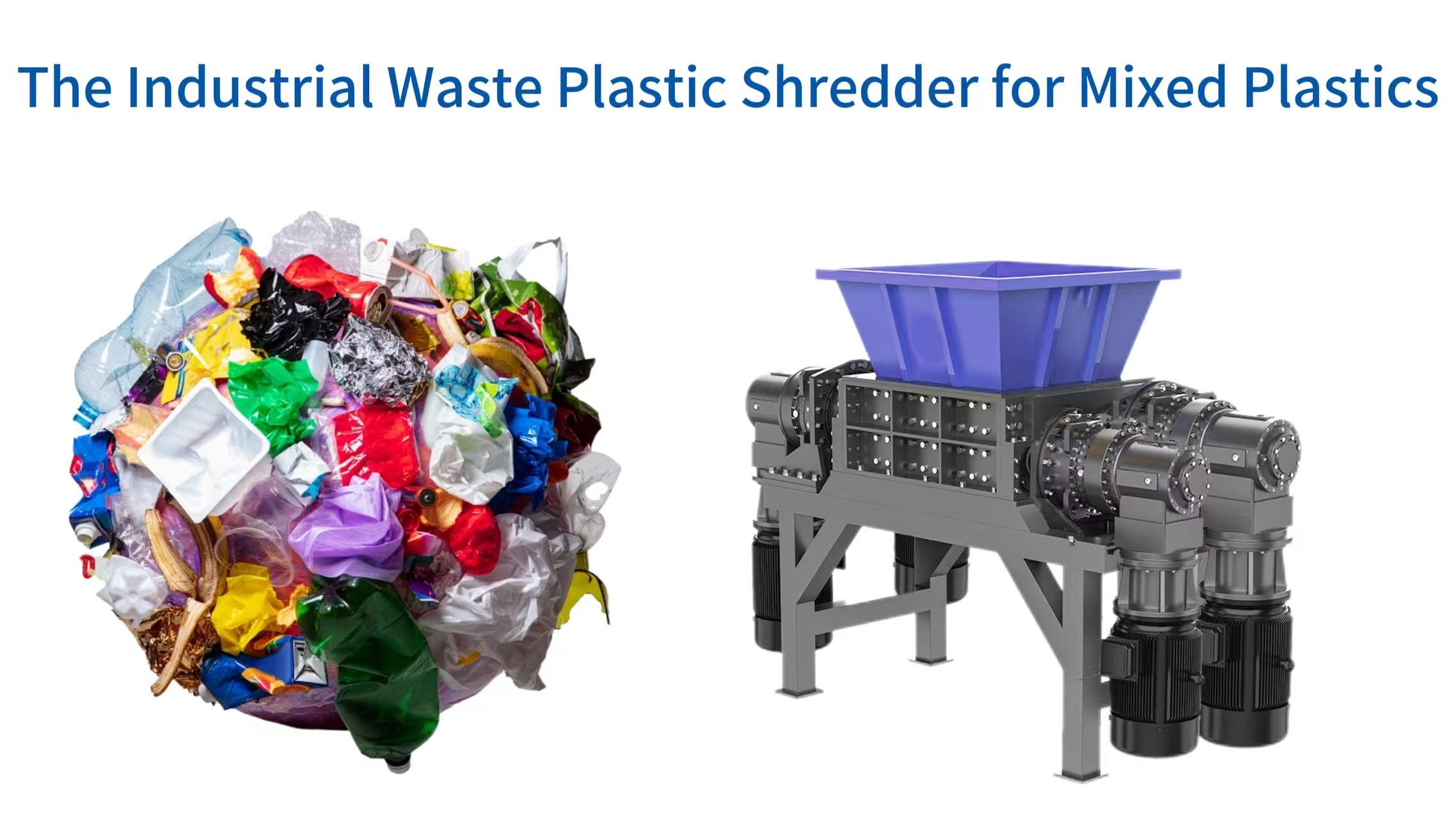
Mixed Plastic Shredding Process & Value Chain
Mixed Plastic Feed
PET/HDPE/PP/PS + Contaminants
Specialized Shredding
Dual/Four-Shaft Configurations
Homogeneous Fragments
8-40mm Controlled Size
Value Enhancement
35% Higher Material Pricing
The global plastics recycling sector currently undergoes a substantial shift in operational methodology. The era of viewing all post-consumer and post-industrial plastic as a single, homogenous waste stream has passed. Modern reclamation facilities now recognize that mixed plastics—a category encompassing rigid polyethylene terephthalate (PET) bottles, flexible polypropylene (PP) and polyethylene (PE) films, high-density polyethylene (HDPE) pipes, and polystyrene (PS) packaging—possess fundamentally different mechanical behaviors when subjected to size reduction. The conventional approach of utilizing a single, unspecialized machine to process this heterogeneous feed stream generates significant operational penalties. These penalties manifest as uneven particle size distribution, accelerated wear rates on cutting implements, elevated energy consumption, and ultimately, a diminution of the final product's market value. The industrial waste plastic shredder for mixed plastics addresses these inefficiencies through engineered adaptations in torque management, blade geometry, and feed control. This article systematically examines the operational principles, machine typologies, functional attributes, material-specific challenges, and economic justifications for deploying dedicated size reduction equipment in the processing of complex plastic waste streams.
The Foundational Technology of Mixed Plastic Shredders
Key Technological Features vs. Conventional Shredders
| Feature | Mixed Plastic Shredder | Conventional Shredder |
|---|---|---|
| Shear Rate Adaptation | Variable Speed/Torque (VFD Systems) | Fixed Speed - No Adaptation |
| Anti-Winding Mechanism | Stationary Scrapers + Oscillating Screens | No Dedicated Protection - Prone to Jams |
| Feed Control | Load-Sensing Hydraulic RAM (PID Algorithm) | Timed/Constant-Speed Feeding |
| Tooling Design | 4-Edge Indexable Inserts (PM Tool Steel) | Single-Edge Fixed Blades |
A mixed plastic shredder constitutes an assembly of high-torque mechanical drives, programmable logic control systems, and specialized cutting configurations engineered specifically for heterogeneous feed stocks. Unlike equipment designed for homogeneous inputs, this machinery must accommodate wide variations in feedstock density, tensile strength, and melting behavior within a single operational cycle. The technological architecture addresses the persistent industry difficulties of shaft wrapping, screen blinding, and inconsistent fragment dimensions.
The Principle of Differential Shear Rate Adaptation
Mixed streams contain materials exhibiting divergent melt flow index values. Flexible films display high elasticity and tensile elongation, whereas rigid containers demonstrate brittle fracture characteristics under impact. Modern equipment resolves this dichotomy through rotor geometry optimization. The implementation of V-shaped rotor configurations combined with variable frequency drive systems permits the machine to apply different shear angles depending on real time load feedback. When processing film components, the system operates at reduced rotational speed with elevated torque delivery, utilizing scissor-style cutting actions that sever the material cleanly without generating the frictional heat that leads to melting. For rigid fractions, the control logic permits increased rotational velocity, allowing the hardened tool steel inserts to fracture the material through impact and compression. These operational principles align with established soft material shredding solutions methodologies.
The Mechanism of Anti-Winding and Screen Protection
Flexible materials present the singular greatest operational challenge in mixed plastic processing. Their high aspect ratio and tensile strength facilitate wrapping around rotating shafts, leading to progressive binding and eventual stall conditions. Contemporary shredder designs integrate stationary scrapers and counter-knives positioned in close tolerance to the rotor. These elements physically remove entangled material during each revolution. Furthermore, certain configurations employ a "shred-and-sift" integrated chamber where a hydraulically actuated screen carriage oscillates, permitting properly sized rigid particles to discharge rapidly while retaining oversize film for continued processing. This separation prevents the accumulation of softened film on the screen surface, which otherwise would blind the apertures and terminate production.
The Hydraulic Feed Management System Based on Load Sensing
The irregular bulk density of mixed plastics renders timed or constant-speed feeding methods ineffective. A loose accumulation of film possesses significantly lower mass per unit volume than compacted regrind or bottle fragments, yet it can rapidly overwhelm the cutting chamber if fed indiscriminately. Intelligent shredders incorporate closed-loop control architectures that monitor main motor amperage continuously. This data feeds a programmable logic controller executing a proportional-integral-derivative algorithm that modulates the hydraulic ram's advance speed and retraction cycle. When the system detects elevated resistance indicative of hard material engagement, the ram velocity decreases, granting additional residence time for size reduction. Conversely, during periods of light loading, the feed rate increases to maintain optimal motor loading. This dynamic response maintains consistent throughput while preventing the torque spikes that induce mechanical fatigue.
The Quick-Change Tooling and Clearance Adjustment Protocol
Abrasives including glass fibers, mineral fillers, and environmental contaminants such as silica are invariably present in recycled plastics. These constituents induce progressive wear on cutting surfaces, altering the clearance between rotating and stationary elements and degrading cut quality. Advanced shredder engineering addresses this through modular tooling concepts. Cutting inserts are manufactured with multiple indexing edges, typically four per insert. When the active edge becomes dull, operators can rotate the insert to present a fresh cutting surface without removing the insert from its holder. External clearance adjustment mechanisms permit restoration of optimal knife-to-knife spacing as wear progresses, maintaining consistent particle dimensions throughout the operational life of the tooling set. This design philosophy reduces maintenance downtime and extends the interval between complete rotor rebuilds. High durability granulator blades are essential for this application.
Machine Classifications for Varied Mixed Waste Applications
The selection of an appropriate shredder configuration depends primarily upon the physical characteristics of the input material and the desired output specifications. Different machine architectures offer distinct advantages when applied to specific mixture compositions. Understanding these distinctions enables operators to match equipment capability to processing requirements effectively.
The Dual-Shaft Configuration for Primary Reduction and Bag Opening
Dual-shaft shredders operate on the principle of low rotational speed combined with extremely high torque delivery. Two contra-rotating shafts equipped with interlocking hook-shaped cutters engage the material, applying tensile and shearing forces that tear the feed stream apart. This configuration excels in applications involving baled materials, municipal solid waste fractions, and mixed commercial-industrial discards containing rigid plastics intermingled with films and textiles. The aggressive hooking action effectively opens plastic shipping bags and compresses, exposing contained materials for subsequent processing. Output particle size from this primary stage typically ranges from one hundred to four hundred millimeters, suitable for downstream secondary shredding or manual sorting operations. The robust construction tolerates occasional contaminants including light metals and stones without catastrophic damage.
The Single-Shaft Configuration for Precision Particle Size Control
When downstream processes demand uniform particle dimensions, typically below thirty millimeters, the single-shaft shredder becomes the appropriate selection. This machine type employs a horizontal rotor fitted with multiple cutting inserts that shear material against a stationary bed knife. A hydraulically powered ram continuously feeds material into the rotor engagement zone. Beneath the rotor, a precisely perforated screen determines the final particle dimension. Material remains within the cutting chamber until reduced sufficiently to pass through the screen apertures. This configuration produces consistent fragment geometry with minimized fines generation, characteristics essential for efficient washing, density separation, and extrusion feed. For chemical recycling applications requiring precise particle size for reactor feed, this machine type provides the necessary dimensional control.
The Four-Shaft Configuration for Intractable Mixed Fractions
Certain waste streams combine extreme challenges including high film content, bulky rigid components, and contaminating materials that defeat simpler machine configurations. Four-shaft shredders incorporate two pairs of cutting shafts operating in sequence. The upper pair performs initial size reduction and material tearing, while the lower pair, operating in conjunction with an integrated screen, provides final particle sizing. This arrangement effectively processes materials that would either wrap around dual-shaft rotors or plug single-shaft screen apertures. The four-shaft design finds application in processing electronic waste plastics mixed with films, agricultural plastic collections containing both rigid drip tape and flexible mulch film, and mixed construction-demolition plastics where dimensional variation is extreme.
The Specialized Film and Rigid Combination System
Materials collected from post-consumer sources, particularly the mixed plastics stream commonly termed the "yellow bag" in European collection systems, present a unique processing challenge. These collections contain approximately equal volumes of flexible packaging films and rigid containers. Standard single machines struggle with this combination due to the contradictory processing requirements. Specialized systems address this through a two-stage approach. A primary unit with aggressive tearing geometry opens the film bags and releases contents without extensively winding the film. The liberated stream then passes to a secondary unit configured with film-specific rotor designs and screen arrangements optimized for mixed feed. This dedicated approach achieves higher throughput rates and lower maintenance frequency compared to attempting to process the combined stream in a single machine. The primary unit often functions as a dedicated plastic film shredder for the initial breakdown.
Core Operational Functions of Mixed Plastic Shredding Equipment
The value proposition of modern shredding equipment extends beyond simple size reduction. These machines perform several distinct functions that collectively determine the economic viability of the recycling operation. Each function addresses specific operational requirements that influence downstream process efficiency.
The Function of Homogeneous Fragment Production
The presence of both rigid and flexible materials in a single feed stream historically resulted in bimodal particle size distribution. Rigid materials fracture into plate-like fragments, while flexible materials tear into elongated strips with inconsistent dimensions. This variation complicates every subsequent process step, including washing, hydrocyclone separation, and melt filtration. Modern shredder design addresses this through controlled residence time and positive size constraint. The combination of rotor configuration, screen aperture selection, and feed rate control ensures that both material types exit the machine within a narrow dimensional range. This homogeneity enables downstream equipment to operate at peak efficiency, as wash water flows uniformly through the material bed and melt pumps receive consistent feedstock density. The use of a precisely sized screen mesh is critical to this function.
The Function of Adaptive Overload Prevention
Unexpected contaminants or surges in feed density represent unavoidable occurrences in commercial recycling operations. Without protective systems, these events generate mechanical overloads that trip circuit breakers, shear drive couplings, or damage gearboxes. Intelligent shredder controls incorporate predictive overload management. Continuous monitoring of shaft speed and motor current enables the system to detect developing overload conditions before they reach critical levels. Upon detection, the control system initiates a sequenced response beginning with feed interruption, followed by brief reverse rotation if necessary, and resumption of forward operation after clearing the obstruction. This automatic intervention maintains production continuity without requiring operator attention and prevents the cumulative mechanical stress associated with shock loading. These features are particularly important in high-toughness material shredding solutions.
The Function of Wear Component Life Extension
Cutting tools represent the primary consumable cost in shredding operations. In mixed plastic processing, the abrasive action of fillers and contaminants accelerates wear beyond rates observed in clean material applications. Equipment designed for this service incorporates several features extending tool life. Cutting inserts fabricated from powdered metallurgy tool steels containing vanadium and molybdenum carbides maintain cutting edge geometry under abrasive conditions. The indexing insert design multiplies useful life by a factor of four compared to single-edge tools. Hard facing applied to rotor surfaces and chamber liners protects structural components from contact wear. Collectively, these features reduce the cost per ton of processed material and extend intervals between maintenance interventions.
The Function of Fugitive Dust Containment
Brittle plastics including general purpose polystyrene, acrylic, and certain PET grades generate fine particulates during size reduction. These particles, if uncontrolled, create respiratory hazards, accumulate on electrical equipment creating fire risks, and contaminate work surfaces throughout the facility. Modern shredder engineering incorporates multiple dust control strategies. Rotor designs that produce cutting rather than impact action minimize fines generation at the source. Fully enclosed cutting chambers with gasketed access panels prevent dust escape during operation. Integrated extraction ports connect to central filtration systems, drawing dust-laden air from the cutting zone and conveying it to collection devices. These features maintain regulatory compliance and preserve clean working conditions without compromising production rates. Effective soundproof enclosures also contribute to a better working environment by containing both dust and noise.
Material-Specific Processing Challenges and Engineering Responses
Plastic Type Processing Parameters
| Plastic Type | Key Challenge | Optimal Rotor Speed (RPM) | Target Particle Size (mm) | Engineering Response |
|---|---|---|---|---|
| PET (Rigid) | Brittle Fracture / Fines Generation | Medium (50-80) | 10-15 | Hardened Steel Inserts + Precision Screens |
| HDPE (Thick-Walled) | Viscoelastic Deformation | Low (30-50) | 8-20 | High Torque + Positive Hold-Down |
| PP/PE (Film) | Winding / High Elongation | Ultra-Low (15-20) | Random Strips | Anti-Winding Rotors + Scrapers |
| ABS/PS (E-Waste) | Contaminants / Spark Risk | Controlled (40-60) | 10-25 | Explosion-Resistant + Metal Separation |
Different plastic types exhibit distinct mechanical responses to size reduction forces. Understanding these material behaviors and the corresponding equipment adaptations enables operators to configure processing lines for maximum efficiency and product quality.
The Processing of PET Bottles and Rigid Sheet Stock
Polyethylene terephthalate presents as a hard, relatively brittle material at ambient temperature. When subjected to impact, it fractures into plate-like fragments with sharp edges. The primary processing objective for PET is the production of clean flakes within the ten to fifteen millimeter range with minimal fines generation. Equipment configured for this material employs medium rotor speeds, hardened tool steel inserts, and screens with precisely punched apertures. The cutting action should produce a clean fracture rather than a crushed edge, as crushed edges generate additional fines during subsequent washing and friction stages. The machine structure must absorb the impact loads associated with whole bottle feeding, where containers collapse and spring back repeatedly during size reduction. This falls under the category of hard material shredding solutions.
The Processing of HDPE Pipes and Thick-Walled Containers
High-density polyethylene exhibits viscoelastic behavior under stress. Rather than fracturing brittlely, it deforms, stretches, and tears. This characteristic demands high shear forces applied over relatively long durations. Equipment for HDPE processing utilizes rotors operating at the lower end of the speed spectrum with correspondingly elevated torque output. Cutting geometry emphasizes slicing actions with positive material hold-down to prevent the work piece from lifting away from the cutting zone. Hydraulic feed systems apply continuous pressure, forcing the material into engagement with the rotor. Output particle size typically ranges from eight to twenty millimeters, providing optimal bulk density for washing systems and consistent feed for extrusion operations.
The Processing of PP and PE Films and Woven Sacks
Films and flexible packaging represent the most challenging plastic category for size reduction. Their high tensile strength and elongation at break cause them to stretch rather than tear under moderate loads. They readily wrap around rotating components, progressively building up until the machine binds completely. Successful film processing requires specialized approaches including extremely low rotor speeds, typically fifteen to twenty revolutions per minute, combined with very high torque capability. Rotor designs incorporate features that actively discourage winding, including tapered profiles and strategically positioned scrapers. Some installations employ pre-compaction equipment that densifies loose film into manageable plugs before introduction to the shredder. Output from film shredding typically consists of randomly torn strips rather than uniformly sized granules, suitable for densification or washing lines designed for film feed.
The Processing of ABS and PS from End-of-Life Electronics
Electronic waste plastics present multiple simultaneous challenges. The materials themselves range from high-impact ABS to brittle polystyrene, often within the same feed stream. They contain metallic inserts, flame retardant additives, and surface coatings that complicate processing. The presence of residual electronic components creates fire risk if sparks occur during size reduction. Equipment for this service incorporates explosion-resistant construction, spark detection systems, and inerting capabilities where required. Rotor designs minimize impact zones that could generate sparks from metal-to-metal contact. Integrated separation equipment removes ferrous and non-ferrous metals immediately following size reduction to protect downstream processing equipment and maximize material value recovery. Specialized e-waste shredder designs are often adapted for these complex streams.
The Engineering Principles Underlying Shredder Performance
Core Engineering Principles of Shredder Design
Frame Rigidity (450MPa Steel)
Finite Element Analysis + Stress Relief
Planetary Gear Reduction
1750 RPM → Low Speed High Torque
Closed-Loop Hydraulic Control
PID Algorithm + Load Sensing
Screen Constraint Sizing
Open Area % + Particle Control
→ Combined Effect: Reliable, Efficient Size Reduction for Mixed Plastics ←
The reliable performance of industrial shredding equipment derives from fundamental engineering principles applied across multiple technical domains. Understanding these principles provides insight into equipment capabilities and limitations.
The Structural Principle of Welded Frame Rigidity
The cutting forces generated during plastic shredding are neither constant nor uniformly distributed. Impact loads from hard materials and tensile loads from flexible materials impose complex stress patterns on the machine structure. Engineering response to this loading employs finite element analysis during design phase to optimize material distribution. Fabrication utilizes high-strength low-alloy steel plate, typically four hundred fifty megapascal yield strength minimum, cut and formed to precise dimensions. Welding follows controlled procedures with preheat and post-weld heat treatment to relieve residual stresses. The completed structure exhibits sufficient rigidity to maintain precise alignment of bearing housings and cutter shaft positions under full rated load, ensuring consistent cutter clearances and prolonged bearing life. The integrity of the hardened steel shaft assembly depends on this foundational rigidity.
The Transmission Principle of Planetary Gear Reduction
The conversion of electric motor speed to usable cutter shaft torque requires substantial mechanical advantage. Standard electric motors operate at seventeen hundred fifty revolutions per minute or higher, speeds entirely unsuitable for direct shredder drive. Planetary gear reducers provide the necessary speed reduction while maintaining compact physical dimensions and high mechanical efficiency. Multiple stages of planetary gears divide the load across multiple tooth contacts, distributing stresses and extending service life. The output shafts connect to cutter rotors through heavy-duty couplings designed to accommodate minor misalignments while transmitting full torque. In dual-shaft configurations, synchronization gears maintain precise phase relationship between the two shafts, ensuring cutters intermesh correctly throughout each revolution. The heavy-duty gearbox is the heart of this transmission system.
The Control Principle of Closed-Loop Hydraulic Regulation
Hydraulic systems serve dual functions in modern shredder design. For primary drive applications in ultra-high torque configurations, hydraulic motors provide inherent overload protection and infinitely variable speed control. More commonly, hydraulic systems power the feed mechanisms that present material to the cutting zone. These systems operate under closed-loop control, receiving continuous signals from the main drive monitoring system. A hydraulic power unit supplies pressurized fluid to proportional control valves that modulate flow to the feed cylinder. When the control system detects rising motor load, it signals the proportional valve to reduce flow, slowing feed advance. Conversely, falling load generates signals to increase feed rate. This continuous adjustment maintains the cutting process at the maximum sustainable power level without exceeding design limits. The entire system is often managed by a sophisticated control panel with PLC and HMI.
The Sizing Principle of Screen Constraint and Discharge Dynamics
The final particle size produced by a shredder results from the interaction of cutting geometry, material characteristics, and screen aperture selection. Material within the cutting chamber remains subject to size reduction until reduced to dimensions smaller than the screen openings. Screens consist of perforated plate with holes sized and spaced according to application requirements. The open area percentage, defined as the ratio of hole area to total plate area, determines material discharge rate and influences machine capacity. Screens with excessive open area may permit oversize particles to exit, while insufficient open area restricts throughput and promotes material recirculation. Screen selection thus represents a compromise between production rate and particle size control, optimized according to the specific requirements of each application.
The Economic Case for Specialized Mixed Plastic Processing
Investment in appropriately configured size reduction equipment generates measurable economic returns through multiple mechanisms. These returns extend beyond simple throughput improvements to encompass product quality enhancements and operating cost reductions.
The Economic Impact of Reduced Manual Intervention
Processing lines lacking effective anti-winding and anti-jamming capabilities require continuous operator attention. Personnel must monitor machine operation constantly, ready to intervene when film wraps accumulate or when jams occur. This requirement consumes labor hours that could otherwise be applied to productive activities. Each jam event, even when cleared promptly, interrupts production flow and requires time to restart the system. Modern equipment with effective anti-winding design and automatic jam clearance functionality operates for extended periods without operator intervention. This autonomous operation reduces direct labor requirements by up to three operators per shift while increasing effective operating time through reduced stoppages. The labor cost savings alone frequently justify equipment upgrade investments within the first operating year.
The Economic Impact of Enhanced Product Valuation
Downstream consumers of processed scrap plastic base purchase decisions on material quality and consistency. Regrind containing mixed polymers, excessive fines, or contaminated fractions commands significantly lower prices than clean, homogeneous material. Dedicated processing using appropriately configured equipment produces material meeting stringent quality specifications. PET processed through dedicated lines with proper screen control achieves flake dimensions optimal for washing and decontamination, commanding premium pricing from bottle-to-bottle recyclers. Film processed through anti-winding equipment emerges as consistently sized strips suitable for agglomeration and pelletizing. Industry data indicates that segregated, properly processed material achieves prices approximately thirty-five percent higher than mixed, poorly prepared fractions, with the differential flowing directly to the processor's bottom line. These solutions are part of our comprehensive composite material shredding solutions portfolio.
The Economic Impact of Reduced Consumable and Energy Costs
Equipment operating outside its optimal application range consumes excess energy and wears prematurely. A machine configured for rigid materials attempting to process film operates inefficiently, with energy wasted in flexing and heating the material rather than cutting it. Conversely, film-configured equipment attempting rigid materials suffers impact damage and accelerated wear. Application-matched equipment operates at peak efficiency, converting electrical energy to productive size reduction with minimal losses. Tooling wear proceeds at predictable rates consistent with the material's abrasivity rather than being accelerated by inappropriate loading. Documented cases demonstrate tooling cost reductions exceeding forty percent and electrical consumption reductions approaching sixteen percent following conversion from mixed-operation to dedicated equipment configurations.
The Economic Impact of Regulatory Compliance and Market Access
Regulatory requirements governing recycled content and material purity continue to tighten globally. European Union regulations for food contact recycled plastics demand extremely low contaminant levels and fully documented processing conditions. Automotive manufacturers specify maximum allowable polymer cross-contamination in recycled content components. Producers unable to meet these specifications find themselves excluded from premium market segments, confined to low-value applications where material quality matters less. Investment in processing equipment capable of producing specification-grade materials enables access to these regulated markets, diversifying customer base and reducing exposure to commodity price fluctuations. This market access represents strategic value beyond immediate operational economics.
MSW Technology: Integrated Solutions for Complex Plastic Processing
MSW Technology - Mixed Plastic Processing Solution Workflow
Material Testing
In-House Lab Analysis
Custom Configuration
Shaft/Tooling/Screen Design
System Integration
Shredding + Washing + Separation
Support & Maintenance
Training + Spare Parts + Service
Capacity Range: 500 - 5000 kg/h | 15+ Years of Engineering Experience
MSW Technology brings fifteen years of continuous engineering development and field experience to the challenge of mixed plastic processing. Our design philosophy emphasizes practical solutions derived from extensive operational observation across diverse applications and material types. Each machine we produce reflects accumulated knowledge of what works reliably in the demanding conditions of commercial recycling operations.
The engineering team at MSW Technology approaches each application individually, recognizing that no two feed streams present identical characteristics. We maintain an in-house testing facility where customer material samples undergo controlled processing trials to establish optimal machine configuration before equipment construction begins. This empirical approach eliminates guesswork and ensures that delivered equipment matches application requirements precisely. Our laboratory analyzes particle size distribution, energy consumption, and wear characteristics during these trials, generating performance data that guides configuration decisions.
Our equipment range encompasses single-shaft, dual-shaft, and four-shaft configurations with processing capacities spanning five hundred to five thousand kilograms per hour. Each machine incorporates the technical features described in this discussion: intelligent load sensing controls, anti-winding rotor designs, quick-change tooling systems, and integrated dust management. Standard components including bearings, seals, and hydraulic elements originate from established international suppliers, ensuring replacement part availability and service life predictability.
Beyond equipment supply, MSW Technology provides comprehensive process engineering support. Our team evaluates material flow from receiving through finished product storage, identifying opportunities for efficiency improvement and quality enhancement. We design complete processing lines incorporating shredding, screening, washing, and separation equipment configured for specific material combinations. This holistic approach ensures that each component operates in harmony with those preceding and following it, avoiding the bottlenecks and mismatches that plague piecemeal system assembly.
Field service technicians based in multiple regions provide installation supervision, operator training, and ongoing maintenance support. Our spare parts inventory maintains stock of critical wear components, supporting rapid response to maintenance requirements. Technical documentation accompanies each machine, providing operators with detailed procedures for routine maintenance and troubleshooting.
MSW Technology invites potential customers to discuss their processing requirements with our applications engineers. Material samples may be submitted for complimentary testing and analysis, with detailed reports documenting observed performance and recommended equipment configurations. This collaborative approach, refined over fifteen years of industry engagement, ensures that each installation achieves its performance objectives and delivers projected economic returns.