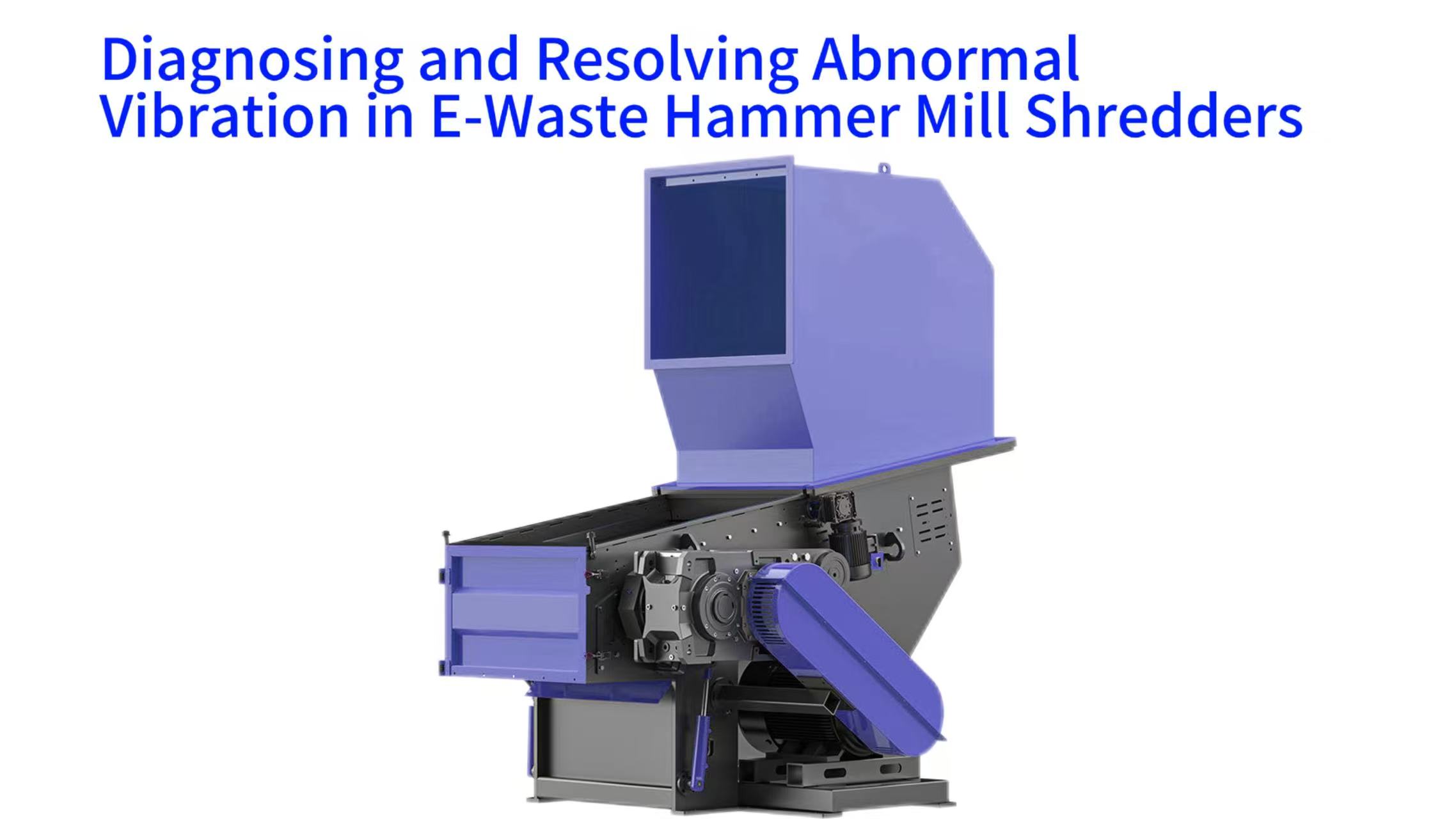
Abnormal vibration within an E-Waste Hammer Mill Shredder represents a critical operational symptom requiring immediate and systematic investigation. This phenomenon acts as a primary indicator of underlying mechanical distress, signaling potential failures that can compromise the entire electronic waste processing line. The operational integrity of such industrial shredders, including specific models like the e-waste-hammer-mill-shredder, depends on maintaining rotational balance and structural stability. Unchecked vibration directly accelerates the wear of core components such as bearings, rotors, and screening grates, leading to unplanned downtime and costly repairs. Furthermore, consistent vibratory forces degrade the quality of the output shred, affecting downstream separation processes for recovering valuable metals and plastics. A comprehensive understanding of vibration diagnosis is therefore fundamental to ensuring safety, maximizing productivity, and protecting capital investment in recycling infrastructure. Companies like MSW Technology, with over fifteen years of engineering experience in solid waste reduction systems, emphasize vibration analysis as a cornerstone of predictive maintenance for industrial shredding equipment.
The Critical Role of Vibration Analysis in Predictive Maintenance
Cost Reduction: Predictive vs Reactive Maintenance
| Maintenance Strategy | Repair Cost Reduction | Key Benefit |
|---|---|---|
| Reactive (Breakdown) | 0% | No upfront cost, high downtime risk |
| Predictive (Vibration-Based) | Up to 25% | Early fault detection, minimal downtime |
0%
25%
Source: Industrial Maintenance Studies - Cost Reduction from Vibration-Based Predictive Maintenance
Vibration analysis serves as a non-invasive diagnostic methodology for assessing the mechanical health of rotating industrial machinery. In the context of a hammer mill shredder processing electronic waste, vibration signatures provide early warnings long before a catastrophic failure occurs. These machines operate under high-stress conditions, subjecting their hammermill-rotor and drive train to significant dynamic forces. Monitoring changes in vibration amplitude and frequency allows maintenance teams to identify developing issues such as imbalance, misalignment, or bearing degradation. Proactive intervention based on this data prevents secondary damage to adjacent components and ensures continuous operational reliability. The financial rationale is clear; studies in industrial maintenance suggest that predictive strategies can reduce repair costs by up to 25% compared to reactive approaches, highlighting the value of early vibration detection.
Vibration as a Primary Failure Indicator
Every mechanical fault generates a unique vibratory pattern that can be measured and analyzed. Imbalance typically produces a vibration frequency matching the rotational speed of the shaft, while bearing defects create higher-frequency harmonics. Recognizing these patterns enables precise fault identification before audible noise or visible damage becomes apparent, transforming vibration from a nuisance into a crucial data stream for equipment health management.
Consequences of Ignoring Vibratory Signals
Neglecting initial vibratory warnings leads to a progressive decline in machine condition. The excessive oscillatory motion induces metal fatigue at welding points and bearing housings, loosens mechanical fasteners, and can cause cracks in the shredder's structural frame. This degradation not only shortens the asset's service life but also increases the risk of unsafe operating conditions, where broken components could be ejected from the cutting-chamber.
Impact on Product Quality and System Efficiency
Abnormal vibration directly undermines the shredding process's consistency and efficiency. An unstable rotor assembly cannot deliver uniform impacts on the incoming e-waste stream, resulting in an irregular particle size distribution. This irregularity hampers the performance of downstream separation systems, such as eddy-current-separator units, reducing the purity and yield of recovered materials like copper and aluminum, thereby diminishing the economic return of the recycling operation.
Essential Safety Protocols Prior to Diagnostic Procedures
Conducting a thorough vibration diagnosis mandates strict adherence to industrial safety standards to eliminate risks of injury or accidental machine activation. The foundational step involves the implementation of a Lockout-Tagout (LOTO) procedure, a legally mandated practice to isolate all energy sources powering the shredder, including electrical, hydraulic, and pneumatic systems. This isolation guarantees the machine cannot be energized during the inspection phase. Personnel must utilize appropriate Personal Protective Equipment (PPE), including safety glasses, hearing protection, steel-toed boots, and heavy-duty gloves, to guard against residual hazards such as sharp metal edges or airborne dust particles present within the dust-extraction-system workspace.
Execution of Energy Isolation and Verification
The Lockout-Tagout process requires a systematic approach: shutting down the equipment using normal controls, applying individual lockout devices to every energy isolation point, and attaching durable tags that clearly identify the authorized personnel responsible for the lock. A critical final step is the verification attempt to start the machine, confirming that all energy sources are effectively neutralized before any hands-on inspection begins, ensuring an absolute zero-energy state.
Preparation of the Diagnostic Workspace and Tools
A clean and organized workspace is vital for safe and effective diagnostics. This involves clearing debris from walkways and ensuring adequate lighting around the shredder unit. The diagnostic toolkit should be prepared in advance, containing fundamental items like a flashlight for visual inspection of internal components, a stethoscope or listening device to pinpoint bearing noise, and basic hand tools for checking fastener tightness. For quantitative analysis, a handheld vibration meter or data collector is employed to measure velocity or displacement readings at predefined points on the bearing housings and motor frame.
Systematic Diagnostic Methodology for Identifying Vibration Sources
A structured, step-by-step diagnostic approach is necessary to efficiently pinpoint the root cause of abnormal vibration, moving from general observation to specific measurement. The process begins with a sensory evaluation while the machine is operating under caution, noting any unusual audible rhythms, visible wobble in drive belts, or palpable shaking transmitted through the machine base or connected conveyors. Following a safe shutdown and LOTO, a detailed static inspection examines all accessible mechanical connections for integrity, including foundation bolts, motor mounts, and the condition of flexible couplings or drive belts that transfer power from the motor to the shredder's shredder-shaft.
Initial Sensory Assessment and Observation
Operators and technicians are trained to use their senses as primary detection tools. Auditory clues like rhythmic knocking or continuous grinding can indicate specific faults, while visual observation of material flow and machine behavior during start-up and coast-down can reveal imbalances or resonance conditions. This qualitative assessment forms the initial hypothesis to guide subsequent quantitative measurement efforts.
Static Mechanical Inspection and Verification
With the machine safely de-energized, a hands-on inspection checks for obvious mechanical deficiencies. This includes verifying the torque on critical fasteners, inspecting the screen-mesh or grates for damage or improper seating, and looking for signs of material buildup on the rotor that could cause imbalance. The physical condition of the hammer tips or cutters is also assessed for excessive or uneven wear, a common precursor to vibratory issues.
Dynamic Analysis and Vibration Pattern Recognition
Quantitative analysis involves taking vibration readings at standardized locations on the machine. Data is collected in three planes (horizontal, vertical, axial) to understand the vibration vector. Analysts look for dominant frequencies, comparing them to known fault frequencies for components like bearings and gears. The amplitude of vibration is tracked over time, with a significant increase often signaling a progressing fault that requires scheduling for corrective maintenance during the next planned stoppage.
Primary Root Causes of Vibration in Hammer Mill Shredders
Primary Vibration Root Causes & Characteristics
| Root Cause | Common Triggers | Vibration Characteristics |
|---|---|---|
| Rotor Imbalance |
|
|
| Bearing Degradation |
|
|
| Mechanical Looseness/Feed Disturbance |
|
|
Identifying the specific origin of vibration involves correlating measured data with a finite set of common mechanical failures prevalent in high-torque shredding equipment. Rotational imbalance of the hammer rotor assembly is a frequent cause, arising from uneven wear or breakage of multiple hammer tips, or from adhesive accumulation of processed material on one side of the rotor. Bearing failure represents another critical source, where inadequate lubrication-system performance, contamination, or normal fatigue leads to increased internal clearance and erratic spindle motion. Mechanical looseness, whether at the baseplate or within internal component connections, allows for excessive movement that manifests as vibration.
Rotor Assembly Imbalance and Its Manifestations
Imbalance occurs when the mass center of the rotating assembly does not align with its geometric center of rotation. In a hammer mill, this can be caused by losing a hammer, asymmetric wear, or a bent shaft from an extreme shock load, such as processing an oversized, non-shreddable item. The resulting centrifugal force produces a synchronous vibration with a frequency equal to the rotor's revolutions per minute (RPM), often felt most strongly in the radial direction.
Bearing Degradation Stages and Symptom Progression
Rolling element bearings degrade through identifiable stages. Early-stage defects like minor spalling on a raceway generate high-frequency vibration bursts. As damage progresses, these bursts become more pronounced and develop into bearing-specific fault frequencies. In the final stage, severe degradation causes broad-band vibration noise and a sharp increase in overall vibration amplitude, usually accompanied by audible grinding and elevated bearing housing temperatures, necessitating immediate shutdown to prevent rotary-cutters or shaft damage.
Mechanical Looseness and Feed-Related Disturbances
Looseness can be structural, such as cracked welds or loose anchor bolts, or functional, like worn keyways or poorly fitted bearing housings. It often creates vibration at multiples of the running speed. Feed-related disturbances introduce intermittent, chaotic vibration patterns. Inconsistent feed rates or the introduction of large, dense metallic objects cause sudden shock loads, momentarily distorting the rotor's path. A controlled, uniform feed stream is essential for stable operation, a principle integrated into the design of robust feed-conveyor systems.
Corrective Actions and Precision Realignment Procedures
Upon identifying the root cause, specific corrective measures must be applied with precision to restore the shredder to its optimal operating condition. Correcting rotor imbalance often requires removing the assembly for dynamic balancing on a dedicated machine, or performing in-situ field balancing using trial weights and vibration measurement equipment. Replacing failed bearings demands meticulous procedures: using proper pullers for removal, heating new bearings for installation to avoid force-induced damage, and precisely setting axial and radial clearances as specified by the manufacturer. All fasteners in the affected area should be re-torqued to exact specifications using calibrated tools.
Rotor Rebalancing Techniques and Standards
Field balancing is a practical method performed while the rotor is mounted in the machine. After measuring the initial vibration vector, a trial weight is attached at a calculated position on the rotor. The machine is run again, and the change in vibration is measured. Using vector mathematics, the exact weight and location for a permanent correction weight are determined. This process brings the vibration levels within acceptable limits defined by international standards like ISO 1940, ensuring smooth operation and extended component life for the e-waste-four-shaft-shredder or similar equipment.
Bearing Replacement and Installation Best Practices
The success of a bearing replacement hinges on cleanliness and correct technique. The bearing housing must be thoroughly cleaned of old lubricant and debris. New bearings are never struck directly with a hammer; instead, they are heated uniformly in an oil bath or with an induction heater to expand the inner race, allowing for a smooth, press-fit installation onto the shaft. Proper re-greasing follows, using the correct type and quantity of lubricant, often facilitated by an automated lubrication-system to prevent future failures.
System Realignment and Operational Parameter Adjustment
Misalignment between the motor and shredder input shaft is corrected using laser alignment tools, which provide far greater accuracy than traditional straight-edge methods. The motor is shimmed until angular and parallel alignment is achieved within thousandths of an inch. For issues related to structural resonance, where the machine vibrates excessively at a specific speed, the solution may involve stiffening the base frame, adding vibration damping materials, or slightly altering the operational RPM to move away from the resonant frequency zone.
Developing a Proactive Vibration Monitoring and Maintenance Regimen
Sustained equipment reliability requires transitioning from reactive repairs to a proactive, data-driven maintenance philosophy. Establishing a routine vibration monitoring program is central to this strategy. Baseline vibration readings are taken when the shredder is new or newly overhauled, providing a reference for future comparisons. Subsequent periodic readings, taken monthly or quarterly at consistent measurement points, are tracked over time. Trend analysis of this data reveals gradual deterioration, allowing maintenance to be scheduled during planned outages, thereby avoiding disruptive emergency breakdowns and aligning with the operational philosophy of experienced providers like MSW Technology.
Implementing a Scheduled Condition Monitoring Program
A formal program involves creating a route sheet with specific measurement points on each critical machine. A technician follows this route at set intervals, using a portable data collector to record vibration spectra. The collected data is downloaded to specialized software that compares it against alarm limits and historical trends. This systematic approach transforms subjective observation into objective, actionable intelligence for managing the health of diverse equipment, from a double-shaft-plastic-shredder to complex multi-stage shredding lines.
Preventive Maintenance Scheduling Based on Trend Data
Vibration trend data directly informs the preventive maintenance schedule. A steadily increasing vibration level at a bearing point indicates remaining useful life, enabling the maintenance team to order replacement parts in advance and schedule the repair for a convenient time. This data-driven scheduling maximizes wrench-on time for technicians and minimizes production losses, optimizing overall operational efficiency and total cost of ownership for the shredding asset.
Operator Training for Early Anomaly Detection
While instrumentation provides quantitative data, trained operators serve as the first line of defense. Operational personnel should be educated to recognize the early signs of distress, such as changes in normal sound patterns, unusual smells from overheated components, or slight changes in machine feel. Empowering operators to report these subtle anomalies triggers an early diagnostic investigation, often catching issues before they register on periodic monitoring routes, fostering a culture of shared responsibility for equipment care.