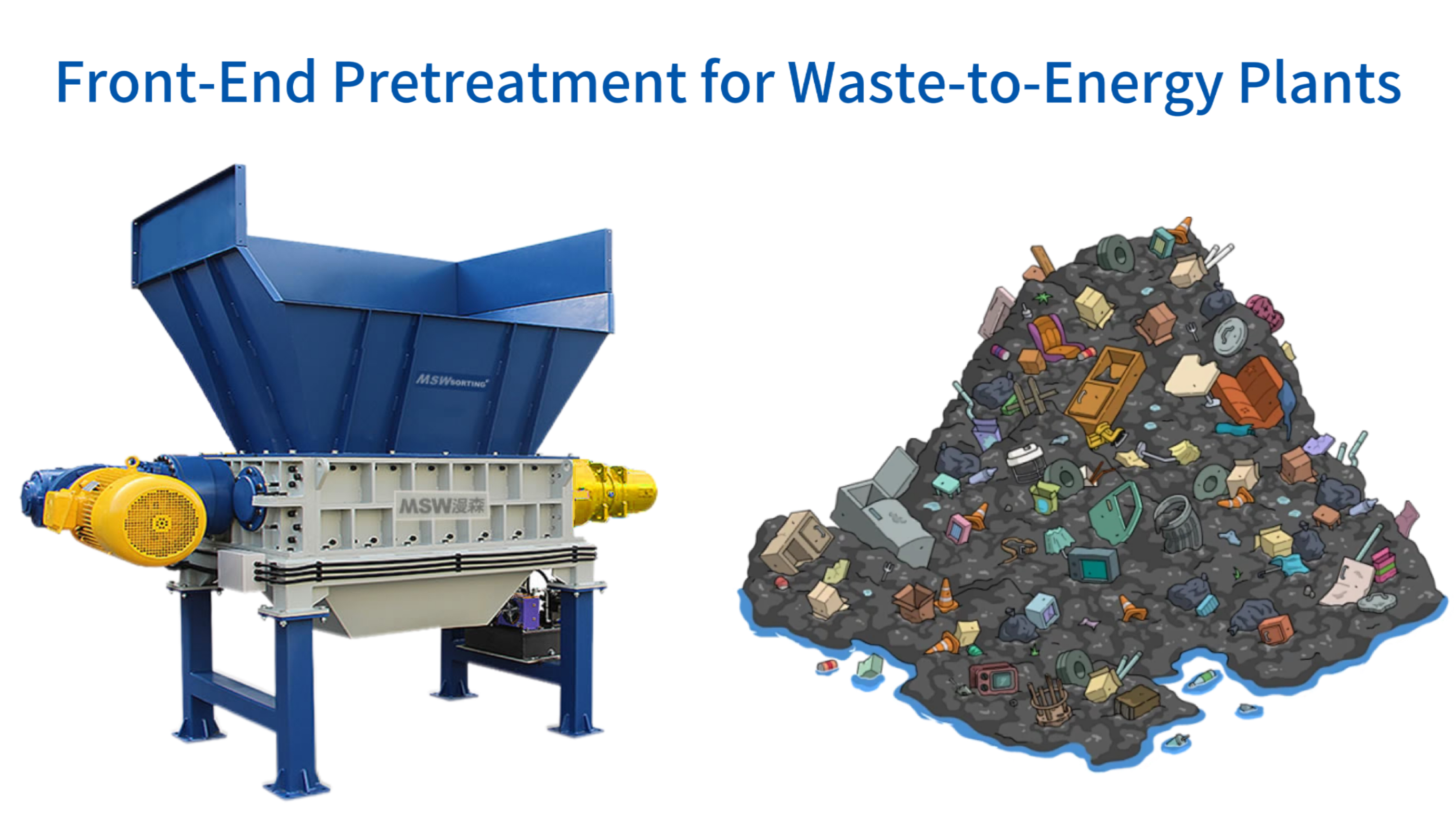
Waste to Energy plants face a fundamental efficiency problem. Burning raw mixed municipal waste leads to unstable combustion, high moisture content, and low power generation. The core issue is the calorific value of the incoming material, which fluctuates too much and often sits too low for profitable operation. Front end pretreatment changes this reality. A specialized RDF shredder applies shear and tear forces to transform heterogeneous garbage into a uniform, high calorific fuel. This article presents real world cases from multiple facilities. The focus stays on measurable outcomes, including higher calorific value per ton, lower moisture percentage, and reduced fuel consumption in cement kilns and power boilers. Readers will learn the working mechanisms of RDF shredders, selection logic for different waste streams, maintenance strategies, and economic returns. MSW Technology brings fifteen years of hands on experience in this field, having designed and installed RDF pretreatment lines across various markets.
Waste to Energy Plants Face an Efficiency Bottleneck Where Calorific Value Determines Profitability
Front-End Pretreatment Core Process
The profitability of a modern Waste to Energy plant depends almost entirely on the calorific value of the material entering the furnace. Raw municipal solid waste in many regions contains fifty to sixty percent moisture by weight, largely from food scraps and green waste. This high water content forces the combustion chamber to consume extra energy just to evaporate the liquid before any actual burning can happen. Boiler operators often add fossil fuels like coal or natural gas to keep the temperature stable. A low calorific value of eight hundred to one thousand kilocalories per kilogram makes power generation nearly impossible to sustain without subsidies. The plant essentially pays to dispose of wet garbage while producing very little electricity in return. MSW Technology has observed this pattern repeatedly across dozens of facilities, and the solution consistently points back to front end shredding and homogenization.
RDF shredders do not directly dry the waste, but they create the physical conditions that make drying possible later in the process. When a double shaft RDF shredder cuts through mixed garbage, it tears open plastic bags, ruptures fruit skins, and separates cling film from wet organic matter. This mechanical action increases the exposed surface area of every particle. A piece of food waste inside a sealed bag might stay wet for months. Once the shredder opens that bag, the same food waste can lose moisture in a forced air tunnel within twenty four hours. The relationship between particle size and drying speed follows a predictable physical law. Reducing the diameter from one hundred millimeters to fifty millimeters doubles the surface area available for evaporation. For Waste to Energy operators, this means moving from a net consumer of energy to a net producer. MSW Technology has helped clients achieve exactly this transition using properly sized shredding equipment integrated with air classification and screening.
The instability of raw waste calorific value creates a second major problem for combustion control. A typical boiler expects a fuel input of twelve hundred to fifteen hundred kilocalories per kilogram for stable operation. Raw garbage can swing between six hundred and twenty five hundred kilocalories per kilogram within the same hour. When a pocket of wet food arrives, the bed temperature drops, carbon monoxide spikes, and the flue gas treatment system struggles. When a bundle of rubber or plastics arrives, the temperature overshoots, slag forms on the boiler tubes, and maintenance costs rise. Operators spend their shifts reacting to these swings instead of optimizing output. Twin shaft shear system technology creates a uniform output stream where every piece measures between fifty and eighty millimeters. This homogeneity allows the boiler to run at a steady state, with burner adjustments measured in hours rather than minutes. The difference in annual power output between a stable furnace and an unstable one often reaches twenty to thirty percent for the same tonnage of input waste.
Older pretreatment methods simply cannot handle the complexity of modern municipal waste streams. Manual sorting lines lose efficiency as soon as the conveyor speed increases beyond a certain point. Workers miss plastic films buried under wet organic layers. Hammer mills smash everything into a wet paste that clogs conveyors and sticks to metal surfaces. The paste like material has no structural integrity, and it cannot be separated by density or magnetic force. A RDF shredder operates on a completely different principle. Low speed and high torque cutting rotors pull material into the cutting chamber and slice it cleanly. Hard objects like wood and rigid plastic break into fragments. Soft objects like fabric and rubber get torn into strips. The output retains a dry, fluffy texture that flows through air separators and magnetic drums without sticking. This clean separation is the essential first step for any facility that wants to produce a saleable fuel rather than paying someone to take away contaminated ash.
Policy changes have accelerated the adoption of RDF pretreatment globally. Feed in tariffs for renewable energy from waste have decreased or disappeared in many markets. Local governments have extended payment terms for waste processing fees, forcing operators to rely more on electricity sales for cash flow. Some regions now tie subsidy levels directly to kilowatt hours generated per ton of waste. A facility falling below a specified threshold receives nothing. Under this pressure, waste stops being a disposal problem and becomes a fuel commodity. The pre shredder unit becomes the gateway to profitability. MSW Technology has calculated that the payback period for a complete RDF preparation line now falls between twelve and twenty four months for most facilities processing over five hundred tons per day. Ignoring front end pretreatment means accepting a permanent competitive disadvantage in a tightening market.
Industry standards now define clear calorific targets for refuse derived fuel and solid recovered fuel. RDF for co processing in cement kilns should deliver thirty five hundred to forty five hundred kilocalories per kilogram. SRF specifications are stricter, requiring over forty five hundred kilocalories per kilogram with chlorine content below two tenths of one percent. Raw municipal waste never meets these numbers straight out of the truck. Only after shredding, screening, iron removal, air classification, and drying does the material approach these values. The shredding step determines the specific surface area of every fuel particle. This surface area directly controls how well the particles bind together when compressed into fuel pellets. For spreader stoker boilers that accept fluff RDF directly, a uniform fifty millimeter size ensures even distribution across the grate. MSW Technology views the RDF shredder not as a simple crusher but as the master switch that activates the entire fuel production line.
RDF Shredder Positioning in the Front End Pretreatment Line Follows a Logical Physical Transformation Sequence
A complete front end pretreatment system contains multiple linked unit operations. The sequence typically starts with a feed hopper and a bag ripper, then moves to a disc screen or trommel for size separation. Magnetic separators pull out ferrous metals before the material enters the shredder. After shredding, air classifiers or ballistic separators split the stream into light combustibles and heavy inerts. A drying step may follow, and the final output goes to a storage bunker or directly to the boiler. The ballistic separator works most efficiently when the input particles have clean edges and distinct shapes. Without shredding, a piece of cardboard might still contain a sealed box of batteries. The shredder opens that box and releases the batteries for magnetic or eddy current capture. Without shredding, a plastic bag might wrap around a glass bottle and carry both into the combustion chamber. The shredder tears the bag and exposes the bottle for gravity separation. The shredder does not do everything, but nothing else works correctly without it.
The mechanical action inside a RDF shredder combines three distinct forces. Shear force cuts material between two moving edges, similar to scissors. Tear force pulls material apart along its weakest axis, especially effective for fabrics and rubber. Crushing force compresses brittle items like hard plastics and wood until they fracture. A double shaft shredder uses interlocking cutters mounted on two parallel rotors. The rotors turn at different speeds, one faster and one slower. Material entering the gap gets pulled down and sliced repeatedly. For electronic waste circuit boards, the shear action exposes the interface between copper traces and epoxy resin, allowing downstream recovery of precious metals. For post consumer plastic bottles, the tearing action creates curled flakes that flow easily through pneumatic conveying systems. The specific energy consumption of this shear based approach measures about one third that of a traditional hammer mill for the same output tonnage. MSW Technology selects rotor configurations based on the dominant waste components at each client site.
The output particle size from a RDF shredder determines the performance of every downstream step. Drying kinetics follow a predictable power law relationship. Reducing the particle diameter from one hundred millimeters to fifty millimeters doubles the specific surface area, and the moisture evaporation rate increases by approximately eighty percent. In a forced air storage bunker with floor heating, fifty millimeter RDF fluff can drop from forty five percent moisture to twenty five percent moisture in thirty hours. Unshredded waste sitting in the same bunker for seven days might lose only ten percent of its surface moisture while the cores of large food pieces remain saturated. A real world example from a southern region facility demonstrates this relationship clearly. A double shaft shredder with a forty millimeter screen aperture fed into a heated floor drying bunker produced RDF with thirty eight hundred kilocalories per kilogram and eighteen percent moisture. The original raw waste had measured only eleven hundred kilocalories per kilogram. This transformed fuel replaced half a ton of standard coal for every ton of RDF burned. The screen aperture size on the shredder directly sets the slope of the drying curve that follows.
Different waste components respond to shredding in different ways, and the cutter configuration must adapt to this variation. Paper and cardboard offer low shear resistance but can wrap around shafts if the cutters lack counter knives. Rigid plastic containers resist cutting moderately but shatter under impact. Textiles and rope apply high axial tension to the cutters, attempting to pull the rotor out of alignment. A well designed shredder addresses each of these challenges through specific mechanical features. Polygonal rotor shafts prevent round objects from spinning without cutting. Staggered hook cutters create a self cleaning action that strips wrapped fibers with every rotation. A hydraulic reversal system detects jams and automatically reverses the rotors to eject metal objects that would otherwise damage the cutters. For standard municipal solid waste, the cutting tools are machined from high alloy tool steel with a hardness of fifty eight to sixty two on the Rockwell C scale. Replaceable cutter seats allow field swapping of worn tips without removing the entire rotor. MSW Technology stocks multiple cutter geometries to match specific waste profiles.
The separation of non combustible materials from the fuel stream depends heavily on shredding. A brick inside a plastic bag will pass right over a magnetic drum and end up in the furnace. A battery sealed inside a cardboard box will similarly escape detection. The shredding process destroys these containment structures. Plastic bags become ribbons. Cardboard boxes unfold into flat sheets. The heavy impurities inside fall out and become visible to downstream sorting equipment. A ballistic separator uses oscillating decks to bounce light flat materials forward while heavy round materials roll backward. This machine works correctly only when the light materials are flat and the heavy materials are free. Shredding produces exactly this condition. A facility in a coastal city documented a rise in heavy impurity removal from sixty five percent to ninety four percent after installing a double shaft shredder before their existing sorting line. The reduction in glass content in the bottom ash protected the grate bars and improved the quality of the slag sold to construction companies.
Waste composition changes throughout the day and across the seasons. Morning collections contain more food waste from household kitchens. Evening collections contain more packaging from online shopping deliveries. A shredder running fixed parameters will struggle. The machine may overheat during evening runs when processing high plastic content, and it may jam during morning runs when processing wet organics. Modern RDF shredders solve this problem with intelligent current monitoring. Sensors track the electrical load on each rotor motor continuously. When the load exceeds a programmed threshold, the control system reduces the feed conveyor speed or reverses the rotors to clear the blockage. When the load falls below a second threshold, the system speeds up the feed to maximize throughput. The human machine interface records operating parameters for different times of day, allowing operators to switch between wet mode and dry mode at the touch of a button. This adaptive control reduces manual interventions and increases effective throughput by twenty five percent compared to manually adjusted machines. MSW Technology has observed cutter life improvements of thirty percent in facilities that use these smart controls correctly.
Real World Facility Cases Demonstrate Measurable Calorific Value Gains from RDF Shredding
Real Cases: Calorific Value Improvement
| Facility Type | Raw Waste (kcal/kg) | RDF (kcal/kg) | Improvement |
|---|---|---|---|
| Municipal WtE Plant | 900 | 2800 | +211% |
| Cement Plant | 1200 | 4200 | +250% |
| Landfill Mining | 800 | 3500 | +337% |
| Recycling Residuals | 1000 | 5000 | +400% |
A large facility in a river delta region processed two thousand tons of municipal waste per day. The plant suffered from severe leachate production in summer and frozen waste blocks in winter. The management installed two double shaft RDF shredders integrated with a series of disc screens. The operational logic worked as follows. Raw waste entered a bag ripper and then moved to a disc screen. The undersized fraction, mainly food waste, went to an anaerobic digestion system for biogas recovery. The oversized fraction, containing plastics, paper, and textiles, entered the RDF shredders for size reduction to sixty millimeters. A zigzag air classifier then separated the light fluffy material from heavy contaminants, and a magnetic drum pulled out remaining steel. The final RDF went directly to the combustion grate. Before the modification, the incoming calorific value averaged nine hundred kilocalories per kilogram. After the modification, the RDF delivered twenty eight hundred kilocalories per kilogram. The facility manager reported a tripling of plastic film recovery and a drop in slag unburned carbon from eight percent to two percent. This case shows that shredding and screening together unlock the full energy potential of heterogeneous waste.
A cement plant in a southwestern region needed a much higher fuel specification. Cement kilns require a stable calorific value above four thousand kilocalories per kilogram and strict control of chlorine content to prevent buildup in the preheater tower. The plant installed a three stage RDF preparation system. A single shaft coarse shredder first reduced the incoming construction and demolition waste to one hundred fifty millimeters. A double shaft fine shredder then reduced the material to thirty millimeters. An electrostatic precipitator removed dust, and a pelletizer formed the material into dense fuel pellets. The original waste stream contained PVC wire coatings and gypsum board pieces. During the fine shredding step, the PVC material became exposed on the surface of every flake. A near infrared sorter detected the PVC signature and ejected those flakes before pelletization. The final RDF pellets achieved forty two hundred kilocalories per kilogram with chlorine below fifteen hundredths of one percent. This case demonstrates a clear principle. Higher target calorific values require exponentially finer shredding outputs. A primary shredder alone cannot produce cement grade fuel. Fine shredding is essential.
A recycling center in a tropical region processed industrial waste with very high plastic content. More than sixty percent of the incoming material consisted of plastic packaging and production scraps from nearby factories. Traditional shredders generated frictional heat during operation, and this heat melted the plastic onto the cutter surfaces. The melted plastic cooled into hard deposits that locked the rotors and required hours of manual chipping to remove. The facility selected a heavy duty double shaft shredder with water cooled cutter housing and a non stick coating on the cutter surfaces. The cooling system maintained the cutter temperature below the melting point of the most common plastics in the waste stream. The non stick coating, a fluoropolymer similar to that used in cookware, prevented adhesion of the softened material. After shredding, the plastic flakes passed through a hot wash tank and a friction washer to remove surface contaminants. A local power plant burned these clean flakes as a thirty percent substitute for coal. The power plant reported a twenty five percent reduction in coal consumption and a decrease in sulfur dioxide emissions due to the low sulfur content of the plastic derived fuel. In this case, the shredder enabled a washing process that could not have worked on whole, unshredded plastic items.
A landfill mining project in a northern region targeted aged waste from a closed dump site. This material, often called legacy waste, had decomposed over ten to fifteen years. The remaining components included plastic fragments, textile pieces, soil like fine material, and glass. The calorific value of the raw excavated waste measured only six hundred to one thousand kilocalories per kilogram. Most operators considered this material worthless for energy recovery. The project team used a novel approach. A trommel screen separated the waste into two streams. The fine stream, below eighty millimeters, consisted almost entirely of soil and went back to the landfill for closure capping. The coarse stream contained plastic and rubber pieces originally rejected from the screen. This coarse stream entered a double shaft RDF shredder with a thirty millimeter screen. The shredded material passed through an air classifier that lifted the light plastic fraction away from the heavy sand and glass. The lifted plastic fraction achieved a calorific value of thirty five hundred kilocalories per kilogram. A nearby cement kiln accepted this material as alternative fuel. This case reveals the potential of RDF shredders for remediating legacy waste stockpiles while recovering energy value. The shredder released fossil derived plastics from the inert soil matrix and returned them to the energy cycle.
A facility in North America processed single stream recycling residuals. Single stream collection simplifies recycling for households, but it produces a residue stream heavily contaminated with broken glass and food residue stuck to paper fibers. Traditionally, this residue went directly to landfill. The facility deployed a fully automated pretreatment line with a high speed single shaft fine shredder as the core component. The shredder reduced the material to a fifteen millimeter top size. This fine shredding action physically abraded the food residue off the paper fibers. A downstream screen separated the abraded organic fines from the clean paper and plastic mixture. The clean mixture achieved a calorific value of five thousand kilocalories per kilogram. A biomass power plant burned this material as a substitute for wood fuel. The power plant reported stable combustion and no increase in ash handling costs. The unique insight from this case is that even dirty mixed paper, when finely shredded, becomes a clean fuel. The abrading effect during fine shredding, not just the size reduction, was the critical factor for calorific value recovery. MSW Technology incorporates this insight into designs for facilities processing contaminated paper streams.
A distributed pretreatment model solved a logistics cost problem in a European region. Waste to Energy plants tend to locate outside city boundaries due to land costs and public acceptance issues. Trucks carrying raw waste with fifty percent moisture travel long distances to reach these plants, and half the truck capacity transports water. A network of small transfer stations around the city installed compact RDF shredders and primary drying equipment. Each station processes waste from its local collection area, reducing moisture to twenty percent and raising calorific value to twenty five hundred kilocalories per kilogram before any long distance transport. The trucks now carry fuel instead of water. The logistics cost per ton of useful energy delivered dropped by sixty percent. A Nordic case study documented one compact mobile shredder serving three communities. The machine operated eight hours per day, processing accumulated waste into RDF fluff loaded directly into shipping containers. The containers traveled by rail to a portside power plant. This model fundamentally changed the waste logistics equation. The shredder transitioned from a plant floor machine to a distributed resource recovery node. MSW Technology has replicated this model for clients in several countries with similar geography constraints.
Industrial RDF Shredder Selection Requires Matching Machine Parameters to Pretreatment Line Goals
The number of shafts in a RDF shredder determines its material handling characteristics. Single shaft shredders use a hydraulic ram to push material against a rotating rotor fitted with cutters. A fixed counter knife mounted on the housing provides the shearing edge. This design produces the most consistent output size because every particle stays in the cutting zone until it passes through the screen. Single shaft machines work well for relatively uniform feed streams with thickness under fifty millimeters, such as plastic drums or wooden pallets. Double shaft shredders rely on interlocking cutters on two counter rotating shafts. Material gets pulled down between the shafts and sheared against opposing cutter faces. Double shaft machines handle higher throughput and accept large foreign objects like rocks or steel pieces without catastrophic failure. They struggle somewhat with thin film materials that can wrap around the shafts. Four shaft shredders add a second pair of shafts beneath the first pair, creating a multistage reduction in one machine. Output size is extremely uniform, but throughput drops significantly and energy consumption rises. For Waste to Energy front end lines processing municipal solid waste, the double shaft shredder has emerged as the industry standard. It balances throughput capacity against material adaptability better than any other configuration. MSW Technology offers all three types and helps clients choose based on detailed waste composition analysis.
Cutter structure directly affects long term operating costs. Monoblock cast cutters are machined from a single piece of wear resistant steel. They offer excellent initial durability, but when the cutting edge wears out, the entire cutter must be replaced. This leads to high replacement costs and frequent downtime for major repairs. Segmented or assembled cutters consist of a durable cutter holder with replaceable cutting tips. The holder stays on the rotor for years. The tips get unbolted, flipped, or replaced as they wear. The initial purchase price for segmented cutters is higher, but the lifetime maintenance cost runs forty percent lower than monoblock designs. The cutter material itself matters significantly. Cold work die steels such as chromium molybdenum vanadium alloys achieve hardness over sixty Rockwell C after heat treatment. For waste streams containing sand or other abrasives, the cutter cutting edges can receive a tungsten carbide hardfacing overlay. When selecting a shredder, buyers should calculate cost per ton processed for the cutter set, not just the purchase price. A facility using imported high alloy cutters paid three times the price per set but achieved five times the cutter life compared to domestic alternatives. The total cost per ton was actually lower for the more expensive cutters. MSW Technology provides cutter life data from similar installations to support this selection decision.
Throughput claims from manufacturers require careful scrutiny. The theoretical capacity printed on a specification sheet usually assumes ideal feed material such as empty plastic bottles or clean cardboard. Real municipal waste with fifty percent moisture and high bulk density will achieve only fifty to seventy percent of the claimed throughput. A shredder rated at ten tons per hour in the brochure might deliver five to six tons per hour in real operation. The installed motor power provides a more reliable performance indicator. For mixed waste, each additional five hundred millimeters of cutting chamber length requires approximately thirty kilowatts of additional motor power to maintain the same throughput. Prospective buyers should request video recordings of the same model shredder processing similar waste at an existing installation. If the manufacturer cannot provide such a reference, the claimed capacity should be treated with suspicion. An undersized shredder will trigger overload protection constantly, halving effective throughput. An oversized shredder wastes capital cost and consumes excessive no load power during operation. MSW Technology uses a proprietary sizing model that accounts for waste density, moisture, and component mix to predict real throughput within ten percent accuracy.
The screen aperture installed in the shredder determines the output particle size distribution. A twenty millimeter aperture produces fine material suitable for pelletizing, but the shredder throughput drops by forty percent compared to an eighty millimeter aperture. The eighty millimeter aperture works well for circulating fluidized bed boilers that can handle larger particles. Screen shape also matters. Punched plates with louvered or fish scale openings pass material thirty percent more efficiently than round hole plates, and they clog less often with wet waste. A facility manager once changed the screen from eighty millimeters to fifty millimeters in an effort to improve drying efficiency. The drying step natural gas consumption dropped by fifteen percent as expected. However, the shredder electrical consumption increased by twenty percent due to the finer screen. The net financial effect, accounting for higher power generation from the drier fuel, still showed an eight percent gain. This trade off calculation must consider the entire pretreatment line, not just the shredder in isolation. MSW Technology performs whole line economic modeling to find the optimal screen aperture for each client.
Material wrapping around the cutter shafts remains the most common operational problem for RDF shredders processing municipal waste. Fabrics, ropes, and plastic films can wrap around the shaft between the cutters and the housing seals. As the wraps build up, they compress into hard rings that eventually stall the rotor. Good anti wrapping design incorporates several features. The gap between the rotor and the housing wall should measure less than two millimeters, too narrow for most materials to enter. Fixed counter knives should be shaped like scrapers, clearing material from the cutter grooves on every rotation. The shaft ends should have cutting rings that shear any fibers reaching the bearing area. Buyers should conduct a wet textile test during the selection process. Feed old clothes, bed sheets, and woven plastic bags into a running machine. Observe whether material accumulates at the shaft ends after ten minutes of continuous operation. A machine that passes this test without clogging or smoking has adequate anti wrapping protection. Hydraulic drive systems offer an advantage over direct electric drives for jam clearing. The hydraulic motor can deliver full reversing torque without overheating, allowing the machine to back out of a severe wrap condition that would trip an electric motor breaker. MSW Technology specifies hydraulic drives for all waste streams with high textile content.
Modern RDF shredders should not operate as isolated machines. The selection process should prioritize units equipped with Internet of Things connectivity. Sensors on the machine measure motor currents, oil temperatures, vibration levels, and bearing temperatures continuously. This data flows to a cloud platform through a cellular or Ethernet connection. Machine learning algorithms analyze the historical data to predict cutter wear life and send maintenance alerts seventy two hours before failure becomes likely. A facility using vibration spectrum analysis detected a rotor bearing ball race defect a full week before the bearing would have seized. The maintenance team scheduled a weekend shutdown and replaced the bearing during normal off hours. The alternative would have been an unplanned five day shutdown for major repairs after the bearing failed catastrophically. Remote connectivity also allows the equipment supplier to adjust control parameters without a site visit. For waste management companies operating multiple facilities across a region, this digital capability provides management visibility that outweighs the machine hardware cost. MSW Technology includes a standard connectivity package on all RDF shredder models and offers predictive maintenance analytics as a subscription service.
Maintenance Strategies for RDF Shredders Maximize Both Calorific Output and Machine Life
Cutter wear monitoring deserves systematic attention. Dull cutters do not stop the machine, but they increase specific energy consumption and reduce output uniformity. The simplest monitoring method tracks the difference between no load current and loaded current. Sharp cutters produce clean shearing action with low current variation. Dull cutters struggle through each cut, causing the current to spike repeatedly and trip protection circuits. Another indicator is the screen passage rate. If the screen is not clogged but the throughput has declined, the cutters have likely rounded over. A more scientific approach uses a laser gap measurement tool. The distance between the cutter tip and the counter knife should be checked every operating shift. When the gap exceeds three millimeters, the cutters need resharpening or replacement. Facilities should maintain a cutter log book recording total tons processed and resharpening events for each cutter set. Field data from multiple installations shows that residential waste requires cutter flipping to a fresh edge every five thousand to eight thousand tons processed. MSW Technology provides cutter resharpening services and exchange programs to minimize downtime.
The hydraulic reversal system acts as the immune system of a double shaft RDF shredder. During normal operation, the system monitors motor load. When the load exceeds a set threshold for a specified duration, the controller commands the hydraulic pump to reverse the rotors for several seconds. This action ejects the blockage, and the rotors return to forward rotation. The load threshold requires regular adjustment based on the current waste stream. Setting the threshold too low causes frequent unnecessary reversals, cutting effective throughput by half. Setting the threshold too high allows hard objects like steel bars to enter the cutting chamber and damage cutters or shafts. Maintenance teams should perform a hardness test weekly. Introduce a standard test object, such as a steel rod of known diameter, and verify that the reversal system triggers correctly and ejects the object. Hydraulic oil cleanliness is critical. Contaminated oil with metal particles will destroy the piston pump. Oil and filters should be changed every two thousand operating hours. A portable particle counter should confirm water content below one tenth of one percent. Poor hydraulic maintenance is the leading cause of sudden shredder failure in facilities that otherwise run clean operations.
Screen maintenance requires a scheduled cleaning protocol. Wet food waste and plastic films clog screen apertures gradually. As the open area decreases, material recirculates inside the cutting chamber and gets ground into fine dust. This dust increases downstream dust collection costs and can create explosion hazards in extreme cases. The best screen design incorporates self cleaning features. Serrated edges on the screen surface catch the cutter tips on every pass, pushing out lodged material. Even with self cleaning screens, a weekly manual cleaning stop remains necessary. Operators open the cutting chamber and use high pressure water jets to wash the screens clean. During cleaning, inspectors should check for cracked screen plates or worn edges. Uneven screen wear allows oversized material to escape, spoiling the uniformity of the final RDF. Replacement screens should be ordered every thirty thousand tons processed. Facilities facing distinct wet and dry seasons should consider keeping two screen sets. A coarse screen for wet season operation maintains throughput when moisture is high. A fine screen for dry season operation maximizes calorific value when drying conditions are favorable. MSW Technology supplies screens in any aperture size and can recommend change intervals based on local waste data.
Bearings and seals operate in a harsh environment. Dust and moisture penetrate the bearing housings over time. Early warning signs include increased running noise and localized temperature rise on the bearing housing. Online vibration monitors detect bearing fault frequencies two to three weeks before spalling becomes severe enough to cause failure. Seal failure typically precedes bearing failure. When black grease appears at the shaft end, the seal has already been compromised. Immediate shutdown for seal replacement is necessary to prevent dust ingress that would destroy the bearing. The industry best practice follows a time based replacement schedule rather than a run to failure approach. Bearings, seals, and grease should be replaced every four thousand operating hours regardless of condition. This policy seems expensive on the surface, but it avoids catastrophic failures that damage the rotor shaft journals. A damaged journal requires removing the entire rotor assembly and sending it to a machine shop for metal spray repair. The cost of this repair is ten to twenty times the cost of a scheduled bearing replacement. MSW Technology supports clients with bearing kits and remote vibration analysis services.
Operator training and safety procedures determine the long term success of any shredder installation. Every operator must understand the lockout tagout procedure. Before any cleaning or repair work, the main power disconnect switch must be opened and locked with a personal lock. The key remains in the operator pocket until the work is complete. No one should ever reach into the feed hopper while the rotor is turning. The correct method for clearing a bridged material is to use a long handled tool or adjust the feed conveyor speed. Reaching in by hand causes most shredder related injuries. Operators should learn to recognize abnormal sounds. A metallic ringing noise suggests a hard object has entered the cutting chamber, requiring an immediate stop and inspection. Training must include emergency hydraulic pressure release procedures and fire extinguisher operation. A certification system should require refresher training every six months and annual emergency drills. Facilities with well trained crews achieve thirty percent longer cutter life and ninety percent higher equipment availability compared to facilities with untrained crews. MSW Technology includes onsite operator training and certification in every shredder delivery contract.
Maintenance budget decisions should balance input costs against calorific output gains. Excessively early cutter replacement wastes money. Running cutters too long wastes electricity and loses the opportunity to produce higher calorific fuel. Each facility should build a total cost per ton model that includes cutter amortization, electricity cost, labor, and spare parts. Tracking this metric over time reveals the optimal cutter replacement interval. One facility found that cutters in the final two hundred hours of life still cut well enough to keep the machine running, but the reduced throughput increased the fixed cost allocation for the drying step. The facility decided to shorten the replacement interval from eighty thousand tons to sixty thousand tons. Cutter costs rose by twenty five percent, but total pretreatment costs fell by ten percent because the drying fans and heaters operated fewer hours per ton of output. The decision criterion shifted from machine condition to overall profit maximization. Maintenance strategies must evolve dynamically based on operating data, not static rules. MSW Technology provides data analytics tools to support this continuous optimization process.
Economic Returns and Investment Payback from RDF Shredder Front End Pretreatment
The alternative fuel value of RDF can be calculated directly from coal replacement rates. Raw waste converted to RDF typically reaches a calorific value of twenty five hundred to forty five hundred kilocalories per kilogram. Every ton of RDF at thirty eight hundred kilocalories replaces half a ton of standard coal at seven thousand kilocalories. At a coal price of eighty dollars per ton, the fuel replacement value of one ton of RDF ranges from thirty to fifty dollars. A facility processing one thousand tons per day that converts fifty percent of its input to RDF generates sixteen thousand to twenty four thousand dollars per day in avoided coal cost. After subtracting pretreatment costs of roughly eight dollars per ton, the net daily benefit remains substantial. More importantly, self produced RDF frees the facility from exposure to fossil fuel price volatility. During a recent coal price spike to one hundred twenty dollars per ton, one facility actually increased its profit margin while competitors using coal saw their margins disappear. MSW Technology designs systems to maximize this fuel replacement value through careful shredder selection and integration.
Electricity generation revenue grows in direct proportion to calorific value improvement. A facility receiving subsidies based on kilowatt hours generated sees every calorie of added heat value translate into incremental revenue. A five hundred ton per day furnace running at twelve hundred kilocalories per kilogram might generate fifty million kilowatt hours per year. Raising the input calorific value to eighteen hundred kilocalories per kilogram pushes generation to sixty five million kilowatt hours. At an electricity price of ten cents per kilowatt hour, this twenty five percent increase adds one and a half million dollars in annual revenue. The marginal cost of this additional generation is very low because the boiler and turbine are already in place and depreciated. In other words, the RDF shredder investment unlocks idle generation capacity that the plant already owns. Many facilities were designed with excess generator capacity for future expansion, but low calorific waste prevented them from using it. Front end pretreatment solves this mismatch. MSW Technology has completed multiple projects where the client achieved full payback of the shredder investment within the first year from electricity gains alone.
Bottom ash volume and quality affect disposal costs significantly. Raw waste incineration produces bottom ash equal to twenty five percent of the input weight. This ash contains glass, ceramics, and metals that reduce its market value. Many facilities must pay a third party to haul away the ash for landfill disposal, at a cost of negative fifty dollars per ton. RDF pretreatment removes most inert materials before combustion. The resulting bottom ash represents only eight percent of the original waste weight, and it consists primarily of mineral ash with some unburned carbon. This clean ash can be sold as a concrete additive or lightweight aggregate for positive value, often one hundred dollars per ton. The combined effect on the facility bottom line is dramatic. For every ton of waste processed, the ash management cost changes from negative thirteen dollars to positive eight dollars, a swing of twenty one dollars. The shredder does not remove ash directly, but by exposing contaminants so they can be rejected before combustion, it enables near ash free incineration. MSW Technology has documented this effect across multiple installations with consistent results.
The capital cost of a complete RDF pretreatment line ranges from half a million dollars to one and a half million dollars for a five hundred ton per day facility, depending on automation level and material handling complexity. Using the electricity gain and ash value improvements described above, the same facility can expect annual additional revenue of eight hundred thousand to one million two hundred thousand dollars. The payback period falls between one and two years. Some well optimized projects have recovered their investment in ten months. This payback speed is exceptional for environmental equipment, where three to five year paybacks are typical. The short payback has attracted new financing models. Equipment suppliers increasingly offer performance contracts where they guarantee a minimum calorific value improvement and take a share of the energy savings as payment. The customer pays nothing upfront. This contract energy management model removes the capital barrier for facilities with tight budgets. MSW Technology offers such performance contracts and has a track record of meeting or exceeding guaranteed calorific value targets.
Carbon emission reduction adds a hidden revenue stream that will become more important as carbon markets mature. RDF contains biogenic carbon from paper, wood, and textiles. Combustion of biogenic carbon releases carbon dioxide that is considered part of the natural carbon cycle, not counted as greenhouse gas emission. The coal that RDF replaces is fossil carbon. Every ton of standard coal replaced avoids two point six tons of carbon dioxide emissions. At current carbon trading prices of fifteen to twenty dollars per ton, a facility replacing thirty thousand tons of coal annually can claim carbon credit revenue of one hundred twenty thousand to one hundred sixty thousand dollars per year. European carbon prices have traded above one hundred dollars per ton, making the carbon value of RDF larger than its fuel value. While carbon accounting rules for waste to energy are still being finalized in many markets, the direction is clear. Facilities that establish RDF pretreatment capability now will hold valuable carbon assets in the future. MSW Technology assists clients with carbon calculation methodologies and registration for voluntary carbon markets.
The social license to operate improves measurably with front end pretreatment. Waste to Energy plants generate neighborhood opposition primarily due to odor and dioxin concerns. Raw waste stored in a reception hall emits volatile organic compounds continuously. RDF pretreatment reduces storage time dramatically. Shredded waste moves through enclosed pipework and storage bins, reducing odor emission points by eighty percent. Stable RDF combustion maintains furnace temperature consistently above eight hundred fifty degrees Celsius, the threshold for complete dioxin destruction. Emission readings from pretreated facilities consistently fall below European Union limits by a wide margin. These environmental improvements translate into a community friendly brand image. Local planning authorities become more willing to approve expansion permits. Residents become less likely to protest. Companies with documented green technology also qualify for government subsidies and low interest green loans. The brand value generated by a well operated RDF shredder often exceeds the machine purchase price. MSW Technology has fifteen years of experience delivering these combined economic, environmental, and social benefits through properly designed front end pretreatment solutions.