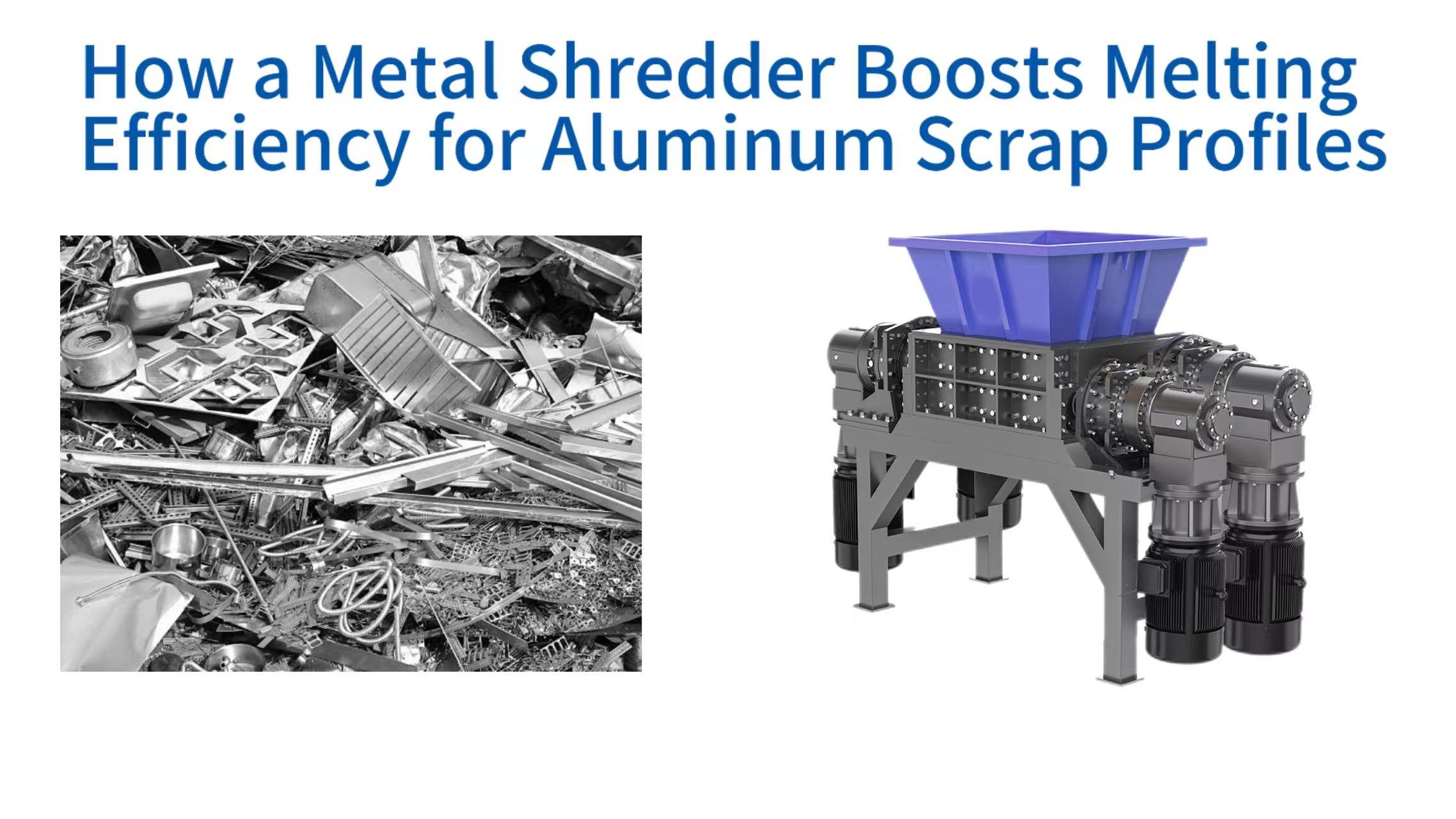
In the aluminum processing and recycling industry, the challenge of handling long aluminum scrap profiles—such as window frames, industrial extrusions, and production waste—is a persistent technical difficulty. These elongated and thin materials have a tendency to intertwine, forming complex structures that resemble bird nests. This entanglement complicates the feeding process into the furnace and significantly degrades both melting efficiency and the overall metal recovery rate. Conventional methods like manual cutting or standard shearing prove inefficient and fail to fundamentally resolve the issues of material accumulation inside the furnace and the increased oxidation losses that occur during melting. This article provides a detailed examination of how a metal shredder systematically enhances the economic viability of the melting stage by effectively tackling the entanglement problem of aluminum scrap profiles. We will conduct an in-depth analysis of the operational principles of the metal shredder, its core functionalities, and its critical role within the aluminum recycling workflow. The discussion will illustrate how this machinery facilitates the production of furnace-ready material with high bulk density and reduced oxidation, enabling businesses to lower energy consumption, improve the quality of their output, and thereby secure a competitive advantage in a demanding market.
The Fundamental Definition and Core Technical Principles of a Metal Shredder in Aluminum Scrap Processing
A metal shredder constitutes a powerful piece of industrial equipment specifically engineered to manage lightweight, ductile metallic scrap, with a particular focus on aluminum profiles. It operates through a distinct combination of shearing and tearing actions to reduce extended aluminum scrap into compact fragments or densified bundles. This process fundamentally alters the physical configuration of the material, establishing the necessary conditions for a subsequent melting phase that is both highly efficient and environmentally clean.
The Principle of Low-Speed, High-Torque Power Transmission
The application of low rotational speeds, typically operating within a range of 20 to 60 RPM, coupled with exceptionally high torque, is a defining characteristic of metal shredders designed for aluminum profile processing. Aluminum, by its metallurgical nature, exhibits substantial ductility. Subjecting such material to high-speed impact forces would generate considerable frictional heat, potentially causing the aluminum to become sticky, smear, or even partially melt, thereby clogging the machinery. The low-speed shear approach circumvents these issues by employing a "cold working" mechanism. It leverages the immense force generated by a heavy-duty gearbox, transforming standard motor energy into the substantial torsional force required for the rotor shafts. This immense torque enables the cutter shafts to positively engage with and tear apart even densely compacted bales or heavily intertwined masses of aluminum extrusions, ensuring consistent material breakdown without heat-related complications.
The Principle of Anti-Winding Shaft Design and Shearing Mechanism
The specific rotor and cutter configuration utilized in these machines is purpose-built to counteract the unique challenges presented by aluminum feedstock. The cutters themselves are manufactured with specialized geometries, including V-profiled or hooked shapes, and are arranged in a staggered pattern along the shafts. As the shafts rotate, this configuration generates a powerful axial pulling force. This force actively drags the loose, entangled strands of aluminum into the narrowing gap between the rotating and fixed cutters. This design philosophy proactively dismantles the entangled structure of the material rather than passively allowing the material to wrap around the rotating components. This aggressive pulling and shearing action is central to maintaining continuous, uninterrupted operation, as it systematically prevents the formation of the very "bird nests" that plague other processing methods and furnace feeding systems.
The Principle of Intelligent Control and Overload Reversal Protection
The inherent variability of aluminum scrap, which frequently contains harder contaminants like steel fasteners, concrete fragments, or other unshreddable items, necessitates the implementation of sophisticated control logic. An intelligent control system, typically based on a programmable logic controller (PLC), performs continuous real-time monitoring of the electric motor's current draw and the gearbox's torque levels. When the system detects a spike in resistance indicative of an encounter with an unbreakable object, it initiates a pre-programmed response. The PLC instantaneously commands the drive system to halt and then reverse the direction of the shafts for a brief period. This reverse rotation serves to eject or loosen the offending foreign object, allowing it to fall away from the cutting area. Following this, the system automatically resumes its normal forward rotation. This automatic protection cycle is essential not only for safeguarding the expensive, wear-resistant cutters and main shafts from catastrophic damage but also for ensuring the continuity of the overall processing workflow, preventing costly downtime associated with manual clearing of jammed machinery.
The Principle of Hydraulic Drive and Forced Feeding
Light-gauge aluminum materials, such as thin-walled profiles, possess a tendency to be buoyant and resistant to being drawn into the cutting chamber under gravity alone. To address this, many metal shredders incorporate a hydraulically powered feed system. This system often takes the form of an intelligent hopper or a movable compaction device, frequently referred to as a pusher ram. This hydraulic mechanism operates in a synchronized cycle with the shredder rotors. It applies continuous downward or horizontal force, actively compressing the loose, fluffy aluminum scrap and forcing it into direct contact with the rotating cutter shafts. This forced feeding action ensures that every portion of the material charge is effectively captured and processed. The principle directly enhances the throughput efficiency of a single processing cycle and contributes to a marked increase in the bulk density of the output material, thereby delivering a more compact, "solid" furnace feedstock that is denser and sinks more readily in a molten bath.
The Main Types of Metal Shredders and Their Application in Aluminum Recycling Scenarios
Given the diversity in aluminum scrap sources, processing volumes, and operational site conditions, metal shredders are manufactured in several distinct configurations. Selecting the appropriate type of machine constitutes the initial and essential step towards establishing a highly efficient aluminum recycling production line.
Application of Stationary Double-Shaft Metal Shredders in Large-Scale Recycling Centers
The stationary double-shaft shredder represents the workhorse of large, dedicated aluminum recycling facilities. These units are characterized by their substantial power ratings and heavy-duty construction, designed for continuous, high-volume operation when firmly mounted on a concrete foundation. They function as the core processing unit within a comprehensive material recovery system. In this capacity, they work in coordinated sequence with other equipment, including infeed conveyors, overband magnets for ferrous removal, and eddy current separators for non-ferrous recovery. Their role is to process large,混杂的 streams of materials, such as complete window and door frames or automotive shredder residue containing aluminum, into a consistent, liberated fraction suitable for downstream sorting and eventual melting. The robust design ensures reliable processing of bulky and difficult feedstocks.
Application of Mobile Metal Shredders at Scrap Yards or Demolition Sites
The mobile metal shredder, available in track-mounted or wheeled configurations, offers the significant advantage of operational flexibility. This type of unit can be transported directly to the point of scrap generation, such as a building dismantling site or a material stockyard. On-site, it can immediately process materials like salvaged aluminum window frames and industrial offcuts. The primary benefit derived from this mobility is substantial cost reduction in logistics. By shredding the material at the collection point, the need to transport large volumes of loose, low-density scrap over long distances is eliminated. The processed material, now compacted into high-density fragments, is much more economical to haul. Furthermore, this on-site processing capability dramatically improves yard space turnover, as processed material occupies significantly less volume than its raw, bulky form.
Application of Four-Shaft Metal Shredders for Fine Size Reduction
Scenarios demanding a smaller and more uniform output particle size call for the application of a four-shaft shredder. While a double-shaft machine typically performs primary粗破碎, a four-shaft unit incorporates two sets of counter-rotating shafts. The first set performs an initial coarse tear, and the second set, operating with a different screen or gap configuration, further refines the material into smaller, more consistent granules. This multi-stage reduction is particularly valuable for subsequent processing steps that require a narrow particle size distribution. For example, downstream separation equipment like eddy current separators operates with greater efficiency on uniformly sized feed. Additionally, applications requiring extremely consistent melting characteristics, such as the production of specific aluminum alloys in a reverberatory furnace, benefit from the predictable melting behavior of uniformly sized shredder output.
The Application of Hammer Mill Shredders in Deconstructing Old Aluminum Windows
An alternative technology for processing contaminated aluminum scrap, particularly old windows containing PVC thermal breaks and rubber seals, is the hammer mill shredder. This machine operates on the principle of impact. A rapidly rotating rotor fitted with hammers swings out and strikes the incoming material, shattering brittle components and liberating them from the ductile aluminum. This action achieves a high degree of material liberation, effectively separating the aluminum from its attachments. However, it is important to distinguish this application from that of a low-speed shear shredder. When processing relatively clean aluminum profiles where the primary goal is simply to reduce size and increase density for melting, the low-speed shear shredder is a more energy-efficient and targeted solution. It produces denser fragments with less material degradation and dust generation, whereas the hammer mill is better suited for applications requiring maximum liberation of contaminants, even at a higher operational cost.
The Core Functions of a Metal Shredder in the Pre-Melting Treatment of Aluminum Scrap
The transformation of bulky aluminum scrap into a high-quality furnace feedstock involves more than just simple size reduction. A metal shredder delivers a set of essential functions, each directly contributing to the optimization of the melting phase. The ultimate objectives are to maximize the value of the recovered metal while minimizing the energy consumed and the material lost during processing.
The Function of Efficient Liberation and Size Homogenization
The shredder performs the critical task of reducing aluminum profiles, which can measure several meters in length, into uniform fragments typically ranging from 50 to 150 millimeters. This process of size homogenization is vital for several downstream handling and processing steps. The consistent dimensions ensure that the shredded material flows predictably through conveyors, storage bins, and feeding systems, eliminating the bridging and blockages often caused by long, entangled pieces. More importantly, within the melting furnace, these uniformly sized pieces exhibit consistent thermal behavior. They heat up and melt at a predictable rate, ensuring that the entire charge reaches the molten state simultaneously. This uniformity prevents the common processing defect where larger pieces remain solid while smaller, thinner pieces have already melted and are susceptible to oxidation.
The Function of Significantly Increasing Furnace Feedstock Bulk Density
One of the most quantifiable benefits of shredding is the dramatic increase in the bulk density of the aluminum scrap. Loose, entangled aluminum profiles possess an extremely low bulk density, often measuring only 0.1 to 0.2 tons per cubic meter. After processing through a metal shredder, this value is substantially elevated, typically reaching a range of 0.4 to 0.6 tons per cubic meter. This increase has a direct and powerful impact on furnace productivity. A higher bulk density means that each charge placed into the melting furnace contains significantly more aluminum by weight. This directly increases the throughput capacity of the furnace, allowing more metal to be melted in a single cycle. Furthermore, the denser material sinks rapidly beneath the surface of the molten bath, reducing its exposure time to the oxidizing atmosphere of the furnace and consequently lowering the rate of metal loss due to oxidation.
The Function of Pre-Removing Impurities and Contaminants
The mechanical forces exerted during the shredding process are instrumental in exposing and liberating contaminants embedded within the aluminum scrap. Plastic thermal break strips, rubber gaskets, steel screws, and other foreign materials are broken, torn, and physically separated from the aluminum matrix. This initial liberation is a prerequisite for effective downstream cleaning. Once the material is shredded to an appropriate size, it can be efficiently passed through magnetic separators, eddy current separators, and air classifiers to remove these impurities. The production of a clean, contaminant-free furnace charge is of paramount importance. It is essential for manufacturing high-quality secondary aluminum alloys that meet stringent specifications. Furthermore, removing contaminants like PVC and rubber prevents the formation of corrosive gases within the furnace, which can damage the refractory lining and increase the costs associated with refining and fluxing the molten metal.
The Function of Reducing Oxidative Loss and Increasing Metal Recovery Rates
The detrimental effects of the "winding problem" on metal yield are profound. When loose, thin-walled aluminum profiles are charged into a furnace, they present an enormous surface area to the hot combustion gases. They often float and linger near the surface, becoming highly susceptible to oxidation. In such conditions, metal losses due to burning, known as melt loss or oxidation dross, can be severe, frequently ranging from 5 to 10 percent of the total aluminum weight. Shredding the material into dense, compact bundles or chunky fragments drastically reduces the exposed surface area. These densified pieces sink quickly and melt rapidly, minimizing their contact time with the oxidizing furnace atmosphere. This transformation can reduce oxidation losses to a much lower range of 1 to 3 percent. For a secondary aluminum smelter processing 100,000 tons of scrap annually, even a modest reduction in melt loss translates to the recovery of several thousand additional tons of saleable metal each year, representing a significant increase in revenue.
The Function of Energy Conservation and Enhancing Melting Velocity
The principles of increased bulk density and uniform sizing converge to directly influence the energy efficiency of the melting operation. A denser furnace charge facilitates more efficient heat transfer. Thermal energy from the flame or hot gases is conducted more readily through the compact mass of metal, as there are fewer insulating air gaps between individual pieces. This improved heat transfer results in a faster melting rate. Empirical data from industrial operations consistently demonstrates that scrap prepared with a metal shredder melts 25 to 35 percent faster than unprepared, loose material. This increase in melting velocity translates directly into reduced fuel consumption, whether natural gas or electricity, per ton of aluminum produced. The resulting decrease in energy costs provides a tangible and continuous improvement to the profitability of the recycling operation.
The Variety of Aluminum Scrap Types Processed by a Metal Shredder and Their Application Scenarios
The physical form of aluminum scrap is highly varied. The application of the metal shredder spans the entire spectrum of material types, from freshly generated manufacturing waste to post-consumer discarded products, demonstrating its adaptability across different recycling scenarios.
Processing Application for New Aluminum Scrap from Industrial Profiles and Fabrication
New scrap, generated during the production of aluminum extrusions, window frames, and other fabricated components, is characterized by its cleanliness, defined shapes, and elongated forms. For in-house recycling loops at extrusion plants or fabrication shops, the metal shredder offers a direct and efficient solution. It processes these long, straight offcuts into short, dense fragments. This immediately prepared material can be conveyed back to the melting furnaces without delay, creating a closed-loop recycling system. This approach eliminates the need for extensive storage areas to accumulate large volumes of bulky scrap and prevents the logistical challenges and safety hazards associated with handling long, sharp-edged metal pieces on the plant floor.
Processing Application for Old Aluminum Scrap from Demolished Windows and Curtain Walls
Post-consumer scrap, particularly materials sourced from building renovation or demolition projects, presents a more complex challenge. Old windows and curtain wall sections are assemblies containing not only aluminum but also a variety of contaminants, including PVC thermal barriers, rubber sealing strips, steel screws, and other hardware. The shredder's primary function in this application is to perform initial size reduction and liberation. By tearing the entire assembly into smaller pieces, the shredder effectively breaks the mechanical bonds between the aluminum and the other materials. This creates a stream of particles with a suitable size distribution for the subsequent multi-stage sorting process, which typically involves magnetic separation for steel, eddy current separation for aluminum, and air classification for light plastics and rubber. The final output is a clean, concentrated stream of aluminum shreds ready for melting.
Application for Loosening and Processing Compressed UBC Bales
Used beverage cans are typically compressed into high-density bales for efficient transportation and storage. Before these bales can be melted, however, they must be broken apart and the material prepared for furnace charging. A metal shredder is ideally suited for this task. It effectively tears apart the compacted bales, reducing them to individual fragments or flakes of coated aluminum. This size reduction is critical for the next step in the UBC recycling process, which often involves a thermal decoating system to remove the lacquer and paint from the can surfaces. The increased surface area of the shredded flakes facilitates more efficient decoating. Additionally, the shredding action helps to liberate any foreign debris that may have been trapped inside the bales, contributing to a purer melt.
Processing Application for Mixed Aluminum Turnings and Borings
Machining operations such as turning, milling, and drilling generate significant quantities of aluminum swarf. This material typically appears as long, stringy, and curled chips, often contaminated with cutting fluids and moisture. Handling and melting this type of scrap directly is dangerous and inefficient. The high surface area and potential for moisture can cause explosions when introduced to molten metal. Metal shredders, or specialized chip crushers, are employed to process this swarf. They break the long, coiled turnings into shorter, more manageable pieces. This process not only reduces volume but also helps to liberate the cutting oils, allowing for more effective downstream drying or briquetting. Properly prepared swarf is essential for safe charging into a furnace and achieving a high metal recovery rate from what would otherwise be a difficult-to-process waste stream.
A Detailed Explanation of the Technical Principles by Which a Metal Shredder Enhances Aluminum Melting Efficiency
Transitioning from the macroscopic action of size reduction to the microscopic improvements in melting dynamics involves a series of precise engineering principles. A thorough understanding of these underlying concepts helps to fully appreciate the value a shredder brings to the aluminum melting process.
The Principle of Specific Surface Area Control
From a physico-chemical standpoint, the rate at which a metal oxidizes is directly proportional to the surface area exposed to the reactive atmosphere. Thin-walled aluminum extrusions, by their very geometry, possess an exceedingly high specific surface area, meaning a large surface area for a given mass. When these pieces float in a furnace, that entire area is subject to oxidation. The shredding process fundamentally alters this geometry through a combination of plastic deformation and fracturing. It compresses and folds the thin walls, transforming them into densified shapes that more closely approximate a sphere or a compact cuboid. This action effectively reduces the specific surface area of the feedstock by a factor of several times. This reduction in area available for reaction with oxygen is the most fundamental physical principle behind the dramatic decrease in melting loss observed when using shredded scrap.
The Principle of Furnace Charge Packing Density and Heat Transfer
Inside an industrial melting furnace, thermal energy is transferred to the solid charge primarily through two mechanisms: conduction from the refractory walls and the molten bath, and convection from the hot combustion gases. A charge consisting of loose, entangled profiles presents a significant barrier to efficient heat transfer. The material forms a porous pile with large internal voids. Hot gases preferentially flow through these paths of least resistance, bypassing much of the metal surface and exiting the furnace without fully transferring their thermal energy. Shredded material, in contrast, forms a dense, interlocking bed with far fewer voids. The close contact between individual fragments promotes efficient conductive heat transfer. Thermal energy flows directly from particle to particle, penetrating the charge more effectively and accelerating the overall melting process.
The Principle of Residual Stress Release During Fragmentation
Aluminum extrusions are formed through a process that imparts significant internal stresses within the material's crystalline structure. A simple shearing action, such as cutting a long profile into shorter lengths, does little to alleviate these locked-in stresses. The more aggressive action of a shredder, involving simultaneous bending, twisting, and tearing, subjects the material to forces that exceed its yield strength across multiple axes. This intense mechanical working results in widespread plastic deformation, which effectively releases the residual stresses throughout the metal. This pre-stress relief has practical benefits during melting. When the aluminum fragments are subsequently heated in the furnace, they undergo less thermally induced distortion. The material remains stable, melting in a smooth and predictable manner, free from the unpredictable movements that can sometimes occur when highly stressed pieces are heated.
The Principle of Selective Fragmentation and Contaminant Liberation
The shredding process exploits the differing mechanical properties of the materials present in the scrap stream. Aluminum is a ductile and malleable material, meaning it tends to bend and tear rather than shatter. In contrast, many contaminants like plastic, rubber, and glass are more brittle. When subjected to the same shearing and tearing forces, these brittle materials fracture and break into relatively fine particles. Steel components, while also ductile, are often present as small fasteners which are liberated intact. This differential response to stress is known as selective fragmentation. The outcome is a processed mixture where the aluminum exists as larger, dense fragments, while the contaminants are reduced to smaller particles. This difference in both size and density provides the physical basis for highly efficient downstream separation using technologies like vibrating screens, air classifiers, and magnetic separators.
The Principle of Cold Processing Advantages and Heat-Affected Zone Control
Compared to size reduction methods that rely on high-speed impact or grinding, such as hammer mills or impactors, the low-speed shear shredding process is definitively a "cold working" technology. The energy imparted to the material is primarily used for plastic deformation and fracture, with very little converted into heat. As a result, the temperature of the aluminum fragments rises only minimally during processing. This is a significant advantage. It prevents the formation of localized oxidation or melting at the cut edges, which would create a small heat-affected zone with different metallurgical properties. By preserving the original, un-oxidized state of the aluminum, the shredder ensures that the material entering the furnace is chemically pristine. This contributes to the stability and purity of the final molten alloy, avoiding the introduction of unnecessary oxides that would have to be removed through additional fluxing.
The Core Value and Return on Investment for Aluminum Recyclers from a Metal Shredder
For an aluminum recycling business, the decision to invest in a high-performance metal shredder is a pivotal step towards achieving operational excellence and enhanced profitability. The value generated by this equipment extends far beyond its function as a standalone machine, positively influencing nearly every aspect of the company's competitive standing.
Focusing on Cost-Effectiveness: Substantially Reducing Operating Costs and Increasing Capacity
By improving the bulk density and melting characteristics of the furnace charge, a company can process significantly more material within the same operational timeframe. Empirical evidence from the industry suggests that the integration of a shredder can boost the daily throughput capacity of a melting furnace by over 30 percent. This increased productivity is achieved concurrently with a reduction in unit operating costs. The energy consumed per ton of aluminum melted decreases, and labor costs are lowered as the need for manual cutting, sorting, and handling of difficult long material is largely eliminated. For many operations, these combined savings and increased revenues lead to a full recovery of the initial capital investment in the shredding equipment within a period of approximately 18 to 24 months.
Focusing on Quality and Profit Margins: Improving Metal Yield and Product Value
The financial impact of reducing metal loss through oxidation is substantial. Lowering the melt loss rate from a higher range to a lower range, even by a few percentage points, opens up a significant profit margin. To provide a concrete illustration, consider a recycling facility processing 50,000 tons of aluminum scrap annually. If the installation of a shredder reduces the average melt loss by just 2 percent, the company effectively recovers an additional 1,000 tons of aluminum each year. At prevailing market prices for aluminum, this directly translates to an increase in annual revenue on the order of several million dollars. Furthermore, the production of a clean, homogenized, and contaminant-free furnace charge enables the smelter to produce higher quality ingots or molten metal, which can command a premium price in the market.
Focusing on Safety and Environmental Stewardship: Improving the Work Environment and Mitigating Risk
The automation of material processing eliminates many of the traditional safety hazards associated with handling bulky aluminum scrap. Manual operations often involve workers using torches or heavy hydraulic tools to cut long pieces, exposing them to risks of fire, explosion, and serious mechanical injury. The shredder replaces these dangerous manual tasks with a fully enclosed, automated process. Additionally, modern shredding systems are designed with environmental controls in mind. They are often equipped with soundproofing enclosures to reduce noise pollution and integrated with dust extraction systems to capture fine particulate matter generated during processing. This leads to a cleaner, safer work environment for employees and assists the facility in complying with increasingly stringent environmental regulations, fostering a culture of responsible, sustainable production.
Focusing on Sustainable Development: Supporting the Circular Economy and Securing Resources
Efficient aluminum recycling is a cornerstone of industrial sustainability. By utilizing a metal shredder to maximize the recovery rate of aluminum from post-consumer and industrial scrap, a recycling company makes a significant contribution to the principles of the circular economy. The high-quality shredder output serves as a valuable "urban mine," a secondary source of metal that reduces society's dependence on the environmentally impactful mining and refining of virgin bauxite ore. This conservation of natural resources and the substantial energy savings inherent in recycling aluminum over primary production position the company not only as an economically successful enterprise but also as a responsible actor contributing to global resource security and environmental protection.
The Advantages of MSW Technology's Metal Shredder Solutions
MSW Technology has dedicated more than 15 years to the engineering and manufacturing of equipment for solid waste processing and resource recovery. Our team has collaborated with hundreds of secondary metal producers across the globe, developing a deep and practical understanding of the specific pain points and operational demands associated with aluminum scrap processing. Our specialized metal shredders, engineered explicitly to resolve the challenge of aluminum profile entanglement, represent a synthesis of advanced engineering and extensive field experience.
The core of our shredder design lies in the use of high-strength, wear-resistant alloy steel cutters. These are mounted on a unique anti-winding rotor configuration that actively pulls material into the cutting zone. This mechanical design is complemented by our proprietary intelligent torque control system. Together, these features ensure that our machinery maintains exceptionally high throughput and operational stability, even when processing the most difficult feedstock, such as entire lots of demolition aluminum windows containing steel and plastic. The output material produced is characterized by its uniform and controllable particle size and its significantly increased bulk density, making it a perfect fit for integration with any melting furnace technology.
The relationship with our clients extends well beyond the initial equipment sale. MSW Technology provides comprehensive, lifecycle support. This begins with a thorough pre-sales analysis of the customer's specific material, followed by expert hard material shredding solutions process design and precise solid waste shredder equipment selection. Our commitment continues after the sale with professional installation and commissioning, thorough operator training, and a reliable supply of original spare parts, such as shredder shaft assemblies and wear-resistant liners. We deliver more than just a dependable scrap metal double-shaft shredder; we offer a customized high-toughness material shredding solutions system designed specifically to increase your melting efficiency and lower your operational costs. We invite you to visit our online platform to discover detailed information about our metal shredder series. Contact our team of application engineers today to begin developing a customized processing solution that will secure your competitive advantage in the dynamic field of secondary aluminum production.