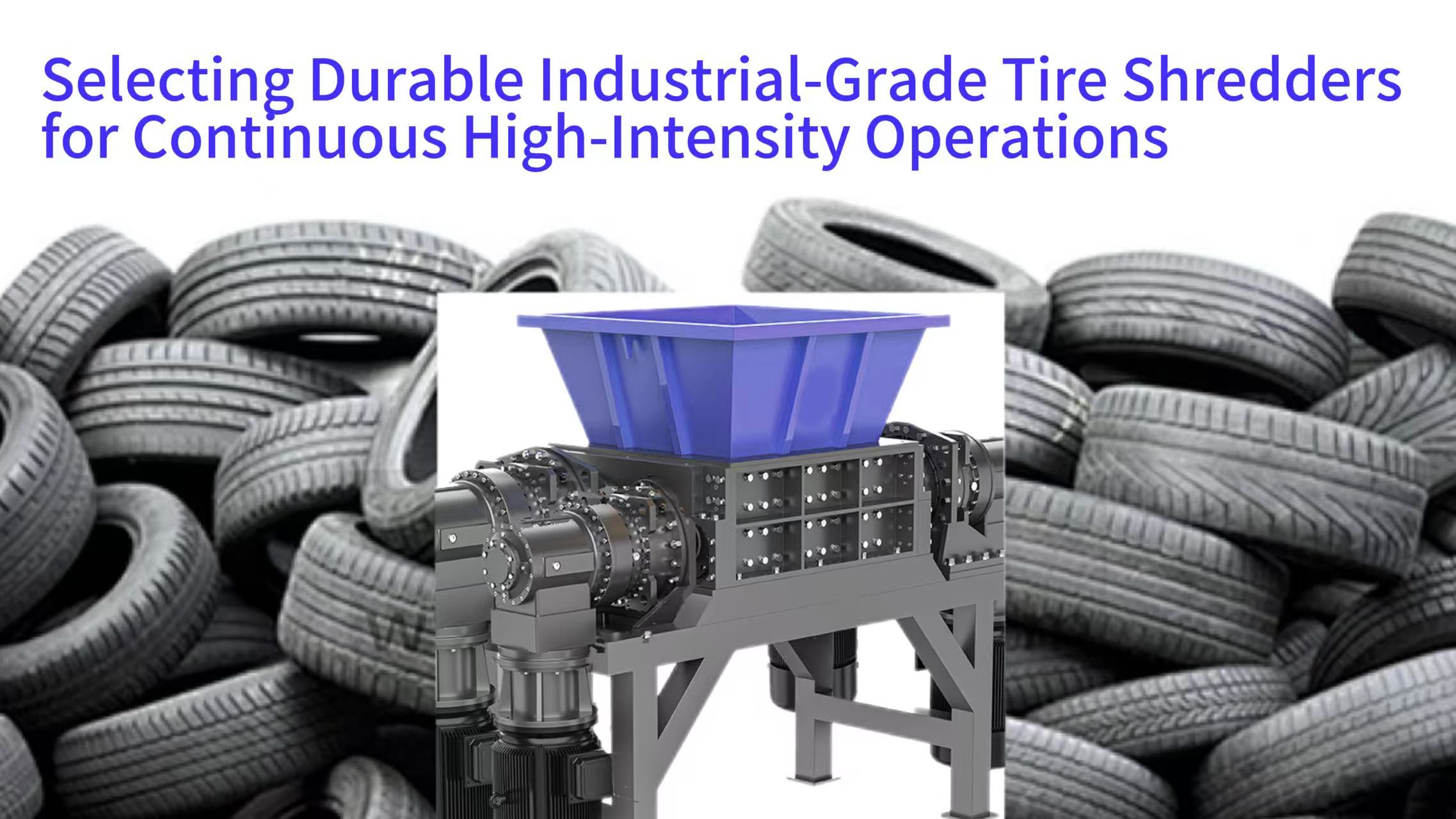
Selecting Durable Industrial-Grade Tire Shredders for Continuous High-Intensity Operations
Industrial tire shredding represents one of the most demanding applications in size reduction technology, requiring machines engineered for relentless operation under extreme conditions. These specialized shredders transform discarded tires into valuable rubber crumb, steel wire, and textile fibers through systematic mechanical processing. The selection process for continuous high-intensity operations demands careful consideration of multiple engineering factors that collectively determine equipment longevity and operational economics. This examination explores the critical technical parameters and design philosophies that distinguish industrial-grade tire shredders capable of sustaining 20-hour daily operations with annual utilization rates exceeding 80%.
Defining Continuous High-Intensity Operational Environments
Continuous high-intensity operations for industrial shredders involve sustained processing under maximum design capacity with minimal interruption for maintenance or adjustments. These operational profiles typically encompass multiple shifts totaling 20-24 hours daily, with only brief windows allocated for routine inspections and minor servicing. The mechanical demands under such conditions differ substantially from standard single-shift operations, as components experience accelerated fatigue cycles and thermal stress accumulation. Facilities operating under these parameters require equipment specifically engineered for endurance rather than adapting standard models through operational compromises.
The economic justification for continuous operation stems from maximizing return on capital investment through consistent throughput and minimizing per-ton processing costs. However, this operational intensity introduces unique challenges including heat management during extended run times, cumulative wear on cutting components, and the critical importance of preventative maintenance scheduling. Operations managers must balance production demands against equipment preservation, recognizing that unplanned downtime in continuous operations carries disproportionately high costs due to lost production and potential contractual penalties.
Typical High-Intensity Application Scenarios
Large-scale tire recycling centers processing municipal collections represent the most common high-intensity application, with annual volumes frequently exceeding 50,000 tons of input material. These facilities typically operate on a merchant model, processing tires from multiple sources with varying characteristics including passenger, truck, and off-the-road varieties. The material heterogeneity presents particular challenges as equipment must accommodate different sizes, steel content, and rubber compounds without adjustment downtime. Successful operations in this sector prioritize equipment flexibility alongside durability.
Portside tire processing facilities handling import/export volumes and pyrolysis plant preprocessing operations represent additional high-intensity environments with specialized requirements. Port operations often process massive stockpiles of accumulated tires, requiring equipment capable of sustained operation despite potential contamination from sand, saltwater, and marine organisms. Pyrolysis preprocessing demands precise particle size control to optimize thermal decomposition efficiency, adding another dimension to equipment selection criteria beyond simple durability considerations.
Quantifying Operational Risks from Inadequate Durability
The financial implications of equipment failure in continuous operations extend far beyond repair costs to encompass substantial production losses and potential contractual liabilities. A single unplanned shutdown in a high-volume facility can result in thousands of dollars in lost revenue per hour, with major component failures potentially idling operations for weeks awaiting specialized repairs. These calculations must factor in both direct costs like replacement parts and technician time alongside indirect expenses including expedited shipping and alternative processing arrangements.
Progressive performance degradation represents a less obvious but equally significant risk, as worn equipment consumes more energy, produces inconsistent output quality, and requires increasingly frequent adjustments. This gradual deterioration often goes unaddressed until it manifests as catastrophic failure or unacceptable product quality. Monitoring key performance indicators including specific energy consumption, particle size distribution, and bearing temperatures provides early warning of developing problems before they escalate into operational crises.
Structural and Material Durability Design Principles
Data Analysis
- Ultra Heavy Duty shredders provide the longest mean time between failures (2800 hours) but require higher initial investment, making them suitable for 24/7 operations processing 50,000+ tons annually.
- There is a clear correlation between equipment duty rating and maintenance costs, with heavier-duty machines requiring more specialized maintenance but spreading these costs over longer operational periods.
- Only shredders classified as Heavy Duty or higher demonstrate sufficient durability for 20-hour daily operations, with Continuous and Ultra Heavy Duty models showing minimal performance degradation under extended run times.
- Industrial Hydraulic models balance reliability and operational cost, making them ideal for portside facilities and pyrolysis preprocessing where consistent performance is critical.
- The total cost of ownership analysis favors Heavy Duty and higher models for continuous operations, as their extended uptime offsets higher maintenance costs and initial investment.
Main Shaft and Bearing System Heavy-Duty Design
The main shaft assembly represents the heart of any tire shredder, transmitting tremendous torque while withstanding alternating bending loads from irregular feed material. Industrial-grade shredders employ forged alloy steel shafts, typically 42CrMo4 or similar chromium-molybdenum steel, heat-treated to achieve optimal strength-toughness balance. This material selection provides the necessary fatigue resistance for continuous operation while maintaining sufficient ductility to withstand occasional shock loads from contaminants or improperly fed tires. The shaft geometry incorporates generous fillet radii at stress concentration points and precision-machined surfaces at bearing and cutter mounting locations.
Bearing selection and arrangement must accommodate both radial and axial loads while providing sufficient service life under contaminated operating conditions. Spherical roller bearings frequently serve as the preferred solution for main shaft applications, with their self-aligning capability compensating for minor deflections under load. Bearing arrangements typically incorporate fixed and floating configurations to accommodate thermal expansion during extended operation. Advanced sealing systems including labyrinth seals and positive-pressure grease purging prevent contamination ingress, while integrated temperature sensors provide early warning of developing lubrication issues.
Cutting System Wear Resistance Strategies
The cutting elements in tire shredders face perhaps the most severe wear environment, simultaneously confronting abrasive rubber, cutting steel cord, and impact loading from irregular material. Industrial-grade cutters utilize tungsten carbide inserts brazed or mechanically fastened to alloy steel bodies, creating a composite structure combining extreme surface hardness with fracture-resistant substrate material. The specific carbide grade selection represents a careful balance between wear resistance and toughness, with finer grain structures providing enhanced abrasion resistance while coarser grades offer superior impact resistance.
Cutter geometry optimization focuses on maintaining sharp cutting edges while providing adequate support to prevent microfractures in the carbide material. Hook-style cutter profiles have demonstrated particular effectiveness in tire applications, providing positive material engagement while generating lower cutting forces compared to straight-edge designs. The cutter mounting system must maintain precise alignment under load while facilitating straightforward replacement, with many designs incorporating hydraulic-assisted cutter removal for maintenance efficiency. Some advanced systems employ individual cutter cartridges that can be replaced without disassembling the entire rotor assembly.
Power and Drive System Reliability and Efficiency
The power transmission system in continuous-duty tire shredders must deliver consistent performance while withstanding the shock loads inherent in processing irregular materials. Drive system selection represents a fundamental decision between direct electric drive and hydraulic power systems, each offering distinct advantages for specific operational contexts. Electric drives typically provide higher overall energy efficiency, with well-designed systems converting over 95% of electrical input to mechanical work. Their relative simplicity translates to reduced maintenance requirements under ideal conditions, though they offer less inherent overload protection than hydraulic alternatives.
Hydraulic drive systems introduce additional energy conversion losses but provide exceptional torque characteristics and built-in overload protection through pressure-limiting valves. This makes them particularly suitable for applications with highly variable feed material or potential contamination from non-processables. Modern hydraulic systems incorporate variable displacement pumps and sophisticated control algorithms that optimize energy consumption based on real-time processing demands. The thermal management of hydraulic fluid represents a critical design consideration in continuous operation, with many systems employing integrated heat exchangers to maintain optimal operating temperatures during extended run times.
Hydraulic Drive System Advantages and Control
Hydraulic power transmission offers several distinctive advantages in demanding tire shredding applications, beginning with exceptional torque multiplication capabilities that enable processing of the toughest materials without drive train damage. The fluid power transmission inherently cushions shock loads, protecting both the power source and reduction elements from the abrupt torque spikes generated when engaging steel belts or bead wires. This damping effect significantly extends component life in continuous operation, particularly when processing mixed tire varieties with unpredictable resistance characteristics.
Advanced hydraulic systems incorporate pressure-compensated variable displacement pumps that adjust output based on system demand, reducing energy consumption during lighter loading conditions. Proportional valve technology enables precise control of motor speed and torque, facilitating optimization of cutting parameters for different tire types. The hydraulic reservoir serves not only as fluid storage but also as a crucial heat dissipation component, with many systems employing integrated cooling circuits to maintain optimal fluid viscosity during continuous operation. Filtration represents another critical aspect, with multi-stage systems maintaining fluid cleanliness despite continuous generation of particulate contamination from component wear.
Electric Drive System Efficiency and Maintenance
Electric drive systems provide the most direct power transmission path for tire shredders, typically employing high-voltage motors coupled to reduction gearboxes through flexible couplings. The efficiency advantage of these systems becomes increasingly significant in continuous operations, where energy costs constitute a major portion of operating expenses. Modern electric drives incorporate soft-start functionality through variable frequency drives that limit intrush current and provide progressive acceleration to operating speed. This controlled start-up sequence reduces mechanical stress on drive components and prevents power quality issues that could affect other equipment.
Maintenance considerations for electric drives focus primarily on bearing lubrication, alignment verification, and electrical connection integrity. The absence of hydraulic fluid eliminates concerns about leaks, contamination control, and fluid degradation that accompany hydraulic systems. Thermal protection systems monitor motor winding temperatures and current draw, providing warning of developing problems before they cause catastrophic failure. Many continuous-operation facilities install redundant drive systems or maintain critical spares to minimize downtime in the event of component failure, recognizing that electrical repairs often require specialized expertise not always available on-site.
Integrated Automation and Monitoring Systems
Modern industrial tire shredders incorporate comprehensive automation systems that optimize performance while protecting equipment from damaging operating conditions. These integrated control systems manage everything from material feeding to emergency shutdowns, using sensor data to make real-time adjustments that maximize efficiency and equipment longevity. The core of these systems typically consists of a programmable logic controller operating through a human-machine interface that provides operators with intuitive access to process parameters and operational data. This centralized control architecture simplifies operation while enabling detailed data collection for performance analysis and maintenance planning.
Automated material handling represents a critical component in continuous operations, ensuring consistent feed rates that prevent both overload conditions and inefficient underutilization. Hydraulic pusher systems or regulated conveyor feeds maintain optimal chamber loading by responding to motor current draw or hydraulic pressure signals. This consistent feeding prevents the cyclic loading that accelerates component wear and generates unnecessary vibration. More advanced systems incorporate material recognition technology that identifies tire types and adjusts processing parameters accordingly, optimizing performance for different sizes and constructions.
Automated Material Conveying and Feeding
Consistent material feeding represents a fundamental requirement for efficient continuous operation, with automated systems providing substantial advantages over manual loading methods. Hydraulic ram feeders offer positive material control, using programmable logic to maintain optimal chamber loading based on real-time power consumption monitoring. These systems typically incorporate load-sensing technology that adjusts feed force according to material resistance, preventing excessive force application that could damage equipment or waste energy. The feeding cycle timing coordinates with shredder rotor position to optimize material engagement and cutting efficiency.
Belt conveyor feeding systems provide an alternative approach particularly suited to facilities processing primarily passenger tires or pre-cut tire fragments. These systems employ weigh belts or laser profiling to measure material volume and adjust conveyor speed accordingly, maintaining consistent throughput. Advanced implementations incorporate metal detection to identify and divert tires with excessive bead wire content that might accelerate cutter wear. The integration between feeding and processing systems ensures optimal performance across varying material characteristics, with control algorithms continuously adjusting parameters to maintain target production rates while protecting equipment from damaging overload conditions.
Critical Parameter Monitoring and Alert Systems
Continuous operation demands comprehensive monitoring of equipment health parameters to identify developing issues before they cause unplanned downtime. Bearing temperature monitoring provides early indication of lubrication problems or impending failure, with thermocouples or RTDs installed at critical locations throughout the drive train. Vibration analysis represents another crucial monitoring dimension, with accelerometers detecting changes in mechanical condition that might indicate imbalance, misalignment, or component wear. These vibration monitoring systems typically incorporate trending capabilities that alert operators to gradual changes that might otherwise go unnoticed.
Power monitoring systems track motor current draw and phase balance, identifying abnormal loading patterns that could indicate feeding problems or component degradation. Hydraulic systems employ pressure and temperature sensors that ensure optimal fluid performance while detecting pump wear or contamination issues. Modern monitoring systems incorporate sophisticated algorithms that correlate data from multiple sensors to provide context-aware alerts rather than simple threshold alarms. This integrated approach reduces false alarms while ensuring genuine problems receive appropriate attention, with tiered alert levels distinguishing between conditions requiring immediate shutdown and those needing observation during next scheduled maintenance.
Maintenance-Friendly Design and Operational Cost Management
Maintenance accessibility represents a critical design consideration for equipment intended for continuous operation, where maintenance duration directly impacts production capacity. Industrial-grade shredders incorporate numerous features aimed at reducing mean time to repair, beginning with strategic component placement that provides clear access to frequently serviced items. Modular design approaches allow replacement of complete subassemblies rather than time-consuming component-level repairs, with quick-disconnect fittings and standardized interfaces facilitating rapid exchange. These design philosophies recognize that maintenance efficiency contributes significantly to overall equipment effectiveness in continuous operations.
Preventive maintenance scheduling forms the foundation of sustainable continuous operation, with service intervals based on actual operating hours rather than calendar time. Comprehensive maintenance programs address not only obvious wear components like cutters and screens but also less frequently serviced items including electrical connections, hydraulic accumulators, and alignment verification. Many operations employ condition-based maintenance approaches that use equipment monitoring data to optimize service timing, performing maintenance when indicators suggest deteriorating performance rather than according to fixed schedules. This data-driven approach maximizes component utilization while preventing failures that could disrupt production.
Wear Component Quick-Change Systems
Rapid replacement of wear components represents a crucial capability in continuous operations, with specialized systems minimizing downtime for routine maintenance. Cutter replacement systems frequently employ hydraulic-assisted ejection that removes cutters from their mounting positions without manual hammering or pressing. These systems preserve the precision fit between cutter and rotor while eliminating damage that can occur during forceful removal. Some designs incorporate cartridge-style cutter assemblies that allow replacement of multiple cutters as a single unit, reducing exchange time from hours to minutes.
Screen changing mechanisms represent another area of innovation, with designs ranging from hinged access doors to complete cartridge systems that facilitate rapid aperture changes. The most advanced systems enable screen replacement without entering the cutting chamber, using external mechanisms to position and secure new screens. These designs significantly reduce both maintenance time and safety risks associated with chamber entry. Similar quick-change principles apply to other wear components including feed system liners, discharge conveyors, and hydraulic filters, with standardized fasteners and alignment features ensuring proper installation without specialized tools or excessive adjustment time.
Supplier Evaluation and Total Cost of Ownership Analysis
Supplier selection for industrial tire shredders extends far beyond initial purchase price to encompass technical support capabilities, parts availability, and service responsiveness. Comprehensive evaluation should include assessment of engineering resources, manufacturing quality control systems, and documentation completeness. The most capable suppliers maintain dedicated application engineering teams that assist with system design and integration, ensuring equipment specifications match operational requirements. Manufacturing facility audits provide insight into quality management practices, with particular attention to processes for critical components like shafts, rotors, and gearboxes.
Total cost of ownership analysis provides a framework for evaluating long-term equipment economics beyond initial capital investment. This comprehensive assessment includes energy consumption, preventive maintenance requirements, expected wear component consumption, and projected productivity across the equipment lifespan. The analysis should incorporate probabilistic modeling of major component lifecycles and repair costs, recognizing that statistical distributions more accurately represent real-world performance than single-value estimates. This approach enables objective comparison between equipment options with different initial costs but varying long-term operational economics.
Supplier Technical Capability and Project Experience Assessment
Evaluating supplier technical capability requires investigating both engineering resources and practical experience with similar applications. Design capability assessment should include review of calculation documentation for critical components, verification of compliance with relevant safety standards, and understanding of design verification processes. Manufacturing capability extends beyond basic equipment to encompass specialized processes like large-component heat treatment, precision machining of hardened materials, and non-destructive testing protocols. These capabilities collectively determine the fundamental quality and reliability of the delivered equipment.
Project experience verification provides crucial insight into a supplier's understanding of real-world operational challenges beyond theoretical design considerations. Reference projects should demonstrate successful implementation in environments with similar operational intensity and material characteristics. Site visits to existing installations offer valuable opportunities to discuss maintenance requirements, operational challenges, and supplier responsiveness with actual users. These investigations should include assessment of equipment performance after several years of operation, as initial performance may not accurately reflect long-term reliability and maintenance characteristics.