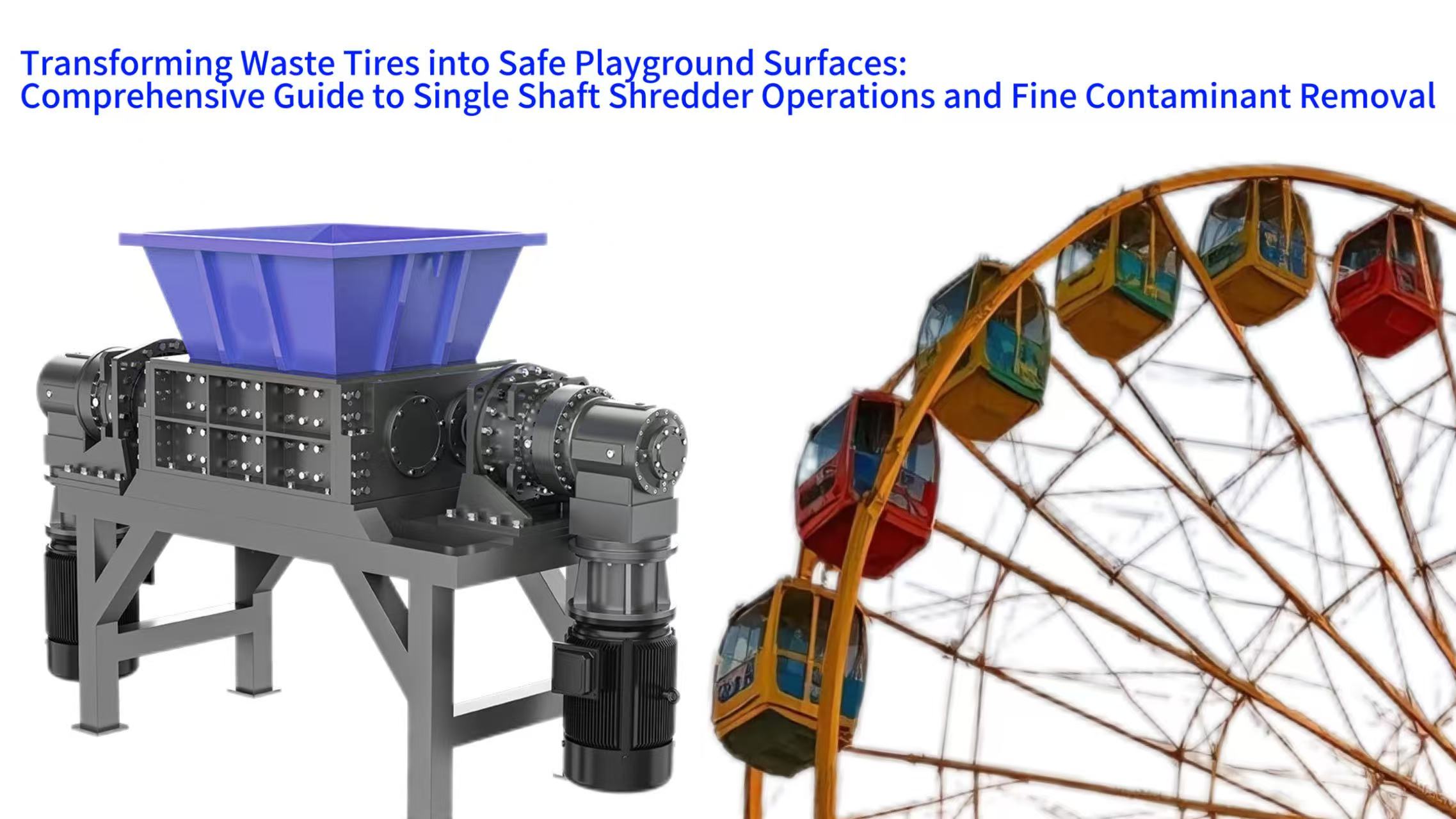
The process of converting discarded tires into safe playground surface materials represents a remarkable achievement in recycling technology and environmental sustainability. This comprehensive guide examines the crucial role of single shaft waste tire shredders in producing high-quality rubber mulch that meets stringent international safety standards for children's play areas. We explore the complete production workflow from initial tire processing to final quality verification, with particular emphasis on removing hazardous fine contaminants that could compromise safety and performance. The transformation involves multiple processing stages including shredding, separation, and purification to eliminate impurities such as steel wire fragments, textile fibers, and rubber dust. Manufacturers must implement rigorous quality control measures throughout production to ensure the final product provides adequate impact absorption, slip resistance, and durability while posing no health risks to children. Understanding these processes enables producers to create superior playground surfaces that protect young users while supporting global recycling initiatives.
Safety Standards and Impurity Requirements for Playground Surface Materials Derived from Shredded Tires
Playground surfaces manufactured from shredded tire rubber must satisfy exceptionally strict safety standards due to their direct contact with children during play activities. These safety-critical applications demand comprehensive impurity control since children interact with the material through various behaviors including crawling, running, and falling. International standards organizations have established precise limitations for contaminant size, concentration, and composition to ensure adequate protection for young users. The material must provide consistent impact attenuation to reduce injury risk from falls, which can be compromised by irregular particle distribution or contamination. Manufacturers must thoroughly understand these requirements before initiating production to avoid costly reprocessing or product rejection that could significantly impact operational economics.
The functional performance of playground surfaces extends beyond basic safety to include durability, weather resistance, and consistent mechanical properties throughout their service life. These characteristics depend heavily on both the base rubber quality and the effectiveness of impurity removal processes during manufacturing. Industry research demonstrates that properly processed tire-derived rubber mulch can provide impact attenuation exceeding 200 G-max ratings when installed at appropriate depths, substantially enhancing playground safety compared to traditional materials like sand or wood chips. The economic implications of meeting these standards are significant, with compliant products commanding premium prices in markets where safety certifications are valued by consumers and regulatory authorities alike.
Origins and Characteristics of Common Fine Contaminants in Shredded Tire Materials
Rubber powder constitutes one of the most prevalent fine contaminants generated during the shredding process, particularly when cutting elements experience wear or operational parameters deviate from optimal ranges. These microscopic particles typically measure between 0.1-1.0 millimeters and can fill void spaces between larger rubber chunks, reducing the material's energy-absorbing properties and potentially creating respiratory hazards during installation. The generation of excessive powder usually indicates blade wear exceeding 0.5 millimeters or rotational speeds inappropriate for the specific tire composition being processed. Controlling this impurity requires both equipment maintenance and process parameter optimization to balance production efficiency with product quality requirements.
Steel wire fragments originating from tire belting present substantial safety concerns due to their potential for creating sharp protrusions in the finished surface. These metallic contaminants typically measure between 0.5-5 millimeters in length and can maintain sharp edges despite processing. Textile fibers from tire reinforcement layers represent another challenging contaminant category with different characteristics, as they can clump together and create inconsistent areas within the playground surface. Both contamination types require specialized removal approaches based on their physical properties and interaction with processing equipment. Understanding these contaminant characteristics enables manufacturers to select appropriate separation technologies and optimize their operation for maximum efficiency.
International Standards Governing Impurity Limits in Playground Rubber Materials
The European Standard EN 1177 establishes specific requirements for playground impact-attenuating surfaces, including precise limitations on impurity size and composition. This standard explicitly prohibits hard contaminants exceeding 2 millimeters in any dimension while requiring thorough removal of sharp metallic particles. Additionally, the standard mandates testing for heavy metal content and other hazardous substances that could leach from the material during use. Compliance with these standards requires manufacturers to implement comprehensive quality control protocols throughout the production process, from raw material intake to final product verification. The testing methodologies specified in these standards provide reproducible assessment techniques that ensure consistent safety evaluation across different production facilities and market regions.
American Society for Testing and Materials Standard ASTM F1292 provides detailed specifications for impact attenuation while addressing impurity concerns through material composition requirements. The standard establishes performance thresholds for critical fall height protection while implicitly addressing impurity control through requirements for consistency and durability. Chinese National Standard GB/T 21286 complements these international benchmarks with specific provisions for rubber playground surfaces, including contaminant concentration limits not exceeding 0.5% by weight. Manufacturers exporting to multiple markets must ensure their products satisfy the most stringent requirements across all applicable standards, often necessitating sophisticated testing equipment and qualified personnel to verify compliance.
Performance Implications of Residual Contaminants in Playground Surfaces
Excessive fine rubber particles significantly reduce the impact-absorbing properties of playground surfaces by filling the void spaces necessary for proper energy dissipation during falls. Laboratory testing demonstrates that contaminant concentrations exceeding 3% by volume can reduce impact attenuation by 15-20%, potentially increasing injury risk during falls from playground equipment. Additionally, these fine particles tend to migrate upward through the material layer over time, creating a less stable surface texture that compromises slip resistance, particularly in wet conditions. These performance degradation issues necessitate rigorous impurity control throughout production to ensure consistent safety performance throughout the product's service life.
Metallic contaminants present both immediate and long-term performance concerns, with sharp wire fragments potentially protruding through the surface immediately after installation. More concerning are the delayed failure modes associated with steel contaminants, as oxidation processes cause expansion that can disrupt the surface integrity months or years after installation. Textile fibers interfere with the binding processes used in some rubber surface systems, creating weak zones where separation can occur under use conditions. Understanding these failure mechanisms helps manufacturers prioritize contaminant removal efforts based on risk assessment and implement appropriate quality assurance measures to detect potential issues before products reach consumers.
Child-Specific Safety Considerations in Contaminant Control
Children's unique vulnerability to environmental hazards necessitates special consideration during the impurity removal process for playground materials. Their developing respiratory systems require particular attention to dust control, with particles smaller than 10 microns presenting potential inhalation risks during active play. Additionally, children's tendency toward hand-to-mouth contact necessitates strict limits on heavy metal content and chemical contaminants that could transfer through dermal contact. These considerations extend beyond basic impurity removal to encompass comprehensive material safety protocols that address both immediate and potential long-term health impacts.
The playing behaviors typical of children including crawling, rolling, and frequent falls create unique exposure scenarios that influence contaminant tolerance levels. Sharp contaminants barely noticeable to adults wearing shoes can cause significant injury to bare-handed or bare-kneed children. Safety testing should therefore include simulated use scenarios that replicate children's interactions with the material, including compression, abrasion, and impact testing. Manufacturers committed to child safety often implement standards exceeding regulatory minimums to address these special considerations adequately, recognizing that children's play environments demand exceptional safety margins to account for unpredictable use patterns and developing physiology.
Fundamental Principles and Key Factors in Fine Contaminant Removal from Shredded Tire Materials
Effective separation of fine contaminants from shredded tire rubber relies on fundamental physical principles including particle size differentials, material density variations, and magnetic properties. The screening process must be precisely calibrated to target specific contaminant types while minimizing loss of valuable rubber material. Understanding these separation mechanisms enables manufacturers to select appropriate equipment configurations and optimize operational parameters for their specific input materials and output requirements. Successful implementation typically employs multiple complementary separation technologies arranged in sequential processing stages to address the diverse contaminant profile present in shredded tires.
The efficiency of impurity removal depends significantly on material characteristics including particle size distribution, moisture content, and contamination concentration. Screening systems must accommodate the irregular shapes typical of shredded tire rubber while effectively separating contaminants with similar physical properties. Operational factors including feed rate, equipment configuration, and maintenance protocols further influence separation effectiveness. Comprehensive process control requires monitoring both input material variability and equipment performance to maintain consistent output quality despite fluctuations in raw material characteristics. Advanced facilities often employ automated monitoring systems that continuously adjust processing parameters to compensate for material variations in real-time.
Particle Size-Based Separation Mechanisms and Applicable Contaminant Types
Vibratory screening systems exploit size differences between rubber particles and contaminants using precisely sized apertures to separate materials mechanically. These systems typically employ multiple deck configurations with progressively smaller screen openings to classify materials into specific size fractions while removing undersized impurities. The vibration frequency and amplitude must be carefully calibrated to prevent blinding while ensuring adequate material transport across the screening surface. Properly configured vibratory screens can achieve separation efficiencies exceeding 95% for size-based impurities when processing dry materials with appropriate particle size distributions. The capital investment for these systems varies significantly based on capacity and automation level, with industrial-scale units representing substantial but justifiable expenses for high-volume producers.
The effectiveness of size-based separation depends heavily on maintaining consistent feed characteristics and preventing screen clogging. Irregularly shaped rubber particles can temporarily bridge across screen openings, reducing effective screening area and allowing impurities to pass through with the product stream. Anti-blinding mechanisms including ball trays, brush systems, or ultrasonic screen cleaners help maintain screening efficiency during extended operation. Additionally, screen inclination and vibration patterns must be optimized for the specific material characteristics to ensure adequate residence time for effective separation without reducing throughput capacity. These technical considerations require careful engineering analysis during system design and continuous monitoring during operation to maintain optimal performance.
Material Property-Based Separation Principles and Targeted Applications
Magnetic separation systems effectively remove ferrous contaminants from shredded tire rubber using high-intensity magnetic fields to extract steel wire fragments and other metallic impurities. These systems typically employ permanent magnets or electromagnets generating field strengths exceeding 10,000 Gauss to ensure capture of fine metallic particles. The separation efficiency depends on both magnetic field strength and the exposure time as material passes through the magnetic zone. Properly configured magnetic separators can reduce ferrous contamination to levels below 0.1% by weight, effectively eliminating visible metal content from the finished product. The operational costs for these systems primarily involve electricity consumption for electromagnetic models or periodic replacement of permanent magnets that gradually lose strength over years of service.
The configuration of magnetic separation systems must accommodate both the material flow characteristics and the specific nature of metallic contaminants present in shredded tires. Self-cleaning magnetic drums automatically remove captured ferrous materials from the magnetic surface, preventing buildup that could reduce separation efficiency. Suspended magnetic units positioned above conveyor belts provide alternative configurations for different processing layouts. The placement of magnetic separation within the overall process flow significantly impacts effectiveness, with multiple magnetic separation stages often employed at different processing points to address various contaminant sizes and concentrations. This strategic placement ensures comprehensive metallic impurity removal while minimizing the load on subsequent processing stages.
Density and Aerodynamic Separation Principles and Implementation Contexts
Air classification systems separate materials based on density and aerodynamic properties, effectively removing lightweight contaminants including textile fibers and fine dust from rubber particles. These systems utilize controlled airflows to create separation zones where materials with different mass-to-surface-area ratios follow divergent paths. The airflow velocity must be precisely calibrated to lift lightweight impurities without carrying valuable rubber particles into the reject stream. Successful implementation requires thorough understanding of the aerodynamic characteristics of both product and contaminant materials under various moisture and temperature conditions. The operational flexibility of these systems allows manufacturers to adjust separation parameters quickly when processing different tire types or addressing specific contamination issues.
The efficiency of air classification depends significantly on material preparation, particularly moisture content control and particle dispersion. High humidity levels can cause fine materials to agglomerate, reducing separation effectiveness and potentially carrying contaminant clusters into the product stream. Pre-conditioning through drying or mechanical agitation may be necessary to ensure adequate material fluidization before air classification. System designs incorporating multiple air classification stages with progressively refined separation parameters often achieve superior impurity removal while minimizing product loss compared to single-stage configurations. The engineering complexity of these multi-stage systems requires higher initial investment but typically delivers substantially better long-term operational economics through improved product quality and reduced waste.
Critical Process Parameters Influencing Separation Efficiency
Material moisture content represents one of the most significant factors influencing screening efficiency, with levels exceeding 8% typically causing particle adhesion and screening surface blinding. Optimal screening generally occurs at moisture levels between 3-6%, requiring pre-drying operations in humid environments or when processing recently washed materials. The relationship between moisture content and screening efficiency follows a non-linear pattern, with dramatic efficiency reductions occurring once specific threshold moisture levels are exceeded. Continuous moisture monitoring and control systems help maintain optimal conditions throughout processing operations, typically adding 5-15% to equipment costs but delivering substantial returns through improved processing efficiency and product quality.
Feed rate consistency directly impacts screening efficiency by influencing material bed depth and residence time on screening surfaces. Excessive feed rates create thick material layers that prevent smaller particles from reaching screening surfaces, while insufficient feed rates reduce processing capacity without improving separation quality. Optimal feed rates typically maintain material bed depths between 1-3 centimeters on vibratory screens, though specific ideal parameters vary with equipment design and material characteristics. Automated feed control systems using weighing conveyors or level sensors help maintain consistent feed rates despite fluctuations in upstream processing. These control systems represent additional capital investment but typically pay for themselves within 12-18 months through improved processing efficiency and reduced operator intervention requirements.
Preparatory Procedures for Screening Fine Contaminants from Shredded Tire Materials
Effective impurity removal begins with thorough preparation of shredded tire materials to optimize subsequent separation processes. These preparatory steps address material characteristics that could impede screening efficiency, including inconsistent particle size distribution, excessive moisture content, and contamination concentration variations. Proper preparation typically reduces screening system loadings while improving separation precision, ultimately enhancing both product quality and processing throughput. Manufacturers implementing comprehensive preparation protocols typically achieve 20-30% higher screening efficiency compared to operations feeding raw shredded materials directly to separation equipment. The economic benefits of these improvements often justify the additional processing steps through reduced energy consumption, longer equipment life, and higher product quality.
The preparatory phase encompasses both mechanical processing to modify physical characteristics and conditioning treatments to address chemical or surface properties. Mechanical preparation typically includes secondary size reduction to eliminate oversize particles and mixing operations to homogenize material characteristics. Conditioning may involve drying to optimal moisture levels, surface treatment to reduce particle adhesion, or even chemical additives to modify separation characteristics. Each preparation step must be carefully calibrated based on both input material analysis and desired output specifications to avoid unnecessary processing costs or material degradation. The sequential nature of these preparation stages requires careful planning to ensure each step properly prepares materials for subsequent processing without introducing new complications or contamination sources.
Preprocessing Techniques for Shredded Tire Materials
Secondary shredding operations process oversized rubber particles that could impede screening efficiency or create inconsistent product characteristics. These operations typically employ different cutting mechanisms than primary shredding, focusing on precise size reduction rather than bulk processing. The target size distribution depends on both the screening equipment specifications and the final product requirements, with most playground applications favoring particles between 2-12 millimeters. Properly configured secondary shredding can reduce the proportion of oversize particles from 15% to under 3%, significantly improving downstream processing efficiency. The energy consumption for these secondary processing stages typically represents 15-25% of total processing energy requirements, making efficiency optimization economically important.
Particle size normalization must balance the benefits of uniform sizing against the potential for generating additional fine impurities through excessive size reduction. Monitoring systems that track the generation of fines during secondary processing help optimize equipment parameters to minimize undesirable particle creation. The selection of cutting elements, screen configurations, and operating speeds in secondary shredders significantly influences the resulting particle size distribution. Manufacturers often implement closed-loop control systems that automatically adjust secondary processing parameters based on real-time particle size analysis of output materials. These advanced control systems represent substantial capital investment but typically deliver rapid return through improved product consistency and reduced waste generation.
Moisture Content Optimization Methods for Screening Preparation
Mechanical drying systems reduce moisture content to optimal levels for screening operations using heated air circulation, mechanical pressure, or centrifugal force. The selection of drying technology depends on initial moisture levels, throughput requirements, and energy efficiency considerations. Rotary drum dryers provide high-capacity processing for materials with moderate moisture content, while centrifugal dryers offer rapid moisture reduction for smaller batches. Achieving optimal screening moisture levels between 3-6% typically requires removing 5-15% of the material's initial weight as water, representing significant energy input that must be managed efficiently. The thermal efficiency of these drying systems varies substantially, with modern units achieving 70-85% efficiency compared to 40-60% for older designs.
Natural drying methods including spreading materials in thin layers and turning periodically offer lower-cost alternatives for operations in suitable climates. These methods require substantial space and longer processing times but eliminate energy consumption associated with mechanical drying. The choice between natural and mechanical drying involves balancing throughput requirements, facility constraints, and climate considerations. Regardless of the specific approach, consistent moisture monitoring using precision instruments ensures materials reach optimal conditioning before screening operations commence, preventing efficiency reductions from residual moisture. The capital requirements for comprehensive moisture control systems vary widely based on approach and scale, with natural methods requiring more land while mechanical systems demand higher equipment investment.
Equipment Inspection and Calibration Before Screening Operations
Screening system inspection protocols verify equipment integrity and calibration before processing operations commence. These inspections include visual examination of screening surfaces for damage or wear, verification of drive system operation, and confirmation of all safety systems functionality. For magnetic separation equipment, field strength verification using precision gaussmeters ensures adequate capturing force for ferrous contaminants. Air classification systems require airflow calibration and filter integrity confirmation to maintain separation efficiency throughout processing operations. These inspection procedures typically require 30-60 minutes before each production shift but prevent costly operational interruptions and quality issues that could result from equipment malfunctions.
Preventive maintenance activities during equipment preparation address wear components before they compromise processing quality or cause unplanned downtime. Screening surface replacement, magnetic element inspection, and airflow system servicing represent typical preparatory maintenance tasks. Documentation of maintenance activities and equipment condition establishes baseline performance metrics and supports predictive maintenance scheduling. Operations implementing thorough equipment preparation protocols typically experience 30-40% fewer unplanned interruptions during screening operations compared to reactive maintenance approaches. The resource allocation for these maintenance activities typically represents 5-8% of total operational costs but delivers substantial returns through improved equipment reliability and product consistency.
Preliminary Parameter Setting and Verification for Screening Processes
Initial screening parameter establishment begins with comprehensive analysis of input material characteristics including particle size distribution, contamination concentration, and moisture content. This analysis informs the selection of appropriate screen apertures, magnetic field strengths, and airflow velocities for the specific material batch being processed. Historical processing data from similar materials provides valuable reference points for initial parameter settings, though material variability necessitates adjustment based on current characteristics. The parameter establishment process typically requires 15-30 minutes per material batch but ensures optimal processing conditions that maximize separation efficiency while minimizing product loss.
Verification testing using small material samples confirms the appropriateness of preliminary parameter settings before full-scale processing commences. These tests involve processing 5-10 kilogram samples through the configured system and analyzing output quality to verify contaminant removal effectiveness. The verification process typically identifies necessary parameter adjustments in 20-30% of cases, preventing substantial material waste that would result from proceeding with suboptimal settings. Facilities implementing comprehensive verification protocols typically achieve 15-25% better consistency in output quality compared to operations relying solely on historical parameters without current material verification. The minor time investment in verification testing delivers substantial returns through improved product quality and reduced reprocessing requirements.
Specific Equipment and Operational Procedures for Contaminant Removal from Shredded Tires
Effectiveness of Contaminant Removal Technologies
Operational sequencing represents a critical consideration in multi-stage separation systems, with each process stage preparing materials for subsequent treatment. Typical configurations begin with coarse separation to remove large contaminants, progress through targeted impurity removal stages, and conclude with final quality verification. The specific equipment sequence must be optimized based on both contaminant characteristics and equipment capabilities to maximize overall system efficiency. Facilities implementing properly sequenced separation systems typically achieve contaminant reduction exceeding 98% while maintaining product yields above 85% of input material weight. The technical expertise required for optimal system sequencing often necessitates consultation with equipment specialists or engineering firms specializing in recycling operations.
Vibratory Screening System Operational Procedures and Critical Control Points
Vibratory screening equipment initialization follows a systematic procedure beginning with safety verification and progressing through sequential system activation. Operators first confirm that all guards are properly positioned and emergency stop systems are functional before powering control systems. The screening surface inspection ensures absence of damage or residual material from previous operations that could compromise separation efficiency. System activation typically proceeds from discharge equipment backward through material handling systems to prevent congestion, with vibration mechanisms engaged only after material flow is established to prevent screen damage from empty operation. This systematic approach typically requires 5-10 minutes but ensures safe equipment operation and prevents costly damage that could result from improper startup sequences.
During operation, monitoring protocols track critical parameters including vibration amplitude, material bed depth, and discharge patterns to identify developing issues. Visual inspection of both accept and reject material streams provides immediate feedback on separation effectiveness, while periodic sampling and analysis offer quantitative performance assessment. Operational adjustments might include feed rate modifications, vibration parameter fine-tuning, or screening surface tension adjustments to maintain optimal separation conditions. These continuous monitoring and adjustment protocols ensure consistent performance despite normal variations in input material characteristics. The operator attention required for comprehensive monitoring typically represents 25-40% of total operational labor costs but delivers essential quality assurance that justifies the investment through consistent product quality.
Magnetic Separation Equipment Operational Procedures and Contaminant Collection
Magnetic separator activation begins with verification of magnetic field strength using calibrated measuring instruments positioned at critical locations within the separation zone. This verification ensures adequate capturing force for the specific contaminant profile of the material being processed. Concurrently, mechanical components including self-cleaning mechanisms, conveyor systems, and protective housings undergo functional testing to confirm proper operation. The sequential startup procedure typically engages material handling systems before activating magnetic elements to ensure immediate contaminant capture once processing begins. This methodical approach prevents material processing before separation capability is confirmed, avoiding potential quality issues that could require costly reprocessing.
Operational monitoring of magnetic separation systems focuses on both separation efficiency and equipment protection parameters. Visual inspection of processed material for residual ferrous contaminants provides immediate performance feedback, while regular collection and weighing of captured metals offers quantitative efficiency measurement. Temperature monitoring of magnetic assemblies prevents overheating damage, particularly in electromagnetic systems operating at high intensities. The cleaning cycle frequency for self-cleaning systems must be calibrated based on contaminant loading to prevent captured material from returning to the product stream while minimizing unnecessary interruption to processing operations. This balanced approach ensures consistent separation performance while protecting equipment from damage that could result from excessive contaminant accumulation.
Air Classification System Operational Procedures and Airflow Adjustment
Air classifier startup follows a carefully sequenced procedure beginning with airflow system verification and progressing through material introduction. Initial steps confirm that all filters are clean and properly seated, airflow dampers move freely, and safety interlocks are functional. Fan systems engage first to establish baseline airflow, with subsequent adjustment to predetermined initial settings based on material characteristics. Material introduction begins only after stable airflow conditions are confirmed, with feed rates gradually increasing to operational levels while monitoring system response to prevent overloading. This gradual approach to system commissioning typically adds 5-10 minutes to startup procedures but prevents equipment damage and process upsets that could result from rapid material introduction before stable operation is achieved.
During operation, air classification systems require continuous monitoring of multiple parameters to maintain separation efficiency. Airflow velocity measurements at critical points confirm proper system operation, while pressure differentials across filters indicate loading levels that could impact performance. Visual observation of material trajectories within separation chambers helps identify issues with distribution or airflow patterns. Regular collection and analysis of both product and reject streams provides quantitative data for system optimization. Operational adjustments typically focus on fine-tuning airflow rates, feed distribution patterns, and reject collection system operation to maximize separation precision. The continuous nature of these adjustments requires trained operators who understand the relationship between parameter changes and separation outcomes.
Integrated System Coordination and Optimization Strategies
Multi-stage separation systems require coordinated operation across all components to achieve optimal overall performance. Startup sequences typically follow material flow direction from final processing stages backward to initial preparation equipment, ensuring each downstream system is ready to receive material before upstream units activate. This sequential activation prevents material accumulation at transfer points and reduces the potential for system overload during startup. Coordination extends beyond simple timing to include parameter synchronization across complementary separation stages working on the same material stream. This comprehensive approach to system coordination typically requires sophisticated control systems but delivers substantial benefits through smoother operation and reduced transition material between processing states.
Performance optimization in integrated systems involves balancing the operation of individual components to maximize overall efficiency rather than focusing solely on single-stage performance. This systems approach recognizes that changes in one separation stage inevitably impact subsequent stages, requiring compensatory adjustments throughout the process line. Data collection from multiple points in the system enables comprehensive analysis of interactions between process stages and identification of optimization opportunities. Facilities implementing this holistic approach typically achieve 15-25% higher overall efficiency compared to operations optimizing individual components independently. The technical expertise required for this level of optimization often justifies employing dedicated process engineers or contracting with specialized optimization services.
Common Challenges and Practical Solutions in Contaminant Removal Operations
Contaminant removal operations face numerous technical challenges stemming from material variability, equipment limitations, and processing constraints. These challenges manifest as reduced separation efficiency, increased operational costs, or compromised product quality if not properly addressed. Understanding both the underlying causes and practical solutions for these common issues enables manufacturers to maintain consistent production quality while minimizing downtime and resource consumption. Proactive problem identification and resolution typically reduces quality-related production losses by 40-60% compared to reactive approaches. The economic impact of these improvements often justifies investments in monitoring equipment, staff training, and process optimization initiatives.
The complexity of shredded tire materials creates unique processing challenges that differ from those encountered with more homogeneous recycling streams. The combination of rubber, steel, and textile components presents separation difficulties that require specialized approaches beyond standard recycling equipment capabilities. Additionally, variations in tire construction, age, and prior use history introduce significant batch-to-batch variability that complicates process optimization. Successful operations implement flexible systems capable of adapting to these variations while maintaining consistent output quality through continuous monitoring and adjustment. This adaptive approach requires both technical capability and operational discipline but delivers substantial competitive advantage through consistent product quality despite input material variations.
Inadequate Contaminant Removal Efficiency Causes and Solutions
Persistent metallic contamination despite magnetic separation typically indicates insufficient magnetic field strength, excessive material velocity through the separation zone, or inadequate exposure of all material to magnetic forces. Solutions include upgrading to higher-intensity magnetic systems, reducing conveyor speeds to increase residence time, or implementing multiple magnetic separation stages at different processing points. Additionally, material presentation improvements including thinner bed depths and better distribution across the separation width can significantly enhance capture efficiency without major equipment modifications. These operational adjustments typically require minimal capital investment while delivering substantial improvements in separation effectiveness and product quality.
Textile fiber retention problems often stem from inadequate liberation from rubber particles or insufficient air classification system performance. Addressing these issues may require mechanical pre-treatment to separate bonded materials, adjustment of air classifier parameters to better match fiber characteristics, or implementation of secondary separation technologies specifically targeting fibrous materials. In some cases, modifying upstream shredding parameters to produce cleaner separation between rubber and textile components proves more effective than attempting to remove thoroughly embedded fibers during later processing stages. This comprehensive approach to problem resolution addresses root causes rather than symptoms, delivering more sustainable improvements in processing efficiency and product quality.
Screening System Operational Issues Causes and Resolution Methods
Screen blinding represents a frequent challenge in vibratory screening systems, particularly when processing materials with high moisture content or significant fine particle concentrations. Immediate remediation techniques include mechanical cleaning using specialized brushes or air blasts, though these approaches typically require process interruption. Preventive measures focus on moisture control, screen selection optimization, and implementation of anti-blinding technologies including ultrasonic screen cleaners or bouncing ball systems. In severe cases, modifying screen opening geometry or implementing alternative screening technologies may be necessary to maintain continuous operation. The economic evaluation of these solutions must consider both implementation costs and the value of reduced downtime and improved processing efficiency.
Capacity limitations in screening systems often result from improper feed distribution, suboptimal vibration parameters, or screen deck configuration mismatches with material characteristics. Solutions include installing feed distribution systems that evenly spread material across the full screening surface, adjusting vibration amplitude and frequency to improve material transport, or modifying deck configurations to better match the specific separation requirements. These technical modifications typically require engineering analysis and possible equipment modifications but deliver substantial improvements in processing capacity and efficiency. The return on investment for these improvements varies based on specific circumstances but often justifies implementation through increased production capacity and reduced operational costs.
Excessive Product Loss During Screening Causes and Control Measures
Overly aggressive screening parameters represent the primary cause of excessive product loss during contaminant removal operations. This typically occurs when screen apertures are too small, magnetic field strengths are excessive, or air classification velocities are too high for the specific material being processed. Solutions include careful recalibration of separation parameters based on comprehensive material analysis, implementation of product recovery systems from reject streams, or installation of secondary processing stages to recapture valuable material. The economic analysis of these solutions must balance the value of recovered product against implementation and operational costs to determine the most economically viable approach.
Material characteristics including particle size distribution, moisture content, and contamination concentration significantly influence product loss rates during screening operations. Addressing these issues may require modifications to upstream processing stages to produce more consistent input materials for separation equipment. Additionally, implementing more sophisticated control systems that automatically adjust separation parameters based on real-time material analysis can minimize product loss while maintaining effective contaminant removal. These advanced control systems represent substantial capital investment but typically deliver rapid return through reduced product loss and improved processing consistency. The technical expertise required for implementation and operation often necessitates specialized staff or external technical support.
Throughput Limitations Causes and Enhancement Strategies
Equipment design limitations often constrain processing throughput in contaminant removal operations, particularly when using systems designed for different materials or capacity requirements. Solutions include equipment upgrades to higher-capacity models, implementation of parallel processing streams, or optimization of existing equipment through mechanical modifications or control system enhancements. The selection among these options depends on specific operational constraints, available capital, and expected future production requirements. Comprehensive analysis typically considers both immediate throughput needs and anticipated growth to ensure selected solutions provide adequate capacity throughout their operational lifespan.
Operational practices significantly influence achievable throughput in contaminant removal systems, with suboptimal procedures often reducing capacity below design specifications. Addressing these issues requires thorough review of all operational aspects including material handling, equipment operation, and maintenance practices. Implementation of standardized operating procedures, comprehensive staff training, and regular performance monitoring typically identifies opportunities for throughput improvement without major capital investment. These operational improvements often deliver substantial capacity increases while simultaneously improving product quality and reducing operational costs. The systematic approach to operational optimization requires management commitment and staff engagement but delivers sustainable improvements rather than temporary fixes.
Quality Verification and Long-Term Contaminant Control for Playground Surface Materials
Comprehensive quality verification protocols ensure that shredded tire materials meet all applicable safety standards before use in playground surface applications. These protocols include both laboratory testing and practical performance assessments to verify contaminant levels, physical properties, and safety characteristics. Manufacturers must establish clear acceptance criteria based on relevant international standards and customer requirements to guide quality decisions. Implementation of rigorous quality verification typically adds 5-10% to production costs but delivers essential product assurance that justifies the investment through reduced liability risk and enhanced market reputation. The specific testing requirements vary based on target markets and applicable regulations but typically share common elements addressing fundamental safety concerns.
Long-term contaminant control requires establishing sustainable systems that maintain consistent quality throughout production operations despite normal variations in input materials and processing conditions. These systems typically incorporate multiple elements including staff training, equipment maintenance, process monitoring, and continuous improvement initiatives. Successful implementation creates a quality-focused culture where all personnel understand their role in maintaining product standards and proactively address potential issues before they impact product quality. The organizational commitment required for effective long-term quality control represents significant investment but delivers substantial returns through consistent product quality, reduced waste, and enhanced customer satisfaction.
Contaminant Content Testing Methods and Standard Compliance Verification
Gravimetric analysis provides quantitative assessment of contaminant levels by measuring weight differences before and after specific separation processes. This method involves processing representative samples through standardized separation procedures and precisely weighing both recovered contaminants and purified product materials. The resulting data enables calculation of contaminant percentages with accuracy typically exceeding 95% when properly executed. Standard compliance verification requires comparing these results against established limits specified in relevant safety standards. This quantitative approach provides objective quality assessment that supports consistent compliance decisions across different production batches and testing personnel.
Microscopic examination offers complementary qualitative assessment of contaminant characteristics that may not be fully captured through gravimetric methods alone. This approach involves systematic inspection of representative samples under appropriate magnification to identify and characterize contaminants based on size, shape, and composition. Specialized techniques including polarized light microscopy and scanning electron microscopy provide detailed contaminant information that supports comprehensive quality assessment. The combination of quantitative gravimetric data and qualitative microscopic examination provides thorough contaminant characterization that ensures complete compliance with safety standards addressing both contaminant quantity and specific hazard characteristics.
Particle Size Distribution Analysis and Uniformity Assessment
Standardized sieve analysis determines particle size distribution by processing representative samples through a series of screens with precisely calibrated openings. This method involves sequential separation using screens with progressively smaller apertures and precise weighing of material retained on each screen. The resulting data enables calculation of percentage distributions across defined size ranges that can be compared against specification requirements. Proper execution requires careful attention to procedural details including sample size, processing duration, and equipment calibration to ensure reproducible results. This standardized approach facilitates consistent quality assessment and supports comparative analysis across different production batches and facilities.
Particle shape characterization provides additional quality information beyond basic size distribution data, addressing aspects that influence material performance in playground applications. This assessment typically involves microscopic examination combined with image analysis software that quantifies shape parameters including aspect ratio, circularity, and surface texture. These parameters influence critical performance characteristics including interparticle friction, compaction resistance, and impact attenuation. Comprehensive quality assessment combines size distribution data with shape characterization to ensure materials meet both quantitative and qualitative requirements for playground surface applications. This multidimensional approach to quality verification supports production of superior products that deliver consistent performance throughout their service life.
Performance Testing Under Simulated Use Conditions
Impact attenuation testing evaluates energy absorption characteristics using specialized equipment that measures deceleration when standardized impactors strike test surfaces. This testing typically follows specific protocols outlined in relevant safety standards, using defined impact energies and measurement methodologies. The resulting data provides quantitative assessment of protective performance that can be directly correlated with injury reduction potential. Regular performance testing ensures that materials maintain adequate safety margins despite normal production variations and provides early warning of potential performance issues before products reach consumers. This proactive approach to safety verification represents essential due diligence for manufacturers serving the playground safety market.
Durability assessment evaluates material performance under simulated long-term use conditions including compression, abrasion, and weather exposure. These accelerated aging tests subject materials to controlled stress conditions that replicate years of normal use within significantly shorter timeframes. The resulting data predicts long-term performance characteristics including resistance to compaction, surface degradation, and contaminant exposure. Comprehensive durability assessment typically involves multiple test methods addressing different failure modes that could compromise safety or functionality during the product's service life. This thorough approach to performance verification provides essential confidence in product longevity and supports appropriate application recommendations for specific use environments.
Continuous Improvement Systems for Sustainable Quality Management
Statistical process control methodologies enable proactive quality management through continuous monitoring of key process parameters and product characteristics. These systems establish control limits based on historical performance data and trigger alerts when measurements approach these boundaries. Early warning of developing trends enables corrective action before quality deviations occur, maintaining consistent product quality despite normal process variations. Implementation typically requires initial investment in monitoring equipment and staff training but delivers substantial returns through reduced quality issues, less material waste, and lower reprocessing requirements. The cultural shift toward proactive quality management represents significant organizational development but delivers sustainable competitive advantage in quality-conscious markets.
Root cause analysis protocols provide structured approaches for investigating quality issues and implementing corrective actions that address underlying causes rather than superficial symptoms. These methodologies typically involve multidisciplinary teams systematically examining all aspects of production processes to identify contributing factors and their interrelationships. The resulting understanding enables implementation of comprehensive solutions that prevent problem recurrence rather than temporary fixes that address immediate symptoms only. Facilities implementing rigorous root cause analysis typically experience 40-60% reduction in recurring quality issues compared to operations using less systematic approaches. The initial time investment in thorough investigation delivers substantial returns through sustained quality improvement and reduced firefighting activities.