Tire Recycling Processing Flow Chart
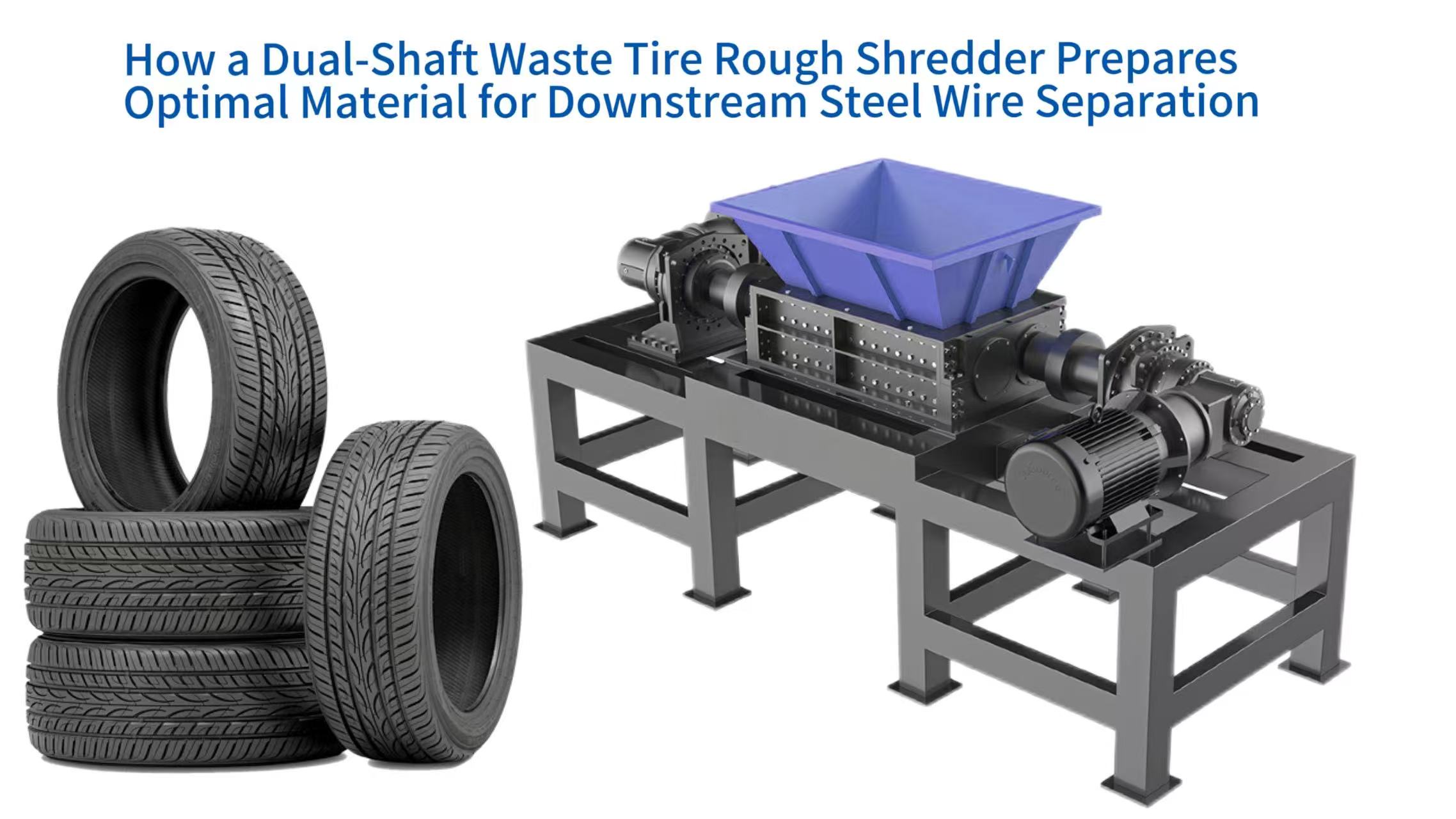
A dual-shaft waste tire rough shredder performs the first critical step in transforming scrap tires into valuable raw materials. This machine converts whole tires into uniformly sized rubber chunks, creating the ideal input for downstream equipment that separates steel wire from rubber. The shredder operates at low rotational speeds while generating very high torque, allowing it to cut through tough tire rubber and steel cord without jamming. Proper material preparation at this stage directly determines how efficiently downstream magnetic separators and steel wire extractors can perform their jobs. This article explains the working principles, machine types, key benefits, material handling capabilities, and maintenance requirements of dual-shaft tire shredders specifically for optimizing steel wire separation.
Tire Recycling Faces Material Preparation Challenges That Dual-Shaft Shredders Solve
Comparison: Traditional Shredders vs Dual-Shaft Shredders
| Equipment Type | Output Uniformity | Wire Exposure | Downtime Risk | Pre-processing Need |
|---|---|---|---|---|
| Hammer Mill | Poor | Very Low | Extreme High | No |
| Single-Shaft Shredder | Medium | Low | High | Yes |
| Dual-Shaft Shredder | Excellent | High | Low | No |
The tire recycling industry struggles with a fundamental problem at the start of every processing line. Whole tires contain a complex composite structure made of high-strength rubber, multiple layers of steel cord, and textile fibers. This combination gives tires exceptional durability but makes them extremely difficult to break down into recyclable components. Traditional processing methods like single-shaft shredders or manual cutting produce inconsistent output sizes. Large chunks of rubber often pass through these systems with steel wires still fully embedded inside them. Downstream equipment such as magnetic separators and wire granulators cannot handle this poorly prepared material efficiently.
A dual-shaft waste tire rough shredder directly addresses this preparation bottleneck through a different operational philosophy. The machine does not attempt to create fine rubber powder in one pass. Instead it focuses on producing consistent rubber chunks roughly the size of a fist or smaller. This primary shredding stage creates what industry professionals call "optimal liberation size" for steel wire. The rubber chunks must be large enough to maintain throughput efficiency but small enough that steel wires become exposed at the cut surfaces. When steel wires protrude from the rubber matrix, downstream magnetic equipment can easily capture them. This careful balance between chunk size and wire exposure represents the true value of a well-configured dual-shaft shredder.
Conventional Shredding Methods Fail to Prepare Material for Wire Separation
Hammer mills operate at high rotational speeds and rely on impact forces to break materials. When applied to tires, these machines generate excessive noise and consume large amounts of energy. The steel cords inside tires tend to wrap around the hammer mill rotor, causing frequent jams and unplanned downtime. Workers must then stop production to cut wrapped wires away from the rotor manually. This maintenance interruption can take several hours and repeats multiple times per week in facilities that process tires with hammer mills. The operational inefficiency makes hammer mills unsuitable for continuous tire recycling operations.
Single-shaft shredders represent another common but problematic approach to tire size reduction. These machines use a single rotating shaft with cutting discs that work against fixed counter knives. While effective for many materials, single-shaft shredders struggle with whole tires because the tire's circular shape and resilience prevent consistent engagement with the cutting system. The shredder may push the tire around the cutting chamber rather than gripping and cutting it. Operators often must pre-cut tires into strips before feeding them into single-shaft machines, adding labor costs and reducing overall throughput. The output material from single-shaft shredders also contains many partially cut sections where steel wires remain fully encapsulated by rubber.
Low-Speed High-Torque Shearing Defines the Dual-Shaft Shredder Working Principle
A dual-shaft waste tire rough shredder contains two parallel shafts fitted with alternating cutter discs and spacers. These two shafts rotate toward each other at low speeds, typically between 30 and 120 revolutions per minute. The cutters on one shaft intermesh with cutters on the opposite shaft, creating a scissors-like shearing action. When a tire enters the cutting chamber, the rotating cutters grab the rubber and pull it down between the shafts. The shear force generated by this intermeshing action cuts through both rubber and steel cord simultaneously. The low rotational speed prevents the machine from flinging material or generating excessive heat.
High torque distinguishes the dual-shaft shredder from other reduction equipment. Each shaft connects to a gearbox and motor system designed to deliver tremendous rotational force at low speeds. This high torque allows the machine to process entire truck tires, including the steel bead wires that form the tire's inner rim. The shredder does not rely on impact or velocity to break materials. Instead it applies steady, powerful cutting force that tears through even the toughest rubber compounds. This operating principle makes dual-shaft shredders highly reliable for continuous, heavy-duty tire processing applications where other machines would stall or break.
Output Size Control Through Screen Meshes Creates Wire-Liberated Rubber Chunks
A screen mesh installed beneath the cutting chamber determines the maximum size of rubber chunks leaving the tire shredder. The shredded material falls through the screen only when the chunks are smaller than the screen openings. Screen hole diameters typically range from 40 millimeters to 120 millimeters for primary tire shredding applications. Choosing the correct screen size requires balancing two competing objectives. A smaller screen opening produces more uniform chunks with better wire exposure but reduces machine throughput. A larger screen opening increases production volume but may leave wires insufficiently exposed for efficient downstream separation.
The ideal output size for steel wire separation falls between 50 millimeters and 80 millimeters. At this size range, the rubber chunks have been cut enough that steel wires become visible at multiple points along each chunk's surface. The wires are not completely free from the rubber, but they are accessible enough for magnetic fields to pull them away. Chunks larger than 80 millimeters often contain wires that remain buried deep inside the rubber, preventing magnetic separation. Chunks smaller than 40 millimeters indicate that the machine is doing more work than necessary, consuming extra energy and generating fine rubber dust that complicates downstream processing.
Cutter and Shaft Design Balances Durability Against Shearing Effectiveness
The cutter discs on a dual-shaft tire shredder experience extreme mechanical stress during normal operation. Each cutter must cut through high-tensile steel cord while also resisting abrasion from the carbon black fillers in tire rubber. Manufacturers produce these cutters from high-alloy tool steels, often with added chromium and molybdenum to enhance hardness and wear resistance. The cutters undergo specialized heat treatment processes that create a very hard outer surface while maintaining a tougher, more impact-resistant core. This combination allows the cutters to stay sharp longer while also resisting breakage when encountering unexpected hard objects embedded in tires.
Cutter arrangement along each shaft follows a carefully engineered pattern. Adjacent cutters are offset from one another, creating a spiral or staggered configuration around the shaft circumference. This arrangement ensures that at any given moment, at least one cutter from each shaft is engaged with the material. The staggered design also generates axial forces that pull tires into the cutting zone rather than pushing them sideways against the chamber walls. Replaceable cutter tips or reversible cutter discs extend the useful life of each cutter component. When one cutting edge becomes dull, an operator can rotate the cutter to expose a fresh edge or replace the worn tip without removing the entire shaft assembly.
Auto-Reverse and Overload Protection Enable Continuous Production Operation
Industrial double shaft tire shredder systems incorporate intelligent control systems that monitor shaft torque in real time. When the machine encounters an overload condition, such as a tire that exceeds the shredder's capacity or a foreign object mixed with the feed material, the control system detects the torque spike instantly. The system then commands the drive motors to reverse direction for a short duration, typically two to three seconds. This reversal backs the material away from the cutting zone and clears the jam condition. After the reverse cycle completes, the shafts resume forward rotation to continue shredding.
The auto-reverse cycle may repeat several times before the control system determines that the jam cannot be cleared automatically. When automatic clearance fails, the system shuts down the shredder and alerts the operator through a visual or audible alarm. This staged response prevents damage to cutters, shafts, and gearboxes while minimizing unnecessary production interruptions. Facilities processing large volumes of mixed tire types benefit significantly from this protection system. A single overload event without auto-reverse could require several hours of manual cleaning, whereas the automatic system resolves most jams within seconds with no operator intervention required.
Different Dual-Shaft Shredder Configurations Match Specific Tire Processing Needs
Dual-shaft tire shredders are not uniform across all applications. Machine configurations vary based on the types of tires being processed, the required output volume, and the specific demands of downstream equipment. Selecting the correct configuration for a given recycling operation requires careful evaluation of these factors. A machine that works perfectly for passenger car tires may fail completely when asked to process off-the-road mining tires. Understanding the available configurations helps buyers avoid costly mismatches between machine capability and processing requirements.
Processing volume targets also influence machine selection. A small tire collection center handling two to three tons per day has different needs than a large regional recycling facility processing twenty tons per hour. The relationship between machine size, power rating, and throughput is not linear. Larger machines generally achieve better efficiency per ton processed, but they also require higher capital investment and more substantial facility infrastructure. Matching machine capacity to expected material flow prevents both underutilization of expensive equipment and bottleneck conditions that limit overall plant output.
Standard Dual-Shaft Shredders Excel at Passenger Car and Light Truck Tires
Standard configuration dual-shaft shredders represent the most common type found in tire recycling operations worldwide. These machines feature shaft lengths between 800 millimeters and 1500 millimeters, powered by electric motors rated between 30 kilowatts and 110 kilowatts. The cutter diameter on standard machines typically measures 350 millimeters to 450 millimeters. This combination provides sufficient torque and cutting force for passenger car tires, light truck tires, and similar sized rubber waste. Standard machines achieve throughput rates between two and eight tons per hour when processing passenger car tires, depending on screen size and motor power.
The economic advantage of standard dual-shaft shredders makes them attractive for most recycling applications. Their initial purchase price is significantly lower than heavy-duty or specialty configurations. Replacement cutters and other wear parts are readily available from multiple suppliers, creating competitive pricing for consumable components. Standard machines also have smaller physical footprints and lower foundation requirements than larger models. Many medium-sized tire recycling operations start with a standard dual-shaft shredder and later add pre-shredding or secondary shredding capacity as their material volumes increase.
Heavy-Duty Dual-Shaft Shredders Handle Truck and Off-The-Road Tires
Heavy-duty dual-shaft shredders incorporate larger components throughout the machine design. Shaft diameters increase to 250 millimeters or more, compared to 150 millimeters on standard machines. Cutter discs are thicker and have larger diameters, often exceeding 500 millimeters. The increased mass of these components allows the machine to withstand the extreme forces generated when cutting through thick truck tire treads and multiple layers of heavy-gauge steel cord. Motor power on heavy-duty machines ranges from 150 kilowatts to 400 kilowatts or more, delivered through high-ratio gearboxes that multiply torque while maintaining low shaft speeds.
These machines frequently include hydraulic ram assist systems that force oversized tires into the cutting zone. Whole truck tires do not feed into a shredder as reliably as smaller passenger car tires. The hydraulic ram pushes the tire steadily downward, preventing it from bouncing or sliding across the top of the cutters. Heavy-duty shredders also feature reinforced cutting chambers with thicker wear liners to resist abrasion from the high-silica compounds used in commercial truck tire treads. Facilities that process significant volumes of truck tires or accept mixed loads containing both truck and passenger tires require heavy-duty machines for reliable operation.
Mobile Dual-Shaft Shredders Enable On-Site Tire Size Reduction
Mobile dual-shaft tire shredders mount the entire machine assembly onto a heavy-duty trailer chassis with road-legal axles and lighting. The power source for mobile units may be an electric motor requiring external power connection, or a diesel engine providing complete operational independence. These machines serve tire collection sites, disaster response operations, and temporary processing projects where installing permanent equipment is not practical. A mobile shredder can travel directly to a location where thousands of illegally dumped tires have accumulated, process them on-site, and then move to the next location without requiring material transport to a central facility.
The reduction in transportation costs drives the economic case for mobile shredding. Whole tires occupy large volumes on trucks, with each standard trailer carrying only 500 to 800 tires before reaching legal weight limits. Shredded tire material occupies roughly 25 to 30 percent of the volume of whole tires, allowing each truck to transport three to four times more material by volume. A mobile shredder processing tires at the collection point creates dense, compact material that loads efficiently onto trailers for transport to final recycling facilities. This approach reduces transportation costs by 60 to 70 percent compared to hauling whole tires.
Machine Sizing Must Match Downstream Wire Separation Equipment Capacity
The upstream shredder and the downstream wire separation equipment must operate at matched production rates. A common and expensive mistake involves installing a very large primary shredder that feeds into an undersized secondary wire separator. In this situation, the wire separator becomes the bottleneck, forcing the entire line to operate at the slower machine's speed. The oversized shredder runs well below its capacity, wasting both capital investment and energy efficiency. The correct approach involves starting with the target output rate of finished rubber product and working backward through each process step to determine required capacities.
Material flow calculations should include a safety margin for variations in tire feed quality and minor equipment downtime. A magnetic separator rated for two tons per hour should receive material from a primary shredder capable of producing 2.2 to 2.5 tons per hour. This excess capacity allows the shredder to feed the separator continuously even during brief periods when the shredder operates at reduced efficiency due to dull cutters or difficult material. The same principle applies to the material handling equipment between machines, including conveyors, elevators, and surge bins. Properly matched equipment capacities create smooth, continuous material flow through the entire processing line.
Dual-Shaft Rough Shredders Deliver Four Core Advantages for Wire Separation
Four Core Advantages of Dual-Shaft Shredders
A dual-shaft tire shredder serves as more than a volume reduction machine within a recycling line. The shredder actively prepares material in ways that make subsequent separation processes more effective and more economical. Four specific advantages emerge when a properly configured dual-shaft shredder feeds into a steel wire separation system. These advantages include improved magnetic capture rates, extended downstream equipment life, enhanced material flow characteristics, and better final product purity. Each advantage contributes directly to the profitability of the tire recycling operation.
These benefits arise from the fundamental characteristics of dual-shaft shredding technology. The low-speed, high-torque shearing action creates cut surfaces where steel wires remain intact rather than being ground into fine dust. Intact wires are far easier to remove magnetically than fragmented wire particles. The consistent chunk size produced by screen-controlled discharge ensures predictable material behavior throughout the remainder of the processing line. Operators who understand these advantages can select shredder configurations and operating parameters that maximize the performance of their entire recycling system.
Maximum Wire Exposure Significantly Improves Magnetic Separation Efficiency
The shearing action of a dual-shaft shredder cuts through rubber and steel cord at the same time. Unlike grinding or hammer milling, which can smear rubber across wire ends and encapsulate them further, shearing creates clean, exposed wire ends at each cut point. A well-prepared rubber chunk may have steel wire protruding from multiple sides of the chunk. When this material passes under an magnetic separator, the exposed wires experience the full force of the magnetic field. The magnet pulls the wires away from the rubber chunks efficiently, leaving rubber that contains very low residual steel content.
Field measurements from tire recycling facilities demonstrate the magnitude of this improvement. Material prepared by dual-shaft shredders achieves steel removal rates of 98 to 99.5 percent in a single pass through a properly configured magnetic separator. Material prepared by single-shaft shredders or hammer mills typically achieves only 85 to 92 percent steel removal under identical magnetic separation conditions. The difference of 7 to 14 percentage points represents significant economic value. For a facility processing 10,000 tons of tires annually, that difference could mean 100 to 200 additional tons of steel recovered or, conversely, that much steel remaining in rubber product and degrading its market value.
Downstream Equipment Protection Reduces Maintenance Costs Substantially
Secondary shredders, fine grinders, and wire separation equipment contain precision components that are expensive to replace. The cutting elements on a secondary granulator may cost several thousand dollars per set and require many hours of labor to change. When oversized chunks or wire-dense material enters this equipment from a poorly performing primary shredder, wear accelerates dramatically. The fine cutting edges on secondary equipment are not designed to handle the impact forces created by large rubber chunks or the abrasion from high concentrations of exposed wire.
A dual-shaft primary shredder equipped with properly sized screen holes acts as a protective gatekeeper for downstream equipment. Only material that passes through the screen reaches the next stage of processing. This screening function eliminates the oversized chunks that would otherwise damage secondary equipment cutters. The consistent material size also allows downstream equipment to operate at optimal settings without constant adjustment to accommodate feed variation. Facilities that upgrade from inadequate primary shredding to proper dual-shaft shredding commonly report that secondary equipment cutter life doubles or triples, reducing annual maintenance expenses by tens of thousands of dollars.
Improved Material Flow Prevents Production Line Blockages and Jams
Irregularly shaped material with protruding wires causes constant problems in automated material handling systems. Long wire strands catch on conveyor belt edges, transfer points, and chute walls. These strands accumulate over time, eventually forming tangles that block material flow completely. Clearing these blockages requires production stoppages and manual labor to cut away the wire nests. Facilities processing poorly prepared tire material may spend 10 to 20 percent of operating time dealing with material handling blockages rather than producing finished product.
Uniform rubber chunks from a dual-shaft shredder flow through handling equipment like a granular material rather than like a tangled mass. The chunks are small enough to pass freely through chutes and hoppers without bridging. Exposed wires on each chunk are short and oriented in multiple directions, preventing them from linking together into long tangles. Conveyors transfer the material smoothly, and elevators lift it without spillage. The reduction in handling-related downtime allows facilities to achieve much higher overall equipment effectiveness. A well-designed line with proper primary shredding can sustain 85 to 90 percent uptime compared to 60 to 70 percent for lines with poor material preparation.
Consistent Feed Material Enables Multi-Stage Purification Processes
High-purity rubber powder commands premium prices in markets such as automotive parts manufacturing and sports surfacing. Achieving this purity requires multiple stages of size reduction and separation. Each stage expects a specific feed material characteristics. The primary shredder must produce a consistent output that serves as a reliable input to the secondary granulator. If the primary output varies widely in size or wire exposure, the secondary equipment cannot be optimized for any single condition. The result is either conservative operation that sacrifices throughput or frequent adjustments that disrupt production flow.
A dual-shaft shredder with appropriate screen sizing creates a consistent foundation for the entire multi-stage process. The secondary granulator receives material that falls within a predictable size range, allowing its screen and cutter configuration to be fixed for optimal performance. The granulator's output then feeds into a tertiary grinding stage that further reduces particle size while liberating any remaining fine wire fragments. Each stage builds on the consistency provided by the previous stage. Without the initial consistency from a proper primary shredder, achieving high-purity rubber powder becomes extremely difficult regardless of the sophistication of downstream equipment.
Dual-Shaft Tire Shredders Process Multiple Tire Types With Specific Adjustments
Processing Parameters for Different Tire Types
| Tire Type | Weight | Steel Content | Suitable Shredder | Pre-cut Needed |
|---|---|---|---|---|
| Passenger Car Tires | 7-12kg | 15-20% | Standard | No |
| Truck/Bus Tires | 50-70kg | 25-35% | Heavy-Duty | No |
| OTR Tires | >3500kg | >40% | Heavy-Duty | Yes |
The versatility of dual-shaft shredders allows a single machine to process various tire types, but each tire category requires specific operational considerations. Passenger car tires, truck tires, and off-the-road tires differ significantly in rubber hardness, steel content, and physical dimensions. A shredder that processes passenger tires efficiently may require different cutter configurations, screen sizes, or drive settings when switched to truck tires. Understanding these differences helps operators maximize throughput and minimize wear for each material type they process.
Many tire recycling facilities accept mixed loads containing multiple tire categories. The shredder operator must decide whether to process the entire mixture together or separate tires by category for dedicated processing runs. Processing mixed loads simplifies material handling but may reduce overall efficiency because the shredder cannot be optimized for any single tire type. Separating tires by category requires additional labor or equipment for sorting but allows the shredder to run at higher efficiency for each category. The best choice depends on the specific mix of materials and the facility's labor and equipment resources.
Passenger Car and Light Truck Tires Process Efficiently on Standard Machines
Passenger car tires constitute the majority of scrap tire volume in most recycling facilities. These tires typically weigh between 7 and 12 kilograms each and have outside diameters ranging from 550 millimeters to 750 millimeters. The steel content of passenger tires averages 15 to 20 percent by weight, distributed through the bead wires at the rim and the steel belt plies under the tread. Standard dual-shaft shredders process these tires readily without pre-shredding or special preparation. The tire's resilience helps it engage with the cutters effectively as the machine pulls the material downward through the cutting zone.
Maintenance priorities for passenger tire processing focus on cutter sharpness and gap management. The relatively fine steel wires in passenger tires can slip between cutters if the gap becomes excessive. When cutters wear and the gap widens, the machine begins to tear rather than cut the steel wires. The resulting output contains long, unsevered wires that hinder downstream separation. Operators processing primarily passenger tires should establish a cutter inspection schedule at shorter intervals than the cutter manufacturer recommends, replacing or rotating cutters before significant wire elongation appears in the output material.
Truck and Bus Tires Require Heavy-Duty Shredder Configurations
Truck tires present a substantially greater challenge to shredding equipment than passenger tires. A single truck tire weighs 50 to 70 kilograms and contains 25 to 35 percent steel by weight. The steel cords in truck tires are thicker than passenger tire cords, and the bead wires are much larger in diameter. The tread rubber of truck tires contains higher carbon black loading for wear resistance, making it harder and more abrasive. Processing truck tires on a standard dual-shaft shredder will accelerate cutter wear dramatically and may cause frequent overload conditions as the machine struggles with the heavier material.
Heavy-duty dual-shaft shredders address these challenges through several design enhancements. The hydraulic ram feeder forces truck tires into the cutting zone, preventing them from bouncing on top of the cutters. Larger diameter shafts with thicker cutter discs provide the necessary strength to withstand the higher torque loads. Some heavy-duty machines incorporate a two-stage cutting chamber where an initial set of coarse cutters reduces the tire size before finer cutters complete the shredding. Operators processing significant volumes of truck tires should expect cutter replacement intervals to be 30 to 50 percent shorter than when processing passenger tires, with correspondingly higher operating costs per ton.
Off-The-Road Tires Require Pre-Cutting Before Shredding
Off-the-road tires from mining and heavy construction equipment represent the most difficult tire shredding application. These tires can exceed three meters in diameter and weigh more than 3,500 kilograms each. The sidewalls and tread are extremely thick, often exceeding 100 millimeters. Steel cord content reaches 40 percent or more by weight, with cord diameters much larger than those found in truck tires. No standard or even heavy-duty dual-shaft shredder can accept a whole OTR tire directly through its feed hopper. The physical dimensions alone prevent direct feeding, regardless of the machine's power or torque capabilities.
The solution for OTR tire processing involves a pre-cutting step before shredding. Hydraulic shears or specialized tire guillotines cut the massive tire into sections small enough to feed into a heavy-duty shredder. The pre-cutting process typically divides the tire into quarters or eighths, with each piece weighing several hundred kilograms. These pieces then feed into the shredder for size reduction. Some facilities use multiple shredding stages for OTR tires, with a very coarse primary shredder followed by a secondary unit that produces the desired output size. The high value of steel and rubber recovered from OTR tires justifies this additional processing complexity despite the higher operating costs.
Steel Tire and Semi-Steel Tire Processing Differences Affect Machine Setup
Not all tires contain the same type of steel reinforcement structure. Steel radial tires, common on trucks and passenger cars, use steel cords in both the belt package and the carcass. Semi-steel tires use steel only in the belt package, with polyester or other textile cords forming the carcass structure. The textile cords in semi-steel tires do not conduct electricity and are not magnetic, but they add toughness to the rubber. When shredding semi-steel tires, the cutters must cut through both steel and textile reinforcement materials, each with different mechanical properties.
The presence of textile cords affects how the shredded material behaves after exiting the shredder. Textile fibers do not separate magnetically and can remain in the rubber product as contaminants. Facilities processing semi-steel tires often add air classification or screening steps to remove these fibers after shredding. The cutter wear pattern when processing semi-steel tires differs from all-steel tires as well. The textile material is abrasive and accelerates dulling of the cutter edges. Operators should track the proportion of semi-steel versus steel tires in their feed stream and adjust both maintenance schedules and downstream processing equipment accordingly.
Regular Maintenance Ensures Consistent Material Preparation for Wire Separation
A dual-shaft tire shredder operates under extreme conditions that cause progressive wear on many components. The cutters lose sharpness over time, the screen holes enlarge, bearings experience fatigue, and seals degrade. Without systematic maintenance, this wear leads to deteriorating output quality before any catastrophic failure occurs. The first sign of trouble often appears downstream, where wire separation efficiency declines or secondary equipment experiences increased wear. Proactive maintenance based on operating hours and material tonnage prevents these quality problems and maintains consistent output characteristics.
Establishing a maintenance program requires baseline measurements of output quality when the machine is new or freshly rebuilt. Operators should periodically take samples of shredded material and measure key characteristics including chunk size distribution, wire exposure length, and the proportion of oversized material. Trending these measurements over time reveals when maintenance interventions are needed. Waiting for obvious signs of trouble, such as visible output deterioration or frequent jams, means the machine has already been producing substandard material for some period.
Blade Wear Management Through Scheduled Inspection and Rotation Cycles
The cutters on a dual-shaft shredder wear primarily at the cutting edge and corner areas that contact the material first. As wear progresses, the effective cutting gap between opposing cutters increases. A gap that has grown too large allows the shredder to push material through without cutting it cleanly. The output contains partially separated chunks connected by uncut steel wire, creating long strands that tangle in downstream equipment. Regular inspection of cutter condition, ideally every 200 to 400 operating hours depending on material abrasiveness, allows operators to replace or rotate cutters before output quality degrades significantly.
Many dual-shaft shredders use reversible or indexable cutters that provide multiple usable edges. A cutter may have four edges that can each serve as the primary cutting edge before the cutter needs replacement. Rotating cutters to expose a fresh edge restores the original cutting gap without purchasing new components. Keeping detailed records of cutter rotation and total tonnage processed allows operators to predict when each set of edges will need attention. This predictive approach prevents both premature rotation that wastes usable cutter life and delayed rotation that allows output quality to decline.
MSW Technology brings fifteen years of specialized experience in industrial shredding equipment to every tire recycling application. The company's engineering team understands how cutter geometry, material selection, and heat treatment parameters affect shredder performance for specific feed materials. This deep knowledge base informs both equipment design and customer support, helping operators select the optimal cutter configurations for their specific tire types and processing goals.
Screen Inspection and Replacement Protocols Maintain Output Consistency
The screen mesh at the bottom of the shredder cutting chamber experiences continuous abrasion from rubber and wire passing through its openings. Over time, the screen holes enlarge, particularly at the edges where material flow concentrates. Enlarged holes allow oversized chunks to pass through to downstream equipment. A screen with holes that have worn from 60 millimeters to 75 millimeters may let through chunks that are much larger than the process design allows. These oversized chunks can jam downstream conveyors or damage secondary shredder components.
Screen replacement should occur when the average hole size has increased by 10 to 15 percent beyond the nominal specification. Operators can monitor screen wear by periodically measuring hole diameters at multiple locations across the screen surface. Wear is rarely uniform, with the center of the screen typically wearing faster than the edges. Replacing screens before they become excessively worn maintains consistent output quality and protects downstream equipment. Some facilities stock spare screens and perform replacement during scheduled cutter rotation to minimize downtime for maintenance activities.
The relationship between screen condition and downstream wire separation efficiency is often underestimated. A worn screen allowing oversized chunks to pass will reduce magnetic separator performance because the larger chunks contain more encapsulated wire. MSW Technology's fifteen years of industry experience has demonstrated that facilities implementing systematic screen inspection programs achieve 5 to 10 percent higher steel recovery rates compared to those replacing screens only when obvious failure occurs.
Bearing, Gearbox, and Hydraulic System Preventive Maintenance
The bearings supporting the shredder shafts carry tremendous radial and axial loads during operation. Each bearing must maintain precise alignment to keep the cutter gaps uniform across the full shaft length. Bearing failure typically begins with lubrication degradation, followed by increased operating temperature, then progressive surface damage on races and rolling elements. Regular lubrication with the manufacturer-specified grease at appropriate intervals represents the single most effective preventive maintenance action for bearing life. Operators should also monitor bearing temperatures using infrared thermometers or permanently installed sensors, noting any trends toward higher operating temperatures.
Gearbox maintenance focuses on oil quality and seal integrity. Gearbox oil loses its lubricating properties over time as it absorbs moisture and accumulates microscopic wear particles from the gears. Oil analysis programs can detect these changes and predict optimal oil change intervals. Seal failure allows contamination to enter the gearbox or oil to leak out, either condition leading to premature gear wear. Shredders with hydraulic ram systems require additional attention to hydraulic oil cleanliness, filter condition, and hose integrity. Contaminated hydraulic oil causes valve sticking and pump wear, leading to erratic ram operation or complete system failure.
MSW Technology has developed comprehensive maintenance protocols based on fifteen years of field experience across hundreds of shredder installations. These protocols specify inspection frequencies, lubrication schedules, and wear component replacement intervals tailored to specific operating conditions. Facilities following these protocols consistently achieve longer equipment life and more predictable maintenance costs compared to those using generic manufacturer recommendations.
Intelligent Control Systems Enable Predictive Maintenance Strategies
Modern dual-shaft shredders incorporate sensors that continuously monitor operating parameters including motor current, shaft torque, bearing temperature, and vibration levels. The machine's control system logs this data and can detect patterns that precede component failures. For example, a gradual increase in average motor current for a given material throughput suggests that cutters are dulling and require more power to achieve the same output. A rising trend in bearing vibration amplitude indicates progressive bearing wear that will eventually require replacement. These early warning signals allow maintenance to be scheduled at convenient times rather than in response to unexpected breakdowns.
The economic benefits of predictive maintenance are substantial for tire recycling operations. An unplanned shredder failure may require two to three days for repairs, during which the entire processing line must remain idle. The lost production revenue during this downtime often exceeds the cost of the repair itself. Predictive maintenance reduces unplanned failures by 50 to 70 percent, converting most maintenance activities from emergency responses to scheduled events. The control system data also helps operators optimize cutter rotation intervals by correlating motor current trends with actual cutter condition measurements, maximizing the useful life of each cutter edge before replacement.
MSW Technology integrates advanced control features into its shredder product line, drawing on fifteen years of continuous development and field feedback. These systems provide operators with clear, actionable maintenance recommendations rather than raw data requiring interpretation. The result is higher equipment availability, lower operating costs, and more consistent output quality for tire recycling facilities of all sizes.