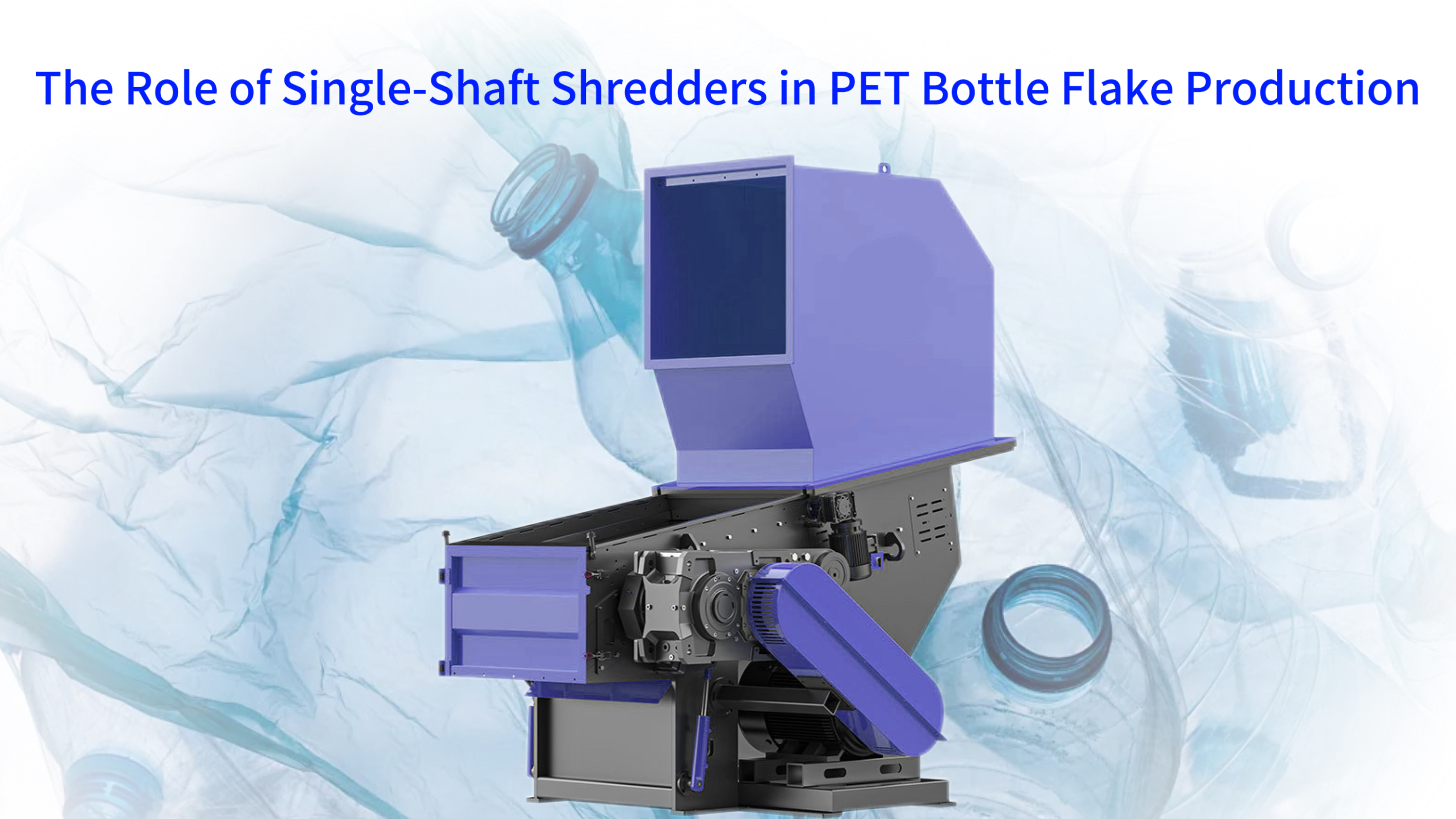
Core Process of PET Bottle to High-Quality Flake Production
The transformation of post-consumer PET bottles into high-quality recycled flake represents a critical process within the modern circular economy. Achieving the stringent purity and consistency standards required for high-value applications, such as food-contact rPET, demands specialized preprocessing technology. The single-shaft solid waste shredder has emerged as the engineered solution for this precise task. This examination details the operational principles of this machinery, its indispensable function within an integrated recycling line, and the technical advantages it provides over alternative shredding methods for optimizing flake size, yield, and material integrity.
Fundamental Challenges in PET Bottle Recycling and Technological Responses
PET Bottle Recycling: Core Challenges & Targeted Technical Responses
| Core Challenge | Negative Impacts | Targeted Technical Response |
|---|---|---|
| Contaminants (Labels/Adhesives/Caps/Liquids) | Impurity embedding, reduced flake purity, failed food-grade certification | Precision shear-cutting, liberated contaminant separation |
| Uncontrolled Particle Size | Uneven washing, fines loss (yield reduction), poor downstream separation | Integrated sizing screen, fixed maximum flake dimension |
| Thermal Degradation (Frictional Heat) | Flake yellowing, reduced IV, limited high-value applications | Low-speed (≤100RPM) high-torque rotor, minimal friction design |
| Irregular Bottle Shape/Volume | Automated handling issues, uneven feeding, machine jamming | Hydraulic ram adaptive feeding, consistent material flow |
PET Glass Transition Temperature
70 - 80°C
Ideal Precision Flake Size
10 - 20mm
PET Specific Gravity
~1.38
The recycling journey for polyethylene terephthalate containers is fraught with material complexities that directly influence the economic viability of the operation. Contaminants such as labels, adhesives, caps, and residual liquids are persistently present. Inconsistent bottle shapes and volumes further complicate automated handling. The primary mechanical size reduction step sets the definitive parameters for all subsequent cleaning and refining stages. An inefficient shredding process can lead to inadequate impurity liberation, excessive fines generation, or thermal degradation of the polymer.
Conventional crushing or hammering methods often prove unsatisfactory for this application. These approaches may embed contaminants deeper into the material matrix or generate uncontrolled particle sizes. Such outcomes severely hinder the efficiency of downstream washing, flotation, and drying systems. The industry's shift towards precision shredding addresses these specific challenges. A solid waste single shaft shredder is fundamentally designed to execute a controlled cutting action. This design philosophy prioritizes the production of uniform, cleanly cut flakes over mere volume reduction, establishing the essential foundation for advanced material recovery.
The Distinctive Material Properties of PET
Polyethylene terephthalate possesses a specific set of physical characteristics that dictate optimal processing conditions. The material exhibits notable toughness and semi-crystalline structure, granting it durability but also presenting a challenge for clean fracture. Its glass transition temperature, approximately 70-80°C, is a crucial thermal boundary. Mechanical processing that generates excessive frictional heat risks softening the polymer. This softening leads to problematic melting and smearing on equipment surfaces, a phenomenon known as bridging, and causes undesirable yellowing of the flake, diminishing its market value for clear pellet production.
Defining the Objective of Precision Shredding
The core objective within a PET bottle recycling line transcends basic fragmentation. The process aims for precision shredding, a targeted methodology yielding consistent flake geometry. Ideal flakes are characterized by controlled dimensions, typically ranging from 10mm to 20mm, with cleanly sheared edges. This specific form factor maximizes the surface area for effective contaminant removal during washing while minimizing the creation of fine dust or elongated strands. The process must efficiently separate the PET from non-PET components, preparing a feedstock that allows downstream separation technologies to function at their highest possible efficiency and recovery rate.
The Positioning of Single-Shaft Technology in the Process Chain
In a sophisticated PET recycling plant, the single-shaft shredder typically occupies the primary or intermediate size reduction position. It follows initial sorting and ballistic separation stages where bulk contaminants are removed. Its role is to receive baled or loose whole bottles and transform them into a defined, manageable feedstock. This transformation is not the final step but a pivotal preparation. The quality of its output directly enables the efficiency of the hot wash, caustic sink-float separation, and final plastic shredder granulation stages that follow, creating a direct correlation between shredder performance and overall plant yield.
The Impact Chain on Final Pellet Quality
The influence of the initial shredding operation propagates through the entire recycling chain. Flakes with inconsistent size cause uneven heating and washing, leading to residual contaminants. Excessively small fines are often lost in water treatment systems, reducing overall yield. Flakes with heat-damaged surfaces exhibit lower intrinsic viscosity, a key polymer property. This degradation limits the applications for the resulting recycled pellets, often preventing their use in demanding applications like new bottle production and consequently reducing their financial value in a market increasingly segmented by quality tiers.
Core Technical Advantages of the Single-Shaft Shredder Mechanism
Single-Shaft Shredder: Core Technical Parameters & Shear-Cutting Principle
Key Operational & Design Parameters
| Parameter | Specifications / Value |
|---|---|
| Rotor Rotational Speed | ≤ 100 RPM (Low-Speed, High-Torque) |
| Cutter Hardness | 58 - 62 HRC (Alloy Steel with Wear Coating) |
| Rotor-Counter Knife Clearance | 0.3mm - 1mm (Precision Calibrated) |
| Processing Throughput | 1 - 10+ Tons per Hour (Model Dependent) |
| Sizing Screen Aperture | 10 - 20mm (Matched to Ideal Flake Size) |
Controlled Flake Size
Guaranteed by sizing screen
Minimal Heat Generation
Low-speed rotor design
Clean Shear Cuts
Scissor-like rotor-bed knife action
Stable Feeding
Hydraulic ram adaptive system
Low Fines Generation
No random fracturing
The operational superiority of the single-shaft shredder for PET processing stems from its fundamental engineering principles. Unlike impact-based systems, it employs a shearing and tearing mechanism facilitated by a high-torque, low-speed rotating rotor. This rotor, equipped with hardened rotary cutters, interacts with a fixed bed knife installed within the cutting chamber. The geometry creates a scissor-like action that cleanly slices through the plastic material. This method requires significant mechanical force but applies it in a controlled, localized manner, minimizing random fracturing and the associated uncontrolled particle generation.
A defining feature of this system is the integrated sizing screen. Positioned at the periphery or bottom of the cutting chamber, this screen features precisely machined apertures. Material must be reduced to a size smaller than these apertures before it can exit the chamber. This mechanical guarantee ensures absolute control over the maximum flake dimension, providing batch-to-batch consistency critical for automated downstream processing. The entire process operates with a deliberate rotational speed, often below 100 RPM, which is a strategic parameter for managing energy input and frictional heat generation.
The Shear-Cutting Action of Rotor and Counter Knife
The cutting process is a direct function of the interaction between the moving and stationary cutting elements. As the hydraulic ram feeds material into the chamber, the rotating hooks or blades engage the bottles. They draw the material against the precisely adjusted counter knife. The resulting shear force cleanly cuts the PET, promoting the separation of bottle bodies from labels and caps. This deliberate cutting, as opposed to random pulverizing, produces flakes with a morphology that is optimal for water-based cleaning and aerodynamic separation systems, enhancing the overall purity of the final product stream.
Adaptive Feeding Systems for Low-Density Material
Efficient processing of lightweight, bulky PET bottles presents a unique feeding challenge. Modern single-shaft shredders integrate specialized feeding mechanisms to overcome this. A hydraulic ram is commonly employed. This ram cyclically compacts the material in the hopper, pushing a consistent volume into the cutting zone. This action eliminates bridging and ensures a steady, dense flow of material onto the rotor. Consistent feeding is paramount for maintaining stable motor amperage, preventing uneven wear on cutting components, and achieving the designed throughput capacity of the machine, which can range from 1 to over 10 tons per hour depending on model size and configuration.
The Critical Role of Low Rotational Speed
The operational speed of the rotor is a calibrated variable with multiple beneficial effects. Low rotational speed directly correlates to reduced friction and kinetic energy conversion into heat. For temperature-sensitive polymers like PET, this is a fundamental advantage. It prevents the localized thermal degradation that causes yellowing and polymer chain scission. Furthermore, lower speeds reduce the abrasive wear on cutting tips, extending service intervals. From an energy consumption perspective, a high-torque, low-speed drive system often proves more efficient for cutting dense materials than high-speed, low-torque alternatives, contributing to a lower operational cost per ton of processed material.
Controlled Discharge and Sizing via Screen Meshes
The final sizing of the PET flake is dictated by the perforated screen enclosing the rotor. Screens are manufactured with specific hole diameters and patterns, typically circular or slotted. The selected screen aperture defines the maximum two-dimensional size of the discharged flake. Operators can change screens to produce different flake specifications for varied end-market requirements. The mechanical necessity for material to pass through these holes ensures a uniform output. This consistency is vital for the efficiency of subsequent eddy current separator and optical sorting units, which rely on predictable particle dynamics for accurate separation of non-ferrous metals and different plastic types.
System Integration within a Complete PET Flake Production Line
Full System Integration of PET Flake Production Line
Key Interdependent Nodes (Shredder & Up/Downstream)
| Process Node | Core Equipment/Technology | Critical Interdependence with Shredder |
|---|---|---|
| Upstream: Pre-Sort | Overband magnet, metal detector | Removes ferrous/metallic contaminants to protect shredder cutting components |
| Core: Shredding | Single-shaft shredder (PLC/HMI controlled) | Consistent flake size (10-20mm) enables optimal efficiency of all downstream processes |
| Downstream: Hot Wash | Caustic wash bath, agitation system | Uniform flake surface area ensures even heat/chemical reaction for contaminant removal |
| Downstream: Separation | Sink-float tank, eddy current separator | Predictable flake geometry guarantees stable buoyancy/particle dynamics for pure separation |
| Automation | PLC/HMI control panel, sensor system | Real-time monitoring (amperage/pressure/temperature) syncs feed rate and prevents jamming |
The single-shaft shredder functions as the central preprocessing unit within a coordinated production system. Its performance is interdependent with upstream preparation and downstream refinement stages. The line begins with feedstock reception, where bales of PET bottles are broken open. An initial manual or automated pre-sort removes large contaminants before a conveyor system transports the bottles to the shredder infeed. This stage may include a overband magnet to extract ferrous metals, protecting the shredder's cutting chamber from damaging metallic objects which could include bottle caps or small bits of wire.
Following size reduction, the shredded material enters a complex cleaning and separation circuit. The consistent flake size produced by the single-shaft shredder is essential here. Flakes are conveyed into a hot caustic wash bath, where labels and adhesives are loosened. The uniform size allows for effective agitation and separation. In the sink-float tank, where material separation occurs by density, consistent flake geometry ensures predictable buoyancy, leading to a pure PET sink fraction. This integrated approach, where the shredder's output is engineered for the next stage, exemplifies the system thinking required for modern recycling, a principle applied by engineering firms like MSW Technology, which leverages fifteen years of experience in designing such synergistic material recovery facilities.
Preprocessing and Infeed Logistics
Effective shredding requires consistent and contamination-controlled infeed. Conveyor systems are designed to meter the flow of whole bottles into the shredder's hopper. Feed rate is often synchronized with the shredder's motor load to prevent overfeeding and potential jamming. Some systems incorporate detection devices, such as metal detectors, to pause feeding and alert operators if a non-processable object is detected. This level of control in the infeed stage maximizes the shredder's operational uptime and protects its internal components from catastrophic damage, contributing directly to the plant's overall equipment effectiveness and annual production volume.
Material Flow Through the Cutting Chamber
Inside the reinforced cutting chamber, the interaction between material and machine is intense but orderly. The rotating cutter hooks seize the bottles, tearing and shearing them against the counter knife. The design of the cutter profile influences the cutting efficiency and the tendency to wrap long materials. For PET bottles, hook-style cutters are often preferred as they pull material in aggressively. The hydraulic ram's push force works in concert with the rotor's pull, creating a dynamic that ensures complete material engagement. Processed material that meets the size requirement exits through the screen, while oversized pieces remain in the chamber for further reduction, a cycle continuing until all feedstock is converted.
Linkage to Washing and Flotation Separation
The discharge from the shredder, now a mixture of PET flakes, liberated labels (mostly PVC or PE), and residual cap fragments, is pneumatically or mechanically conveyed to the wet processing section. The uniformity of the flake is critical in the first hot wash stage. Consistent surface area allows for even heat transfer and chemical reaction with the washing agent. In the subsequent density separation tank, the hydrodynamic behavior of each particle determines its trajectory. PET, with a specific gravity around 1.38, sinks, while polyolefin caps and labels float. Uniform particle size distribution minimizes the fraction of material that might report to the wrong stream due to size-related drag forces, thereby increasing the purity of both output fractions.
Automation and Process Control Integration
Contemporary industrial shredders are governed by sophisticated Programmable Logic Controller systems. These control panel PLC HMI units monitor key operational parameters in real-time. Motor amperage, hydraulic pressure, bearing temperature, and rotor speed are constantly tracked. The system can be programmed to automatically reverse the rotor direction if a jam is detected by a sudden spike in amperage, clearing the obstruction without manual intervention. This level of automation not only safeguards the equipment but also generates valuable operational data. This data facilitates predictive maintenance scheduling and provides insights for optimizing throughput and energy use across the entire production line.
Performance Optimization for Maximizing Flake Quality and Operational Economy
Performance Optimization: Key Parameters & Operational Cost Impact
Critical Tuning Parameters (Optimal Range & Impact)
| Parameter | Optimal Range | Over/Under Adjustment Impact | Optimization Outcome |
|---|---|---|---|
| Rotor-Counter Knife Clearance | 0.3mm - 1mm | Wide: Stringy flakes, wrapping; Narrow: Metal wear, excess heat | Clean shear cuts, minimal heat, reduced component wear |
| Sizing Screen Aperture | 10mm - 20mm | Small: Fines generation, yield loss; Large: Uneven washing | Guaranteed flake size, maximum washing efficiency, no excess fines |
| Cutter Hardness | 58 - 62 HRC | Low: Rapid dulling, high energy use; Over-hard: Brittle, chipping | Long tool life, consistent cutting force, reduced energy consumption |
| Rotor Speed | ≤ 100 RPM | High: Frictional heat, PET degradation; Too low: Low throughput | Minimal thermal degradation, stable throughput, low energy/ton |
Unoptimized Operation (Dull Cutters / Poor Clearance)
Higher energy consumption (measurable percentage increase)
Increased fines generation → yield loss (water treatment loss)
Accelerated component wear → higher maintenance cost
PET thermal degradation → lower flake value (non-food grade)
Machine jamming → unplanned downtime → production loss
Optimized Operation (Preventative Maintenance / Precision Tuning)
Low energy consumption (motor at designed load efficiency)
Minimal fines → maximum yield retention
Extended tool/service intervals → lower maintenance cost
High-purity, undamaged flake → food-grade eligibility (higher value)
Predictive maintenance → 100% planned downtime → maximum uptime
Sustaining peak performance from a single-shaft shredder in PET applications requires a disciplined approach to operational parameters and maintenance. The selection and management of the cutting tools are paramount. Blades are manufactured from specialized alloy steels, often hardened to between 58-62 HRC, and may feature wear-resistant coatings like tungsten carbide tips. The geometry of the hook or blade influences cutting force and material flow. A sharp, correctly profiled cutter produces clean cuts with minimal energy expenditure; a dull cutter tears the material, increasing fines, heat, and power consumption, which can raise energy costs by a measurable percentage.
Another critical adjustable parameter is the clearance between the rotor tip and the counter knife. This gap, typically set between 0.3mm and 1mm, must be meticulously maintained. An excessively wide gap results in poor shearing, causing the machine to pull and stretch the PET instead of cutting it. This leads to long, stringy flakes that can wrap around shafts and cause blockages. A gap that is too narrow increases metal-to-metal contact, accelerating wear and generating excessive heat. Regular inspection and adjustment of this clearance, along with systematic screen inspection, form the cornerstone of preventative maintenance for these machines, a protocol refined over a decade and a half of field operation by service teams at MSW Technology.
Strategic Tooling Selection and Management
The cutting elements are consumable components with a direct impact on process economics. Tool material choice balances hardness, toughness, and corrosion resistance. D2 tool steel offers a strong balance, while more advanced powders metallurgy steels provide longer life in high-abrasion environments. The cutting edge profile is equally important. A hook angle optimized for PET will cleanly engage and cut without excessive wrapping. Implementing a scheduled rotation and sharpening program for the cutters maintains consistent cutting force and product quality. Monitoring the power draw of the main motor provides an indirect indicator of tool sharpness, as dull tools require increased energy to process the same amount of material.
Synchronization of Clearance and Screen Selection
Optimization requires viewing the knife gap and screen aperture as a coupled system. The gap setting determines the cutting efficiency and the initial particle size distribution produced by the direct shear action. The screen then acts as a final sizing gate. For a target flake size of 12mm, a screen with 12mm holes is used, but the knife gap must be adjusted to ensure the primary cuts produce fragments readily passable through this screen. An improper match leads to prolonged recirculation of oversize material within the chamber, increasing residence time, mechanical wear, and thermal load on the polymer. Empirical data from production runs is used to establish the ideal pairing for a given feedstock blend and desired output specification.
Mitigation of Metallic and Inert Contamination
Protecting the flake stream from metal contamination is a non-negotiable requirement for food-grade recycling. While pre-shredder magnets remove ferrous metals, non-ferrous metals like aluminum from bottle caps require additional measures. An eddy current separator placed after the shredder effectively removes these metals. Furthermore, routine inspection and cleaning of the cutting chamber is necessary to remove any embedded foreign debris that could gradually contaminate the flake stream. This holistic approach to contamination control, spanning from infeed to final product, ensures the output meets the stringent purity standards demanded by pelletizers producing rPET for sensitive applications.
Energy and Operational Cost Efficiency Strategies
The total cost of ownership for a shredding system extends beyond the initial capital investment. Energy consumption constitutes a major ongoing expense. Selecting a drive system with a high-efficiency motor and properly sized power unit is the first step. Operational practices significantly influence energy use. Maintaining sharp cutters, correct blade gaps, and an optimal feed rate keeps the motor operating near its designed load efficiency point. Preventing unplanned downtime through predictive maintenance—such as vibration analysis on bearings and regular hydraulic fluid checks—avoids costly production halts and emergency repairs. These systematic practices maximize throughput per unit of energy consumed and per unit of maintenance dollar spent.
Comparative Analysis with Alternative Shredding Technologies
Shredding Technology Comparison & PET Recycling Selection Logic
Core Technology Differences (Mechanism & Output)
| Technology | Core Mechanism | PET Output Characteristics |
|---|---|---|
| Single-Shaft Shredder | Scissor-like shear (rotor + fixed bed knife), low-speed high-torque | Uniform 10-20mm flakes, clean cuts, minimal fines/heat |
| Double-Shaft Shredder | Intermeshing rotors, shear/tension/compression, open chamber | Ragged flakes, wide size distribution, high throughput (mixed waste) |
| Granulator/Fine Grinder | High-speed cutting, tight sizing screen, fine granulation | Very fine particles, high fines generation, heat risk |
PET Recycling Technology Selection Logic (Based on Final Product)
| Final Product Requirement | Recommended Technology | Key Selection Criterion | Economic Justification |
|---|---|---|---|
| High-purity rPET flake (food-grade/bottle-to-bottle) | Single-Shaft Shredder | Uniform flake, minimal fines, heat control, contaminant liberation | Higher flake value (food-grade tier), maximum yield retention |
| Low-purity mixed plastic (lumber/non-critical applications) | Double-Shaft Shredder | High throughput, coarse reduction, heterogeneous material handling | Lower capital cost, high volume processing for low-value feedstock |
| Pellet-ready feedstock (direct extrusion) | Single-Shaft + Granulator | Wash-optimal flake → post-drying fine granulation | Separated processes = optimal quality for both washing and pelletizing |
The selection of a shredder for PET recycling is a technical decision with long-term operational consequences. Different shredder architectures employ distinct size reduction mechanisms, each yielding different material characteristics. The single-shaft shear shredder is specifically engineered for producing a defined, coarse output. In contrast, a solid waste double shaft shredder utilizes two intermeshing, counter-rotating shafts to tear and stretch material. This method is highly effective for high-volume, coarse reduction of mixed or bulky waste but typically produces a more ragged, less uniform particle shape compared to the clean shear of a single-shaft unit, which can be a disadvantage for advanced plastic washing lines.
For applications requiring very fine granulation, such as producing feedstock for direct extrusion, a four-shaft shredder or a granulator might be considered. These machines often employ a scissor-cut mechanism between two pairs of shafts or between rotating and bed knives, followed by a tight sizing screen. However, for the specific purpose of producing washed PET flake, excessive fines are detrimental. They are lost in process water, reducing yield, and can contaminate other material streams. Therefore, the single-shaft shredder, often followed by a dedicated washing and drying process before final granulation, represents the most efficient and yield-preserving pathway for bottle-to-flake production.
Single-Shaft versus Dual-Shaft Mechanisms
The fundamental difference lies in the application of force. A single-shaft machine relies on the shear between one rotating element and a stationary anvil. A dual-shaft system uses the intermeshing action of two rotors to create a combination of shear, tension, and compression. For PET bottles, the single-shaft's shearing action is more deterministic, resulting in flakes with predictable geometry. The dual-shaft's tearing action can produce more variable shapes and a broader size distribution. Furthermore, the enclosed cutting chamber and screen of a single-shaft unit offer more definitive control over maximum particle size, a feature not inherently present in most open-chamber dual-shaft designs.
Contrasting Objectives with Fine Grinding Systems
It is critical to distinguish between shredding for washing and grinding for pelletizing. The single-shaft shredder in a PET line is a preprocessing step. Its output is a wash-grade flake. Final size reduction to pellet-grade feedstock is usually accomplished by a separate, high-speed granulator after the flake is cleaned and dried. Attempting to use a single machine to achieve both a wash-optimal flake and a pellet-ready grind is technically challenging and often compromises both objectives. The dedicated single-shaft shredder excels at the first task, providing the optimal feedstock for the intensive cleaning necessary to remove contaminants that would otherwise be ground into the final product.
Divergence from General-Purpose Volume Reduction
The term "shredder" encompasses a wide range of equipment, from document destroyers to massive scrap metal processors. A general-purpose solid waste shredder is designed for high-throughput volume reduction of heterogeneous material streams, such as municipal solid waste. Its design priorities are durability, throughput, and handling unpredictable feed. A precision PET bottle shredder, while sharing mechanical principles, is a specialized variant. Its design is optimized for a specific, homogeneous material. It incorporates features like corrosion-resistant surfaces for wet environments, tooling optimized for plastic, and sizing screens critical for product specification, reflecting an application-driven engineering focus.
Selection Logic Based on Final Product Specifications
The choice of technology follows a clear decision tree rooted in the final product's requirements. If the goal is to produce high-purity, washed flake for sale to fiber producers or for conversion into food-contact rPET pellets, the single-shaft shredder is the established and optimal primary shredding solution. Its strength is producing a consistent, clean-cut flake ideal for wet processing. If the feedstock is highly contaminated mixed plastics or the output is destined for lower-value applications like plastic lumber where extreme purity is less critical, a dual-shaft shredder may offer higher throughput for the initial coarse breakdown. The investment in precision shredding technology is justified by the enhanced value of the finished recycled material it enables.
Evolutionary Trends and Future Technical Trajectories
Future Technical Trajectories: Smart, Modular & Sustainable Single-Shaft Shredders
Current Technology
PLC/HMI Control
Basic Sensors
Fixed Configuration
Short-Term (1-3Y)
Condition-Based Monitoring
Predictive Maintenance
Modular Tooling
Mid-Term (3-5Y)
AI/Machine Learning
Digital Twin
Full Modular Design
Long-Term (5+Y)
Self-Optimizing Systems
Closed-Loop Integration
100% Sustainable Lifecycle
Sustainability Design: Full Lifecycle Environmental Optimization
| Lifecycle Stage | Sustainable Design Feature | Environmental/Economic Benefit |
|---|---|---|
| Design & Manufacturing | Recyclable steel/copper components, design for disassembly | 100% material recovery at end-of-life, reduced raw material use |
| Operational Phase | IE4/IE5 high-efficiency motors, regenerative hydraulics, oil recirculation | 30%+ energy reduction, minimal fluid waste, lower operational cost |
| Maintenance | Biodegradable lubricants, long-life wear coatings, predictive servicing | No toxic lubricant runoff, reduced waste from replacement parts |
| End-of-Life | Modular construction, labeled material components, easy disassembly | 95%+ component recyclability, zero landfill waste |
The field of size reduction technology for recycling is not static; it evolves in response to higher material quality demands and increasing automation. The next generation of single-shaft shredders is integrating deeper levels of digital intelligence. Sensor technology is moving beyond basic protection to enable condition-based monitoring. Vibration sensors on bearing housings, infrared thermography on gearboxes, and acoustic emission sensors near the cutting chamber can provide continuous data streams. This data, analyzed by machine learning algorithms, can predict component failure long before it occurs, scheduling maintenance during planned downtime and transforming maintenance strategy from reactive or periodic to truly predictive.
Another significant trend is the drive towards greater operational flexibility and sustainability. Modular machine designs allow for quicker changes of cutter rotors or screen configurations, enabling a single processing line to handle different plastic streams with minimal changeover time. Furthermore, the environmental footprint of the equipment itself is under scrutiny. Manufacturers are exploring the use of high-efficiency IE4 or IE5 class motors, regenerative hydraulic systems, and designs that facilitate the recycling of the machine's own components at end-of-life. This holistic view of sustainability aligns with the broader goals of the circular economy that these machines serve, an area of continuous development informed by long-term industry engagement.
Integration of Industry 4.0 and Predictive Analytics
The convergence of operational technology and information technology is creating smart shredding systems. These systems no longer simply process material; they generate a digital twin of their own operation. Key parameters such as specific energy consumption (kWh per ton), cutter wear rates inferred from motor torque trends, and throughput efficiency are logged and analyzed. This data can be used to automatically adjust feed rates for optimal efficiency, signal the need for tool servicing, and provide transparent reporting on production metrics and sustainability indicators. This level of connectivity and intelligence represents a fundamental shift from a standalone machine to an integrated, data-generating node in a smart factory network.
Modularity for Adapting to Diverse Feedstocks
Future recycling plants may need to process a wider variety of plastic packaging formats beyond standard bottles. Shredder design is responding with increased modularity. Quick-change cutter cartridges, interchangeable screen cages, and adjustable hydraulic rams allow a single machine base to be reconfigured for different tasks. A plant might process clear PET bottles one week and colored HDPE containers the next, with the shredder being rapidly adapted to the different cutting characteristics and desired output size for each material. This flexibility maximizes asset utilization and allows recyclers to respond dynamically to changing market demands for different recycled plastic streams.
Advancements for Closed-Loop "Bottle-to-Bottle" Recycling
The most demanding application for recycled PET is its return to food-grade packaging. This closed-loop goal imposes extreme purity requirements. Future shredding systems will likely incorporate more pre-sorting and cleaning functionality at the infeed stage. Enhanced separation of non-PET components like caps, rings, and labels before or during the shredding process will reduce the contaminant load on downstream washing. Innovations in dry separation techniques, such as advanced air classification or electrostatic separation integrated near the shredder discharge, could reduce water and chemical usage. The shredder is becoming the focal point for a more refined and efficient upfront material preparation process.
Sustainability Considerations in Machine Design and Lifecycle
The engineering philosophy for industrial shredders is expanding to encompass the full lifecycle environmental impact. This involves selecting materials for major components that are themselves durable and recyclable. Design for disassembly is gaining importance, ensuring that at the end of its decades-long service life, a shredder's steel, copper, and other materials can be efficiently recovered. Furthermore, the operational phase is optimized for minimal resource consumption. This includes systems for recirculating and filtering hydraulic oil, using biodegradable lubricants where possible, and implementing energy recovery systems. These practices demonstrate a commitment to sustainability that mirrors the resource recovery mission of the recycling industry itself.