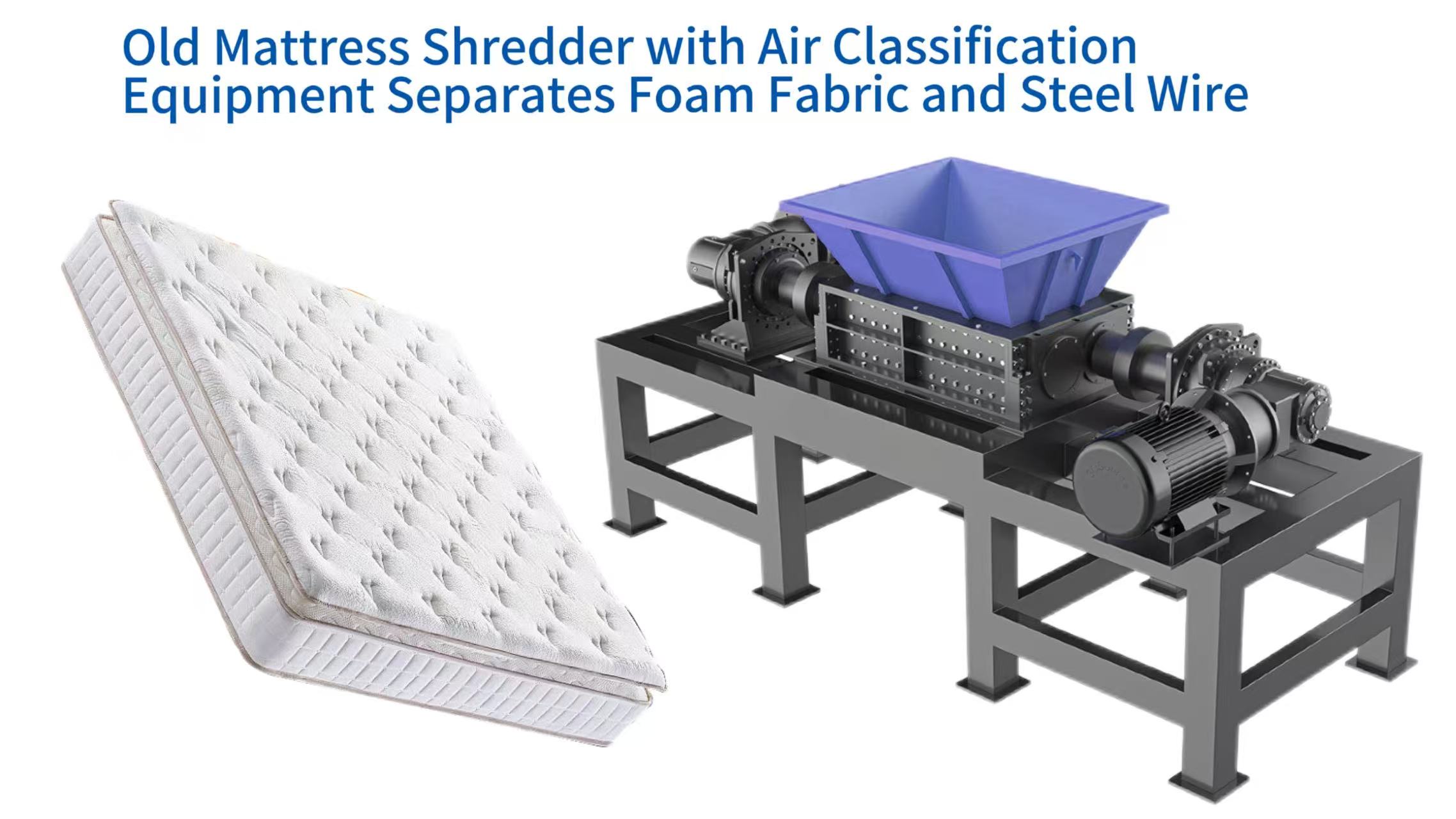
An old mattress shredder working together with air classification equipment creates a system that separates foam, fabric, and steel wire from end-of-life mattresses. Discarded mattresses occupy large volumes in landfills. They contain spring steel wire, foam padding, felt layers, and synthetic fabric covers. Traditional manual dismantling requires workers to cut open the fabric, remove the foam, and cut the springs. A single worker can only dismantle a limited number of mattresses each day. The work exposes people to fiber dust and sharp wire injuries. Mechanical shredding followed by manual sorting does not work either. The shredded mixture contains pieces of foam, fabric strips, and wire segments that are similar in size. Human eyes and hands cannot keep up with the output speed of a shredder. This article explains how the shredder liberates mattress components and how air classification uses density differences to achieve separation. The content covers working principles, equipment types, separation accuracy factors, and complete line configuration.
Mattress Recycling Faces Component Separation Challenges That Shredder-Air Classification Solves
Each year millions of mattresses reach the end of their useful life. The majority are innerspring mattresses and foam mattresses. These products contain multiple materials with very different physical properties. Steel wire has a density of approximately 7.8 grams per cubic centimeter. Foam has a density of only 0.02 to 0.05 grams per cubic centimeter. Fabric density falls between these two extremes. Manual dismantling requires workers to cut through fabric layers with knives. Workers pull out foam padding and cut spring wires using wire cutters. The daily processing volume per worker remains very low. Workers face constant risk of cuts from sharp springs and inhalation of accumulated dust, skin flakes, and microorganisms inside old mattresses.
A solid waste double shaft shredder combined with air classification equipment provides a mechanical solution to this separation problem. The shredder cuts whole mattresses into uniformly sized pieces. This action liberates the steel wire, foam, and fabric from their originally bonded state. The liberated mixture then enters an air classifier. The air classifier uses controlled airflow to separate light materials from heavy materials. Heavy steel wire falls downward against the airflow. Light foam and fabric get carried away by the air stream. This mechanical separation system can process several tons of mattresses per hour. That represents many times the throughput of manual dismantling lines. The recovered steel wire goes to steel mills for remelting. The foam gets processed into recycled padding or carpet underlay. The fabric serves as alternative fuel or recovered fiber feedstock.
MSW Technology has fifteen years of experience designing and manufacturing shredding and separation equipment for complex waste streams. The company's engineering team has developed specific shredder configurations and air classifier designs optimized for mattress recycling applications. This depth of practical experience informs every aspect of system design from cutter geometry to airflow control algorithms.
Manual Dismantling Creates Efficiency Bottlenecks and Health Risks
| Parameter | Value |
|---|---|
| Time per Queen Mattress | 15-30 minutes |
| Daily Throughput per Worker | Max 50 mattresses |
| Annual 100k Mattresses | 10-15 workers required |
The manual dismantling process for a standard queen size innerspring mattress takes fifteen to thirty minutes. The worker must cut through the fabric cover along all four edges. The foam layer must be pulled away from the spring unit. Each spring wire requires individual cutting or the entire spring unit must be compressed and tied. The cutting tools dull quickly when contacting steel wire. Frequent tool replacement adds to operating costs. The dust inside old mattresses includes accumulated human skin cells, pet dander, dust mites, and mold spores. This dust becomes airborne during cutting and pulling operations. Workers who perform dismantling for multiple years show higher rates of respiratory problems.
Production data from mattress recycling facilities indicates that a manual dismantling line achieves a daily throughput of no more than fifty mattresses per worker. A facility processing one hundred thousand mattresses annually would need ten to fifteen full-time dismantling workers. Labor costs become the dominant operating expense at such facilities. Worker turnover rates are high due to the physical demands and perceived low status of the work. Training new workers takes time and reduces productivity during the training period. These economic and operational factors make manual dismantling unsuitable for large-scale mattress recycling operations.
Manual Sorting of Shredded Mattress Material Is Not Practical
A solid waste primary shredder reduces whole mattresses to a mixture of foam chunks, fabric strips, and wire segments. These three materials all fall within a size range of twenty to one hundred millimeters. Foam chunks are soft and springy. Their color is typically light yellow, white, or gray. Fabric strips show various colors depending on the original mattress cover. The edges of fabric strips have loose fibers. Wire segments are bent, have a metallic shine, and feel heavy when picked up. Distinguishing these materials by sight and touch is not difficult for a trained worker.
The problem is speed. A shredder processing mattresses at a rate of two tons per hour discharges approximately one hundred pieces of material every second. No human worker can visually inspect, identify, and sort one hundred pieces per second. Even with multiple workers stationed along a discharge conveyor, the material flow moves too quickly for accurate manual separation. Some facilities have attempted to slow down the shredder to make manual sorting possible. This approach reduces throughput to uneconomically low levels. Manual sorting of shredded mattress material does not provide a viable path to commercial-scale recycling.
Working Principle of the Shredder-Air Classification Combined System
The combined system operates on a simple but effective principle. The shredder first destroys the structural integrity of the whole mattress. This liberation step ensures that steel wire, foam, and fabric no longer remain attached to each other. The liberated mixture then enters the air classifier. Inside the air classifier, a controlled air stream rises through the falling material. Heavy steel wire has enough mass to overcome the upward air force. The wire falls to the bottom of the classifier and discharges through a rotary valve. Light foam and fabric lack sufficient mass to resist the air stream. The air carries these materials upward to a cyclone separator or collection chamber.
The separation interface between heavy and light materials can be adjusted by changing the air velocity. Higher air velocity will lift heavier particles. Lower air velocity will allow lighter particles to fall. Finding the correct air velocity for a specific mattress mixture requires testing and adjustment. If the air velocity is too high, steel wire will be carried over into the light fraction. If the air velocity is too low, foam and fabric will fall into the heavy fraction. A well-tuned system achieves clean separation with minimal cross-contamination between fractions.
Air Classification Offers Advantages Over Alternative Separation Methods
| Method | Cost | Throughput | Suitability |
|---|---|---|---|
| Air Classification | Low | High (5-10 t/h) | Best for Mattresses |
| Wet Separation | High | Medium | Not Recommended |
| Optical Sorting | Very High | Medium | Limited Use |
Several methods exist for separating mixed materials by density. These include wet density separation using liquids, optical sorting using cameras and air jets, and manual sorting. Wet density separation requires immersing the material in a liquid such as water or a dense medium solution. The material must be dried after separation. The liquid must be treated and recycled. These requirements add significant capital and operating costs. Optical sorting equipment costs substantially more than air classification systems. Optical sorters also require clean material surfaces for accurate detection. Dust and dirt on recycled mattress materials degrade optical sorter performance.
Air classification offers the best combination of low cost, high throughput, and acceptable separation accuracy for mattress recycling. An air classifier has no moving parts in contact with the material stream. Wear is minimal. Maintenance requirements are low. A medium-sized air classifier processes five to ten tons per hour. That throughput is sufficient for most mattress recycling operations. The operating cost consists primarily of electricity for the fan motor. No consumables such as filter media or separation liquids are required. For facilities processing end-of-life mattresses as their primary feedstock, air classification represents the most economical separation technology available.
Shredder Output Size Directly Affects Air Classification Accuracy
The particle size distribution coming out of the shredder has a direct influence on how well the air classifier performs. Shredded particles that are too large cause two problems. Large foam chunks may still contain small pieces of steel wire embedded inside them. These foam chunks will behave like heavy particles and fall into the steel fraction. Large wire segments may have fabric strips wrapped around them. These wire segments will behave like light particles and get carried into the foam fraction. Large particles of any material do not respond cleanly to air classification because their surface area to mass ratio varies unpredictably.
Practical experience from mattress recycling operations shows that the optimal particle size range for air classification is thirty to eighty millimeters. Within this range, most particles are fully liberated. Steel wire segments are free of fabric wrapping. Foam chunks contain no embedded wire. The screen installed beneath the shredder cutters controls the maximum particle size. Facilities processing high volumes of mattresses often use a two-stage shredding approach. The primary shredder produces fifty to eighty millimeter particles. An air classifier performs an initial separation. The heavy fraction containing steel wire goes to a secondary shredder for further size reduction. A second air classifier then produces high-purity steel and foam fractions.
Air Classifier Types Suited for Mattress Recycling Applications
Air classification equipment comes in several configurations. The differences lie in airflow direction, material trajectory, and the number of separation stages. Choosing the right type of air classifier for a specific mattress recycling application requires understanding the characteristics of the shredded material and the desired product purity. The following sections describe three air classifier types commonly used in mattress recycling lines. Each type has advantages and limitations that determine its appropriate use case.
Rising Current Air Classifiers Perform Coarse Separation of Foam and Steel
The rising current air classifier is the simplest type in terms of mechanical construction. Material enters at the top of the unit through an airlock. Air blows upward from the bottom of the unit through a distribution plate. Heavy material falls down through the rising air stream and discharges from the bottom. Light material gets carried upward by the air and discharges from the top through a duct leading to a cyclone separator. The absence of moving parts inside the separation zone makes this design highly reliable and low maintenance.
For mattress shredder output, the rising current air classifier effectively removes most of the foam and lightweight fabric from the steel wire fraction. The separation is not extremely precise. Some fine steel wire fragments may get carried over with the foam. Some foam particles may fall with the steel. However for many applications, this level of separation is sufficient. Facilities that sell the foam fraction as low-grade filler material or fuel do not need high purity. The low cost and simple operation of the rising current classifier make it attractive for such operations.
Horizontal Airflow Classifiers Achieve Medium Separation Accuracy
The horizontal airflow classifier uses a different material trajectory. Material enters from one end of a horizontal chamber. Air flows either in the same direction as the material flow or in the opposite direction. Heavy particles drop out of the air stream near the entry point because their momentum carries them only a short distance. Light particles remain entrained in the air stream and travel much farther before dropping out. Multiple discharge outlets positioned along the length of the chamber collect particles of different densities. This design allows the horizontal classifier to produce more than two fractions.
For mattress shredder output, the horizontal airflow classifier achieves better separation purity than the rising current type. Steel wire collects in the first discharge outlet nearest the entry point. Fabric strips collect in the middle outlets. Foam collects in the farthest outlet. The cross-contamination between fractions can be kept below measurable levels with proper adjustment. Facilities that sell foam to automotive parts manufacturers for sound insulation applications need this level of purity. The higher capital cost of the horizontal classifier is justified by the higher product value it enables.
Recirculating Air Classifiers with Screening Achieve High-Purity Separation
The recirculating air classifier incorporates multiple separation stages and internal material recirculation. After the first separation pass, the intermediate density fraction returns to the separation zone for further processing. The light fraction passes through a cyclone separator for collection. The heavy fraction passes over a magnetic separator and then enters a secondary air classification stage. This multistage design achieves very high separation purity. Field data from mattress recycling facilities using recirculating classifiers shows steel wire purity exceeding ninety-nine percent. Foam and fabric purity exceeds ninety-five percent.
Facilities targeting high-value markets for recovered mattress materials choose recirculating air classifiers. Steel wire sold to specialty steel mills commands premium prices but requires very low foam and fabric contamination. Foam sold to automotive parts manufacturers for molded components must be free of steel fragments and fabric lint. The higher investment cost of the recirculating classifier pays back through higher selling prices for all product fractions. Facilities processing more than ten thousand tons of mattresses per year typically select this configuration.
Classifier Selection Depends on Feed Composition and Purity Targets
Before selecting an air classifier, the facility operator should analyze the expected composition of the shredded mattress feed. Innerspring mattresses have higher steel content. Foam mattresses have higher foam content. The steel content affects the required heavy fraction discharge capacity. The foam content affects the required air handling capacity for the light fraction. A classifier designed for innerspring mattresses may not work well for foam mattresses without adjustments to airflow and discharge mechanisms.
The target purity for each product fraction drives the selection toward simpler or more complex classifiers. Steel sold to a low-grade foundry may only need ninety-five percent purity. Steel sold to a specialty steel mill for high-quality products needs ninety-nine percent or higher purity. Achieving higher purity requires more sophisticated classifiers with multiple separation stages. It may also require additional equipment such as magnetic separators or screens after the air classifier. The additional investment must be weighed against the higher selling prices achievable with higher-purity products.
Core Functions of the Shredder-Air Classification Combined System
The combined shredder and air classifier system performs four essential functions in a mattress recycling line. These functions are liberation, separation, purification, and homogenization. Each function contributes to the final product quality and the overall efficiency of the recycling operation. A well-designed system achieves all four functions with minimal material loss and energy consumption.
Liberation Releases Mattress Components From Their Bonded Structure
A new mattress has its components held together by adhesives, stitching, and spring tension. After years of use, the adhesives may have aged and the stitching may have weakened. However the basic structural relationship between components remains intact. The steel wire is still attached to the foam through adhesive points. The fabric cover is still stitched around the foam and spring assembly. The shredder's shearing action cuts through these bonds. Fabric stitches break when the cutters pass through them. Adhesive bonds fail when the cutters tear the foam away from the wire.
Complete liberation is essential for subsequent separation steps. If a foam chunk still contains a piece of steel wire, that chunk will behave like a heavy particle regardless of its foam composition. It will fall into the steel fraction during air classification. Conversely, if a wire segment still has fabric wrapped around it, that segment may behave like a light particle and get carried into the foam fraction. The shredder must be configured with the appropriate cutter design, shaft speed, and screen size to achieve liberation for the specific mattress types being processed.
Separation Divides the Mixture Into Three Product Streams
The air classifier performs the actual separation of the three material types. Steel wire has the highest density. It falls to the bottom of the classifier and discharges through a rotary valve or onto a conveyor. Foam has the lowest density. The air stream carries it to the farthest collection point, typically a cyclone separator or a baghouse. Fabric strips have an intermediate density. They drop out at a point between the steel outlet and the foam outlet. Some air classifier designs produce more than three fractions by having multiple discharge points along the separation chamber.
Actual operating data from mattress recycling facilities shows the separation performance achievable with well-tuned equipment. Steel wire purity exceeding ninety-nine percent is routine. Steel wire contamination by foam is typically below one percent. Foam purity exceeding ninety-five percent is achievable. Foam contamination by steel wire is below half a percent. These purity levels make the recovered materials suitable for most secondary markets. Facilities that achieve these purity levels consistently command premium prices for their products.
Purification Removes Dust and Fine Contaminants From All Fractions
Old mattresses accumulate dust, dirt, skin flakes, pet hair, and other contaminants during their useful life. These fine materials become entrained in the shredder output. Some of them adhere to the surfaces of foam chunks and fabric strips. The air classifier's air stream carries many of these fine particles away from the heavier materials. At the light fraction outlet, a cyclone separator or baghouse collects the fine dust separately from the usable foam and fabric. This dust fraction is typically sent to landfill or used as low-grade fuel.
The purification effect of air classification improves the quality of the recovered foam and fabric. Foam that has passed through an air classifier contains less dust and fewer fine fibers. It can be processed directly into carpet underlay, automotive padding, or other products without a separate washing step. This dry purification method has environmental advantages over wet washing. It consumes no water and produces no wastewater. For facilities located in water-scarce regions or areas with strict wastewater discharge regulations, dry purification is the only practical option.
Homogenization Creates Consistent Feedstock for Downstream Processing
Unprocessed waste mattresses vary widely in their composition. Different brands use different foam densities. Different manufacturing years have different steel wire gauges. Different usage histories result in different levels of material degradation. Feeding this variable material directly into a foam shredder or wire baler would produce inconsistent output quality. The shredder and air classifier combination transforms variable input into consistent output. The steel fraction from the classifier has a uniform particle size distribution and consistent steel grade. The foam fraction has uniform chunk size and consistent density.
This homogenization effect allows downstream processing equipment to run at fixed parameters. A foam fiberizer can run at constant speed without needing adjustment for varying foam density. A wire baler can produce bales of consistent weight and density. The overall production line achieves higher uptime and lower operator attention requirements. Facilities that invest in proper liberation and separation equipment report fewer process upsets and more predictable production outcomes compared to facilities that skip these preparation steps.
Mattress Types Processed by Shredder-Air Classification Systems
Mattresses come in several construction types. Innerspring mattresses contain steel coil springs or pocket springs. Foam mattresses consist entirely of polyurethane foam layers with a fabric cover. Latex mattresses use natural or synthetic latex foam. Coconut fiber mattresses use coir fibers bonded with adhesive. Each type behaves differently during shredding and air classification. A versatile system can handle all these types. The following sections explain the processing considerations for each type.
Innerspring Mattresses Require Robust Shredding and Steel Separation
Innerspring mattresses are the most common type found in the waste stream. They contain fifteen to twenty-five percent steel wire by weight. The wire comes from the coil springs and the border wires around the perimeter. Shredding innerspring mattresses places high demands on the cutter material. The cutters must cut through steel wire repeatedly without chipping or dulling too quickly. Facilities processing mostly innerspring mattresses should select shredders with high-alloy tool steel cutters. Cutter inspection intervals should be shorter than for other mattress types.
Air classification of innerspring mattress shredder output is relatively straightforward. The large density difference between steel wire and foam makes separation easy. However pocket springs present a special challenge. Pocket springs are individual coils wrapped in non-woven fabric pockets. The fabric pockets become small fiber fragments during shredding. These fiber fragments mix with the foam fraction. If the foam recycling application is sensitive to fiber content, a screening step after air classification may be needed. The screen removes most of the fiber fragments from the foam.
Foam Mattresses Allow High Throughput With Minimal Cutter Wear
Foam mattresses contain no steel wire. They consist of polyurethane foam layers of varying densities bonded together. A fabric cover surrounds the foam core. Shredding foam mattresses causes much less cutter wear than shredding innerspring mattresses. The shredder can operate at higher throughput because the material is less dense and easier to cut. The main challenge with foam mattresses is separating the foam from the fabric cover. The fabric strips have a higher density than the foam chunks. They tend to fall out of the air stream before the foam does.
If the facility's business model does not require separate recovery of foam and fabric, the two materials can be collected together. The mixed foam and fabric fraction serves as a fuel for industrial boilers and cement kilns. Its heating value is acceptable for these applications. If separate recovery is required, a vibrating screen after the air classifier can help. The screen uses the different movement characteristics of foam and fabric to achieve separation. Foam chunks bounce and roll across the screen surface. Fabric strips slide and may pass through the screen openings.
Latex and Coconut Fiber Mattresses Have Intermediate Density
Latex foam has a higher density than polyurethane foam. Natural latex is also more elastic. Latex chunks tend to bounce and deform during air classification. Their separation behavior is less predictable than polyurethane foam. Coconut fiber mattresses are made from coir fibers bonded with natural rubber latex. The material is dense and fibrous. Shredding coconut fiber mattresses generates more fine dust than shredding polyurethane foam mattresses. The dust can overload the air classifier's dust collection system if not properly sized.
Both latex and coconut fiber materials have densities that fall between polyurethane foam and steel wire. During air classification, they typically report to the same fraction as fabric strips. If the facility processes a significant volume of these mattress types, a separate product fraction may be created. Alternatively, the material can be blended with the fabric fraction. The market value of these materials is generally lower than high-quality polyurethane foam but higher than mixed fabric waste. Facilities should test their specific feedstock to determine the optimal air classifier settings.
Mattress Size Affects Shredder Feed Hopper Requirements
Mattress dimensions vary widely. A standard twin mattress is ninety centimeters wide. A queen mattress is one hundred fifty centimeters wide. A king mattress can be one hundred eighty to two hundred centimeters wide. The shredder feed hopper opening must be large enough to accept the widest mattress the facility expects to process. Hoppers that are too narrow require manual cutting of mattresses before feeding. This manual pre-cutting defeats the purpose of mechanical shredding and introduces labor costs back into the process.
A hydraulic ram helps feed oversized mattresses into the shredder. The ram pushes the mattress downward into the cutting zone. Without a ram, a large mattress may sit on top of the rotating cutters without being pulled in. The mattress bounces and slides rather than feeding. The ram applies steady downward pressure to overcome this problem. Air classifiers do not have size limitations like shredders. However they require a uniform feed rate for consistent separation. The shredder discharge should pass through a surge bin and a vibrating feeder before entering the air classifier to ensure steady material flow.
Complete Line Configuration From Shredder to Air Classifier
A complete mattress recycling line includes more equipment than just the shredder and air classifier. Conveyors transfer material between machines. Magnetic separators remove steel wire before and after the air classifier. Dust collection systems capture fine particles from all process points. A control system coordinates the operation of all equipment. Each component must be properly sized and configured. The following sections describe the key elements of a complete line.
Conveying System and Magnetic Separation
Belt conveyors transport material from the shredder discharge to the air classifier feed. The conveyors should have dust covers to prevent material from flying off. A magnetic separator should be installed above the conveyor. The magnet pulls steel wire out of the material stream before it reaches the air classifier. This pre-separation serves two purposes. The recovered steel wire can be sold directly. The reduced steel load on the air classifier improves its separation efficiency and reduces wear on the classifier's discharge components.
The magnetic separator must be strong enough to capture bent and tangled steel wire segments. A permanent overband magnet with a deep magnetic field works well for this application. The distance between the magnet and the conveyor belt surface should be as short as possible. Some facilities use a drum magnet instead of an overband magnet. The drum magnet is installed as the head pulley of the conveyor. Material falling off the belt passes through the magnetic field. This configuration works well but requires more careful maintenance than an overband magnet.
Air Flow Adjustment and Material Distribution at the Classifier
The separation accuracy of the air classifier depends on two factors. The first factor is the air velocity through the separation zone. The second factor is the uniform distribution of material across the width of the classifier inlet. Air velocity that is too low allows foam and fabric to fall into the steel outlet. Air velocity that is too high carries steel wire into the foam outlet. Operators must adjust the air velocity based on the composition of the incoming material. A variable frequency drive on the fan motor makes this adjustment easy.
Material must enter the air classifier as a thin, uniform curtain. A vibrating feeder or rotary airlock mounted above the classifier spreads the material evenly. If material piles up in the center of the inlet, the center portion of the classifier will be overloaded. Poor separation results. The material layer thickness should be no more than one particle diameter. For mattress shredder output, this means a layer depth of less than one hundred millimeters on the feeder. Facilities that maintain proper material distribution achieve consistently high separation purity.
Dust Collection System Configuration
Both the shredder and the air classifier generate dust during operation. The shredder produces fine foam particles and short fabric fibers that become airborne. The air classifier's air stream deliberately entrains light particles. Some of these particles are too fine to be useful as recovered foam or fabric. A dust collection system must capture these fine particles. The system typically consists of a cyclone separator followed by a baghouse or cartridge filter. The cyclone removes coarse dust. The baghouse removes fine dust that would otherwise be emitted to the atmosphere.
The air volume of the dust collection system should be balanced with the air classifier's main air flow. If the dust collection system draws too much air from the classifier, the classifier's separation performance changes. If it draws too little air, dust escapes from equipment openings. Proper system design uses balancing dampers to adjust air flows. Facilities processing foam mattresses with high dust generation rates should pay special attention to explosion protection. Foam dust can form explosive mixtures with air under certain conditions. Explosion venting panels are required on the dust collection equipment.
MSW Technology has fifteen years of experience designing complete shredding and separation lines for mattress recycling. The company's engineers understand how to balance air flows between classifiers and dust collectors. They also know how to configure explosion protection systems for foam dust applications. This experience translates into reliable, safe, and productive recycling lines for customers around the world.
Control System and Online Monitoring
Modern mattress recycling lines use a programmable logic controller to coordinate all equipment. The operator interacts with the system through a touch screen human-machine interface. The control system monitors key parameters such as shredder motor current, conveyor speeds, fan speeds, and pressure drops across dust collection filters. When a parameter deviates from its normal range, the system alerts the operator. Some systems can automatically adjust operating parameters to maintain separation performance.
Online monitoring of product purity is possible with more advanced systems. Near-infrared sensors or cameras mounted over the discharge conveyors can analyze the composition of the steel and foam fractions. The purity data appears on the operator screen in real time. The operator can use this data to fine-tune the air classifier settings. Facilities that invest in online monitoring achieve higher average product purity and lower operator labor costs. A single operator can monitor the entire line. The need for manual sampling and laboratory testing is greatly reduced.
Economic and Environmental Value of Shredder-Air Classification Systems
Investing in a shredder and air classifier system for mattress recycling creates economic returns while delivering environmental benefits. The business case depends on several factors. These include feedstock acquisition costs, equipment investment, operating expenses, and product selling prices. Facilities that design their lines correctly achieve attractive returns on investment. The environmental benefits include landfill diversion, resource conservation, and greenhouse gas reduction.
Feedstock acquisition for mattress recycling often generates revenue rather than incurring cost. Waste haulers and municipal waste departments pay tipping fees to dispose of mattresses. A recycling facility that accepts mattresses charges a fee per ton. This fee covers a portion of the operating costs. Product sales provide additional revenue. This dual revenue stream distinguishes mattress recycling from other recycling businesses. The facility gets paid to take the material and then gets paid again for the products recovered from it.
A complete shredder and air classifier line with annual capacity of ten thousand tons requires a significant capital investment. Payback periods typically range from eighteen to twenty-four months. Operating costs include electricity for the shredder and fans, cutter wear parts, and labor. The per-ton operating cost decreases as annual throughput increases due to economies of scale. The steel fraction sells to scrap metal processors or directly to steel mills. The foam fraction sells to carpet underlay manufacturers, automotive parts suppliers, or fuel users. The fabric fraction sells as alternative fuel to cement kilns or industrial boilers.
Product purity determines the selling price achievable for each fraction. High-purity steel wire commands premium prices. Low-purity steel must be sold at a discount. Foam purity above ninety-five percent opens access to high-value markets such as automotive sound insulation. Foam with lower purity is limited to low-value applications such as stuffing for pet beds. The separation accuracy of the air classifier directly determines product purity. Facilities that invest in multistage recirculating classifiers achieve the highest product values.
MSW Technology has fifteen years of experience supplying complete mattress recycling lines. The company's equipment is operating in facilities around the world. Each installation is tailored to the specific mattress composition and market conditions of the customer. This depth of experience ensures that customers receive not just equipment but also the process knowledge needed to operate profitably.