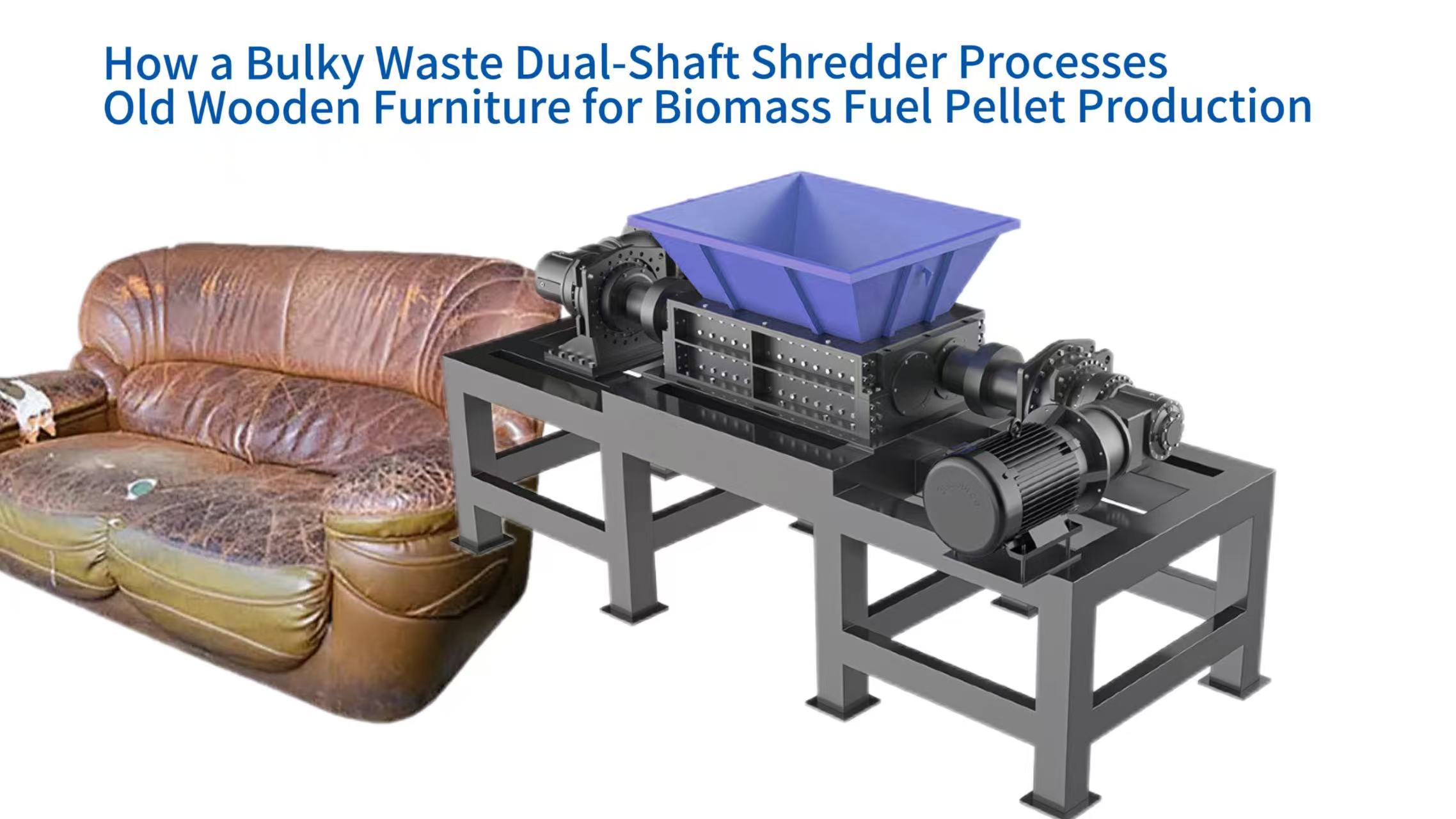
A bulky waste dual-shaft shredder converts discarded wooden furniture into a usable raw material for biomass fuel pellet manufacturing. Urban renewal and residential moves generate large quantities of old sofas, wardrobes, and bed frames. These items take up significant space in landfills. They also contain nails, hinges, and other metal fittings that complicate conventional disposal methods. Biomass pellet production offers an environmentally sound alternative for this waste stream. However pelletizing equipment requires feedstock with specific size characteristics. The dual-shaft shredder solves this preparation challenge through low-speed high-torque shearing action. This article explains the working principles, machine types, functional benefits, material handling capabilities, and complete production line configuration for turning old furniture into biomass pellets. Readers will understand why the dual-shaft shredder serves as the critical first step in furniture waste energy recovery.
Wooden Furniture Waste Faces Disposal Challenges That Dual-Shaft Shredders Overcome
Discarded wooden furniture differs significantly from other wood waste streams. Each piece contains not only solid wood or engineered wood panels but also metal connectors, upholstery materials, and surface coatings. Traditional disposal methods struggle with this complexity. Landfill disposal consumes valuable space while wood decomposes anaerobically, generating methane that contributes to greenhouse gas emissions. Incineration presents different problems. Metal hardware damages furnace components. Variable moisture content creates unstable combustion. The high water content in some furniture lowers thermal efficiency. Many regions have restricted landfilling of untreated wood waste, pushing operators toward recycling and energy recovery solutions.
Biomass pellet production provides a viable pathway for converting this waste into renewable energy. Pellet fuel burns cleanly in industrial boilers and residential heating systems. However pellet mills have strict feedstock requirements. Raw material must be reduced to particles smaller than the pellet die hole diameter, typically 6 to 10 millimeters. Wood chips that exceed this size will block the die holes and stop production. Metal contamination destroys the die and rollers instantly, requiring expensive repairs. The bulky waste dual-shaft shredder addresses both requirements. It produces uniformly sized wood chips while liberating metal fittings from the wood matrix. This preparation step transforms a problematic waste stream into a valuable fuel source.
Old Furniture Contains Mixed Materials With Different Physical Properties
Solid wood furniture consists of natural timber with clear coatings. Engineered wood furniture uses particleboard or medium-density fiberboard bonded with resin adhesives and covered with melamine or wood veneer surfaces. Upholstered pieces add foam padding and fabric coverings to wooden frames. Each material responds differently to mechanical size reduction. Solid wood cuts cleanly under shear force. Engineered wood tends to fracture into fine particles because the adhesive bonds are brittle. Foam compresses and tears rather than shearing cleanly. Fabric wraps around rotating components and creates tangles. A shredder designed for uniform wood chips cannot handle this material diversity.
Traditional hammer mills rely on high-speed impact to break materials. When processing furniture, these machines consume excessive energy. Metal hardware often becomes embedded deeper into wood pieces rather than being liberated. The high rotational speed throws materials violently, increasing noise and dust emissions. Impact forces cause fiber breakage rather than clean cutting, producing excess fine powder that reduces pellet quality. Single-shaft shredders also struggle with furniture. The irregular shapes and varying densities of different furniture types prevent consistent engagement with the cutting rotor. Large pieces may bounce on top of the rotor rather than being pulled down for cutting.
Low-Speed High-Torque Shearing Defines the Dual-Shaft Shredder Working Principle
A solid waste double shaft shredder operates on fundamentally different principles from hammer mills or single-shaft designs. Two parallel shafts rotate toward each other at low speeds, typically between 30 and 80 revolutions per minute. Each shaft carries alternating cutter discs and spacer rings. Cutters on one shaft intermesh with cutters on the opposite shaft. This intermeshing creates a scissors-like shearing action at each cutter intersection point. When a furniture piece enters the cutting chamber, the rotating cutters grab the material and pull it down between the shafts. The shear force generated by this action cuts through wood, adhesives, fabrics, and metal hardware simultaneously.
The low rotational speed produces several important benefits for furniture processing. Vibration and noise levels remain substantially lower than high-speed equipment. Energy consumption per ton of processed material decreases because the machine applies steady force rather than wasting energy as impact noise and heat. The controlled shearing action cuts fibers cleanly rather than breaking them randomly. This preserves fiber length in the resulting wood chips, which improves the binding characteristics during pellet production. The high torque available at low speeds allows the machine to process dense hardwoods and thick particleboard without stalling, maintaining consistent throughput even with difficult feed materials.
Screen-Controlled Output Size Matches Pellet Mill Inlet Requirements
A screen mesh installed beneath the cutting chamber controls the maximum size of material leaving the shredder. The shredded material falls through the screen openings only when the pieces are smaller than the hole diameter. Screen hole sizes for furniture-to-pellet applications typically range from 30 to 50 millimeters. This size range serves two purposes. First, it ensures that any oversized pieces remain in the cutting chamber for further reduction. Second, it provides an upper size limit that downstream pelletizing equipment can accept comfortably. The relationship between screen size and final product quality is well documented in recycling industry studies.
Pellet mills generally accept feedstock with particle lengths up to three times the die hole diameter. For a 6 millimeter die, acceptable particle length extends to approximately 18 millimeters. A 30 millimeter shredder screen produces chips that range from 5 to 30 millimeters. These chips pass through further processing steps before reaching the pellet mill. Any material that remains larger than 10 millimeters after secondary grinding can be returned to the shredder or diverted to a separate recirculation loop. Field data from biomass production facilities shows that shredder screens between 30 and 50 millimeters achieve the best balance between throughput and downstream processing efficiency.
Cutter Design Separates Metal Hardware From Wood Fiber
The cutter discs on a solid waste shredder intended for furniture processing must withstand extreme mechanical stress. Each cutter encounters not only wood fiber but also steel nails, zinc hinges, brass screws, and occasional ferrous brackets. The cutters are manufactured from high-alloy tool steels with added chromium and molybdenum. These alloying elements increase both hardness and wear resistance. A specialized heat treatment process creates a very hard outer surface while maintaining a tougher, more impact-resistant core. This combination allows the cutters to cut through metal fasteners without chipping or fracturing.
The cutter geometry plays an essential role in metal liberation. Rather than cutting through nails or screws, the cutter edges push these metal objects away from the cutting zone. The shearing action separates the metal from the surrounding wood fiber. The metal object emerges from the shredder as a distinct piece, often bent but not cut into small fragments. This intact form makes subsequent magnetic separation highly effective. An magnetic separator installed after the shredder can capture over 99 percent of ferrous metals when the metal pieces remain large. Cutters that fragment metal into small pieces make this separation much more difficult.
Intelligent Controls Protect Against Non-Shreddable Contaminants
Furniture sometimes contains unexpected materials that exceed the shredder's design capacity. Concrete countertop remnants attached to cabinets, steel springs from upholstered furniture, or solid metal plates from industrial furniture can damage the machine if not handled properly. Modern control panel with PLC HMI systems monitor shaft torque continuously. When the torque exceeds a preset threshold, the control system recognizes that an overload condition exists. The system then commands the drive motors to reverse direction for a short period, typically 2 to 3 seconds.
This auto-reverse function clears many jams automatically. The reversal backs the material away from the cutting zone, allowing the non-shreddable object to reposition or fall back. After the reverse cycle, the shafts resume forward rotation. The control system may repeat this auto-reverse cycle several times. If the overload condition persists after multiple attempts, the system shuts down the shredder and activates an alarm. This staged response prevents catastrophic damage to cutters, shafts, bearings, and gearboxes. Facilities processing mixed furniture waste benefit significantly from this protection, as unexpected contaminants appear frequently in this waste stream.
MSW Technology brings fifteen years of specialized engineering experience to the design and manufacture of dual-shaft shredders for waste furniture processing. The company has developed specific cutter geometries and control algorithms optimized for the unique challenges of mixed wood waste containing metal fasteners and fabric materials.
Different Dual-Shaft Shredder Configurations Match Different Furniture Processing Scales
Furniture waste processing operations vary widely in scale and operating requirements. A small wood recycling yard processing 5 tons per day has different needs than a regional biomass fuel plant processing 50 tons per day. Machine selection must account not only for throughput volume but also for the specific composition of the furniture stream, available facility infrastructure, and downstream equipment compatibility. Understanding the available configurations helps buyers avoid costly mismatches between machine capability and operational demands. The following sections describe three common configurations suitable for furniture-to-pellet applications.
Standard Dual-Shaft Shredders Suit Small to Medium Wood Recycling Operations
Standard configuration dual-shaft shredders represent the most common type found in wood waste recycling facilities. These machines typically feature shaft lengths between 800 and 1,200 millimeters. Motor power ranges from 30 to 90 kilowatts depending on the specific model and application. Cutter diameters measure between 300 and 450 millimeters. This combination provides sufficient torque for processing mixed furniture including solid wood furniture, particleboard items, and most upholstered pieces. Standard machines achieve throughput rates between 2 and 8 tons per hour when processing furniture waste with a 40 to 50 millimeter screen.
The economic advantage of standard dual-shaft shredders makes them attractive for smaller operations. Initial capital investment is substantially lower than heavy-duty configurations. Replacement cutters and wear parts are readily available from multiple suppliers. Standard machines have smaller physical footprints and lower foundation requirements than larger models. A facility operating on a single shift with annual throughput under 5,000 tons can achieve profitable operations with a standard machine. Many biomass fuel startups begin with this configuration and add capacity as their feedstock volumes grow.
Heavy-Duty Dual-Shaft Shredders Handle Continuous High-Volume Production
Large biomass fuel plants operating two or three shifts per day require heavy-duty shredder configurations. These machines incorporate larger components throughout the design. Shaft diameters increase to 250 millimeters or more. Cutter discs are thicker and have larger diameters, often exceeding 500 millimeters. The increased mass of these components provides the strength and durability needed for 24 hour operation. Motor power on heavy-duty machines ranges from 150 to 400 kilowatts. Power is delivered through high-ratio gearboxes that multiply torque while maintaining low shaft speeds.
Heavy-duty configurations frequently include hydraulic ram assist systems. The ram pushes bulky furniture items into the cutting zone. This forced feeding prevents large pieces from bouncing or sliding across the top of the cutters. Without a ram, a bulky wardrobe or large sofa may not enter the cutting chamber efficiently. The ram applies steady downward pressure, ensuring continuous material flow. Heavy-duty machines also feature reinforced cutting chambers with thicker wear liners to resist abrasion from high-density hardwoods and abrasive particleboard surfaces. While initial investment is higher, the per-ton operating cost for heavy-duty machines is lower at high volumes.
Mobile Dual-Shaft Shredders Enable On-Site Furniture Processing
Some furniture waste processing scenarios lack permanent facility infrastructure. Disaster debris sites, temporary collection points, or rural transfer stations need processing capability at multiple locations. Mobile dual-shaft shredders mount the entire machine assembly onto a heavy-duty trailer chassis with road-legal axles and lighting. The power source may be an electric motor requiring external power connection or a diesel engine providing complete operational independence. A mobile unit can travel directly to a location where construction waste or furniture has accumulated.
The reduction in transportation costs drives the economic case for mobile shredding. Whole furniture items occupy large volumes on trucks. A standard trailer can carry only limited quantities of assembled furniture before reaching legal volume limits. Shredded wood chips occupy roughly 20 to 30 percent of the volume of whole furniture items. This means each truck can transport 3 to 4 times more material by volume after shredding. A mobile shredder processing furniture at the collection point creates dense, compact material that loads efficiently for transport to the pellet plant. Transportation costs per ton can be reduced by 60 to 70 percent compared to hauling whole furniture items.
Machine Sizing Must Match Downstream Pellet Mill Capacity
Proper machine sizing requires careful analysis of the entire production line. The shredder output must match the capacity of the pellet mill. A common mistake is installing an oversized primary shredder that feeds into an undersized pellet mill. In this situation, the pellet mill becomes the bottleneck. The entire line must operate at the slower machine's speed. The shredder runs below its capacity, wasting both capital investment and energy efficiency. The correct approach starts with the target pellet output rate and works backward through each process step.
Capacity calculations should include a safety margin for variations in feedstock quality and minor equipment downtime. A pellet mill rated for 2 tons per hour should receive feedstock from a shredder capable of producing 2.2 to 2.5 tons per hour of prepared wood chips. This excess capacity allows the shredder to feed the mill continuously even during brief periods when the shredder operates at reduced efficiency due to dull cutters or difficult material. The same principle applies to the conveyors, elevators, and storage bins between machines. Properly matched equipment capacities create smooth, continuous material flow through the entire production line.
A Dual-Shaft Shredder Delivers Four Core Functions for Furniture-to-Pellet Applications
A dual-shaft shredder performs functions beyond simple size reduction when processing furniture for biomass pellet production. The machine simultaneously reduces particle dimensions, liberates metal contaminants, moderates material moisture content, and homogenizes diverse feed materials. Each function contributes directly to the quality of the final pellet product and the efficiency of downstream processing equipment. Understanding these four functions helps operators select appropriate machine configurations and operating parameters.
Size Reduction Creates Feedstock That Pellet Mills Can Accept
Pellet mills require consistent particle size distribution to form uniform pellets. Particles that are too large will not enter the die holes or will block them completely. Particles that are too fine will not bind together properly and will produce weak pellets that break during handling. The shredder's screen controls the maximum particle size leaving the machine. This forced size control ensures that all material moving to downstream processes falls within acceptable dimensions. Material that exceeds the screen opening remains in the cutting chamber for additional shearing.
The relationship between shredder output size and pellet quality is measurable. Research studies of biomass pellet production have shown that feedstock with a maximum particle size less than 80 percent of the die hole diameter produces pellets with the highest durability ratings. For a 6 millimeter die, this means no particles larger than 4.8 millimeters should enter the pellet mill. Since the shredder screen typically ranges from 30 to 50 millimeters, additional particle size reduction occurs between the shredder and the pellet mill. The shredder's role is to create a consistent input for that intermediate grinding step.
Metal Liberation Protects Expensive Downstream Equipment
Nails, screws, hinges, and brackets from old furniture pose severe threats to pelletizing equipment. A single nail entering a pellet mill can damage the die and rollers beyond repair. Replacement costs for a damaged die often exceed several thousand dollars. The downtime for repairs adds additional losses. The dual-shaft shredder liberates metal objects from the wood matrix through its shearing action. Rather than cutting nails into small fragments, the shredder pushes them out of the wood. The liberated metal objects emerge as distinct, identifiable pieces.
Liberated metal is much easier to remove magnetically than metal fragments embedded in wood chips. A magnetic separator installed directly after the shredder can capture most ferrous metals. Field data from furniture recycling facilities shows that wood chips processed through a properly configured dual-shaft shredder achieve metal residual rates below 0.05 percent after magnetic separation. This low residual metal content protects the pellet mill and other downstream equipment from damage. Facilities without adequate metal liberation in the primary shredder experience significantly higher maintenance costs and more frequent unplanned downtime.
Moisture Adjustment Improves Pellet Binding Characteristics
Wood chips must have moisture content between 12 and 18 percent for optimal pellet production. Furniture moisture varies widely. Indoor furniture may have moisture content below 10 percent from years of dry indoor conditions. Outdoor stored furniture can exceed 30 percent moisture from rain exposure. The shearing action of the dual-shaft shredder generates friction heat. This heat raises the temperature of the wood chips by several degrees. The temperature increase drives off surface moisture, reducing moisture content by 1 to 3 percentage points during shredding.
Some shredder configurations incorporate ventilation or heating systems to enhance moisture reduction. A forced air stream through the cutting chamber removes evaporated moisture and carries away fine dust. Heating elements or hot air injection can raise the chip temperature further, increasing moisture evaporation. Combining shredding with preliminary drying reduces or eliminates the need for separate drying equipment. This integration simplifies the production line and reduces capital costs. Facilities processing outdoor-stored furniture benefit most from this moisture management capability.
Material Homogenization Stabilizes Production Line Operation
Furniture waste entering a processing line varies continuously in composition. A load may contain mostly solid oak dining tables. The next load may contain particleboard wardrobes with melamine surfaces. Another load may include upholstered sofas with foam and fabric. Feeding this variable mixture directly to a pellet mill produces inconsistent pellet quality. The pellet mill cannot adjust its parameters quickly enough to compensate for sudden changes in feedstock density, fiber characteristics, or resin content.
The shredder acts as a homogenization device for the production line. It transforms diverse furniture items into a uniform stream of wood chips. The mixing that occurs within the shredder's cutting chamber combines materials from different items. Solid wood chips mix with particleboard chips. Small amounts of foam and fabric become distributed throughout the material stream. The output from the shredder has consistent physical characteristics regardless of variations in the input mixture. This consistency allows downstream equipment to operate at steady parameters, producing uniform pellet quality hour after hour.
A Dual-Shaft Shredder Processes Multiple Categories of Wooden Furniture
Furniture arrives at processing facilities in many forms. Each category presents different processing characteristics. Solid wood furniture requires high shear force but produces clean chips. Engineered wood products generate more fine particles due to adhesive content. Upholstered items add foam and fabric to the output stream. A versatile shredder can handle all these categories without requiring machine reconfiguration between batches. Understanding the processing characteristics of each category helps operators optimize machine settings and predict wear part consumption.
Solid Wood Furniture Processes Efficiently Into High-Quality Feedstock
Solid wood furniture consists entirely of natural timber with clear coatings or paint. Beds, tables, chairs, and solid wood cabinets fall into this category. The wood fibers are long and intact. No adhesives bind the fibers together. Solid wood has higher density than particleboard, requiring more shear force to cut. However the cutting action produces clean chips with minimal fine powder. The metal content in solid wood furniture is typically limited to screws and brackets at joint locations, making metal liberation straightforward.
Wood chips from solid wood furniture produce high-quality biomass pellets. The long fibers bind together effectively during pelletization. The resulting pellets have high durability ratings, meaning they resist breakage during handling and transport. The ash content from solid wood pellets is low because no adhesives contribute to non-combustible residues. The heating value is high, often exceeding 4,500 kilocalories per kilogram. Pellets made from solid wood furniture command premium prices in the biomass fuel market.
Engineered Wood Furniture Requires Careful Parameter Selection
Particleboard and medium-density fiberboard contain wood fibers bonded with urea-formaldehyde or other thermosetting resins. The adhesive content typically ranges from 8 to 12 percent by weight. These materials fracture differently than solid wood. The brittle nature of the resin bonds causes the material to break into smaller particles during shredding. Fine powder generation is higher with engineered wood products compared to solid wood. Too much fine powder in the pellet mill feed reduces pellet strength and increases die wear.
Processing engineered wood furniture effectively requires specific shredder setup. Larger screen openings reduce the amount of time material spends in the cutting chamber, limiting over-shredding. Using screens with round holes rather than square holes also affects fine particle generation. Operators processing significant volumes of particleboard should monitor dust collection system performance closely. The increased fines burden may require more frequent cleaning of filters and cyclones. Despite these considerations, particleboard remains a valuable feedstock for biomass pellets when processed correctly.
Upholstered Furniture Requires Separation of Wood From Non-Wood Materials
Sofas, armchairs, and other upholstered pieces contain wood frames, foam padding, and fabric covers. The shredder processes all these materials simultaneously. The wood frames shear into chips. The foam tears into small chunks. The fabric cuts into strips or shreds. The output mixture contains all three materials. Subsequent processing steps must separate the wood fraction from the non-wood materials. This separation is typically achieved with a combination of screening and air classification equipment.
The foam and fabric fractions are not suitable for wood pellet production. However they have value as refuse-derived fuel for industrial boilers and cement kilns. A complete furniture processing line therefore includes not only a shredder but also separation equipment. Air density separator systems use airflow to separate lighter materials like foam and fabric from heavier wood chips. The recovered foam and fabric become a separate fuel product. This approach maximizes material recovery and generates revenue from all components of upholstered furniture.
Wood Pallets and Packaging Materials Complement Furniture Feedstock
Wood pallets and crates are not furniture, but they frequently arrive at wood recycling facilities along with furniture loads. Pallet wood has specific characteristics that differ from furniture wood. Pallets are typically made from hardwoods that have been kiln-dried to low moisture content. The wood density is high. Nails and staples are present in greater numbers than in most furniture items. The gaps between pallet deck boards allow the shredder cutters to grip the material easily, leading to high throughput rates.
Mixing pallets with furniture can improve overall processing efficiency. The low moisture content of pallet wood helps balance higher moisture furniture items. The consistent geometry of pallets provides steady feed characteristics that help maintain uniform shredder loading. The higher nail density of pallets challenges the cutter durability but also provides a good test of metal liberation effectiveness. Many successful biomass fuel production facilities accept both furniture and pallets, blending them to achieve optimal feedstock characteristics for pellet production.
Complete Production Line Configuration From Shredder to Pellet Mill
Converting furniture waste into biomass pellets requires more equipment than just a shredder. The complete production line includes size reduction, metal removal, screening, fine grinding, drying, pelletizing, cooling, and packaging. Each stage must be properly configured and integrated with the others. A well-designed line operates continuously with minimal manual intervention. Understanding the requirements of each stage helps operators select appropriate equipment and set correct operating parameters.
Magnetic Separation and Screening Follow the Primary Shredder
The material leaving the dual-shaft shredder passes immediately to a magnetic separator. An overband magnet or magnetic drum mounted above or around the discharge conveyor attracts ferrous metals. Nails, screws, hinges, and brackets that the shredder liberated from the wood now exit the wood stream. The magnet holds these metal pieces and moves them away from the conveyor to a collection bin. This metal removal step is critical for protecting downstream equipment. Any metal that reaches the pellet mill will cause immediate damage.
After magnetic separation, the material moves to a screening device. Vibrating screens or trommel screens classify the shredded wood by size. The screen separates the material into two fractions. Oversized material that is larger than the screen opening passes to a recirculation conveyor that returns it to the shredder for further reduction. Undersized material that passes through the screen moves forward to the next processing stage. Some lines include a second screening stage that separates fine dust from the acceptable size fraction.
Fine Grinding and Drying Prepare Material for Pelletizing
The screened wood chips require additional size reduction before pelletizing. A hammer mill or fine shredder reduces the chips to particles between 2 and 5 millimeters. This fine grinding step is essential for pellet quality. Particles that are too large will not enter the die holes smoothly. Particles that are too variable in size will produce pellets with inconsistent density. The fine shredder uses high-speed rotating hammers to impact the material against breaker plates. The material exits through a screen with small openings, typically 3 to 6 millimeters.
Drying follows fine grinding. The wood particles must have moisture content between 12 and 18 percent for optimal pelletization. A rotary drum dryer passes the material through a heated rotating cylinder. Hot gases flowing through the drum transfer heat to the wood particles, evaporating moisture. The temperature and residence time in the dryer must be carefully controlled. Over-drying makes the wood brittle and reduces pellet binding strength. Under-drying causes steam to form inside the pellet mill die, blocking the holes.
Pellet Mill Operation Requires Specific Parameter Control
The pellet mill compresses the dried wood particles into cylindrical pellets. A ring die pellet mill is most common for biomass applications. The wood particles enter the machine and fall onto the rotating die. Rollers press the material through the die holes. The compression generates heat through friction, softening the natural lignin in the wood. This softened lignin binds the wood fibers together as they exit the die. A cutter blade mounted outside the die breaks the extruded material into pellets of the desired length.
Several parameters must be maintained for consistent pellet production. Die compression ratio is selected based on the wood species and desired pellet density. Hardwoods require higher compression ratios than softwoods. Roller to die clearance must be set precisely. Too much clearance reduces throughput. Too little clearance causes metal-to-metal contact and damage. The pellet mill temperature typically runs between 80 and 120 degrees Celsius. At this temperature range, lignin softens without carbonizing. Pellet durability is tested periodically using a tumbler or other mechanical durability tester.
Cooling and Packaging Complete the Production Line
Freshly extruded pellets exit the pellet mill at temperatures of 80 to 90 degrees Celsius. At this temperature, the pellets are still soft and prone to breakage. A counterflow cooler passes the hot pellets upward through a stream of ambient air. The air absorbs heat from the pellets, reducing their temperature to within 5 degrees Celsius of ambient. The cooling process also allows the pellets to harden fully. The binder system sets as the pellets cool, locking the wood fibers in place.
Cooled pellets pass through a final screening step to remove fines. Fines are small particles that broke off from the pellets during cooling and handling. These fines are returned to the pellet mill for reprocessing. The finished pellets are then transferred to storage silos or directly to packaging equipment. Common packaging options include 15 kilogram bags for retail sales, 1 ton super sacks for industrial customers, and bulk delivery trucks for large power plants. Dust collection systems throughout the line maintain air quality and recover valuable material.
Economic and Environmental Value of Furniture-to-Pellet Processing
Converting waste furniture to biomass pellets creates economic value while delivering environmental benefits. The business case depends on feedstock acquisition costs, equipment investment, operating expenses, and pellet market prices. Understanding these factors helps operators evaluate potential returns. The environmental benefits include landfill diversion, greenhouse gas reduction, and renewable energy generation. A properly configured line can achieve both profitability and sustainability goals.
Feedstock acquisition for furniture waste often generates revenue rather than incurring cost. Waste haulers and municipalities pay tipping fees to dispose of bulky waste. A facility that accepts furniture waste charges a processing fee per ton. This fee covers a portion of the operating costs. The pellet sales provide additional revenue. This dual revenue stream distinguishes furniture-to-pellet operations from virgin wood pellet production. The furniture processor receives payment for taking the material and additional payment for the fuel produced from it.
Equipment investment varies with line capacity. A complete line processing 5,000 tons annually may require investment comparable to high-end industrial equipment. A line processing 50,000 tons annually requires substantially higher investment. Payback periods typically range from 12 to 24 months for well-configured lines. Operating costs include electricity for shredders and pellet mills, cutter and die wear parts, labor, and maintenance materials. Per-ton operating costs decrease as line capacity increases due to economies of scale.
Pellet quality determines market price and market access. Premium grade pellets with low ash content and high heating value command the highest prices. Standard grade pellets suitable for industrial boilers sell at lower prices but have larger addressable markets. The shredder's performance directly affects pellet quality through its impact on chip uniformity, metal liberation, and fine particle generation. Facilities that achieve consistent pellet quality can pursue certification to international biomass fuel standards, gaining access to premium markets.
MSW Technology has supplied equipment for furniture-to-pellet production lines for fifteen years. The company's engineering team has developed specific shredder configurations optimized for the challenges of mixed wood waste containing metal fasteners and fabric materials. This depth of experience enables MSW Technology to provide application-specific recommendations based on the actual composition of the customer's feedstock stream.