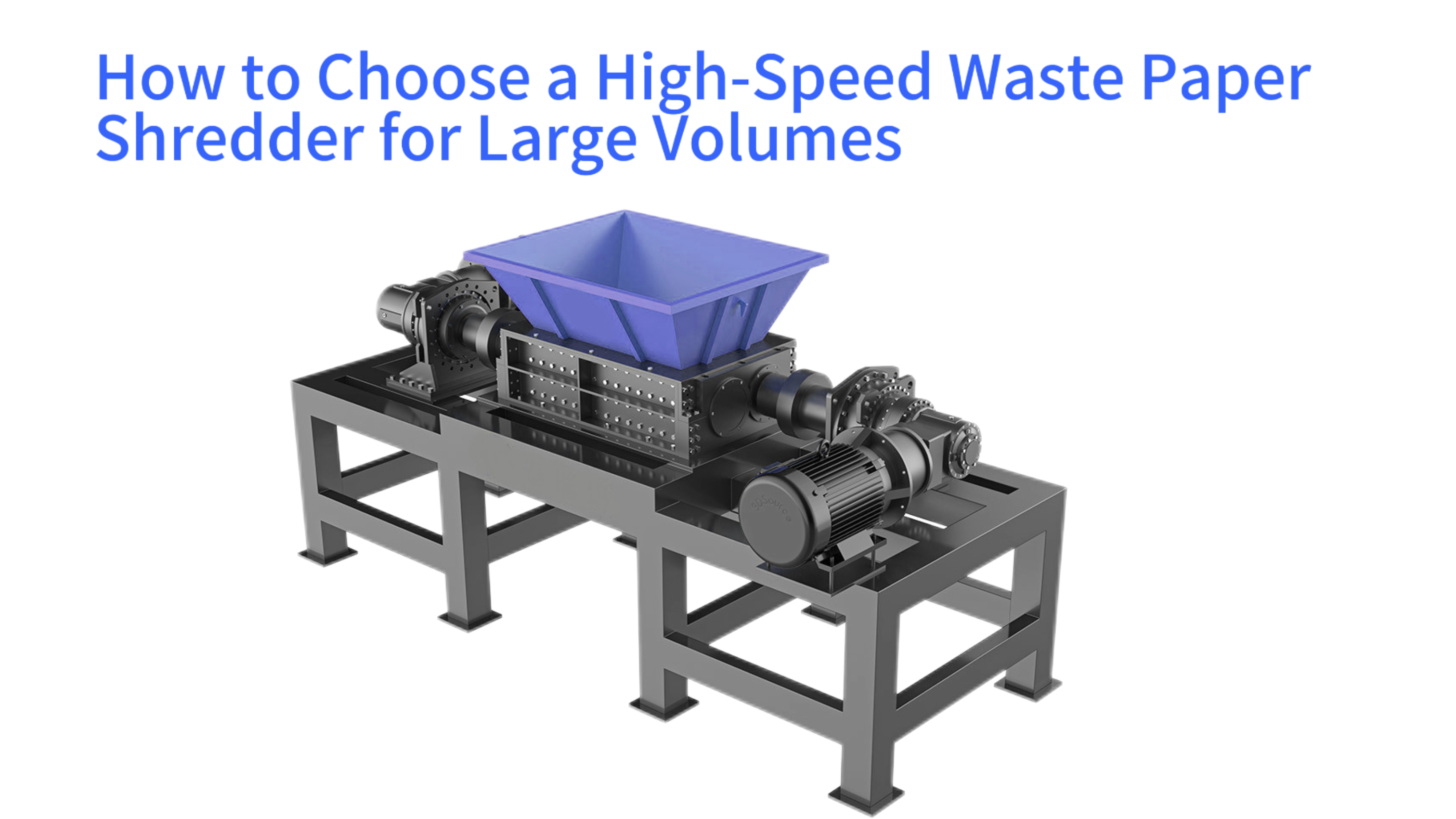
Core Steps to Choose a High-Speed Waste Paper Shredder for Large Volumes
The management of confidential information remains a critical operational priority in modern professional environments. A central component of this practice is the secure and efficient destruction of paper-based documents. Standard shredders often prove inadequate for organizations or departments that generate substantial paper waste, leading to bottlenecks and potential security lapses. This guide provides a detailed examination of the factors that define a true high-volume, high-speed paper shredder. It moves beyond basic specifications to analyze the engineering principles, practical selection criteria, and long-term performance considerations necessary for making an informed investment. The objective is to identify a machine that transforms document destruction from a time-consuming task into a seamless, secure, and reliable process.
Defining "High-Speed" Shredding: Core Performance Metrics
| Performance Metric | Consumer-Grade Shredder | Commercial-Grade Shredder |
|---|---|---|
| Sheets Per Minute (SPM) | 8-10 SPM (marketed as "fast") | 20-30 SPM (cross-cut); >100 SPM (heavy-duty) |
| Continuous Run Time | 5-10 minutes | 30-60 minutes (before cooling) |
| Cutting Style & Speed | Strip-cut (fastest); basic cross-cut | Cross-cut/micro-cut (high security + high torque motors) |
| Feed Opening Width | Narrow (≈9 inches) | Wide (≥12 inches) |
The term "high-speed" in the context of shredders is frequently misunderstood, often incorrectly associated solely with motor noise or a single numerical figure. Genuine high-speed performance for large volumes is a composite result of several interdependent metrics that determine real-world throughput. A machine must sustain its processing rate over extended periods, not merely in short bursts. Evaluating these metrics together provides a realistic forecast of daily document destruction capacity and operational workflow efficiency.
Sheets Per Minute and Feed Opening Width
The advertised shred speed, measured in sheets per minute, indicates how many individual sheets a machine can theoretically process in one minute under standard conditions. However, this number alone is misleading without considering the feed opening width. A wider feed opening allows multiple sheets or folded documents to be fed simultaneously, drastically increasing actual throughput. A shredder rated at 20 sheets per minute with a 12-inch wide entry will process a ream of paper significantly faster than a model with the same sheet-per-minute rating but a narrow 9-inch throat. The practical efficiency is a function of the shred speed and the physical capacity of the intake.
Continuous Run Time and Cooling Intervals
Motor durability is paramount for volume processing. Specifications for continuous run time and required cool-down periods reveal a machine's true stamina. A robust commercial shredder may operate continuously for 30 to 60 minutes before requiring a cooling pause, while a light-duty model may be limited to 5-10 minutes. For processing hundreds or thousands of pages, a long run time is more valuable than a high peak shred speed that cannot be sustained. Selecting a unit with a run time that matches your typical destruction sessions prevents frustrating mid-task stoppages due to motor thermal protection triggers.
The Security-Speed Trade-off in Cutting Styles
There exists an inherent engineering compromise between particle size and processing speed. Strip-cut shredders, which slice paper into long strips, offer the fastest throughput due to simpler cutting blades mechanics. Cross-cut and micro-cut shredders provide exponentially higher security by creating small particles or confetti, but the complex cutting action requires more power and time per sheet. High-volume, high-security environments need machines specifically engineered to mitigate this trade-off, often through more powerful motors and hardened cutting systems.
Classifying Consumer-Grade vs. Commercial-Grade Speed
The expectations for "high speed" differ categorically between home offices and corporate settings. A consumer-grade model processing 8-10 sheets per minute may be marketed as fast for its class. In contrast, a true commercial high-speed shredder starts at approximately 20-30 sheets per minute for cross-cut models, with heavy-duty variants exceeding 100 sheets per minute. Recognizing this classification prevents the disappointment of under-specifying a machine for demanding professional use.
Engineering Principles Behind Shredding Velocity
Engineering Principles of Shredding Velocity
Primary force source (HP/Watts + rotational torque) for heavy loads
Blade design (staggered/hook-shaped) reduces friction & boosts feed speed
Eliminates manual operation, streamlines sequential feeding
Cooling fans/heat sinks prevent overheating for sustained speed
| Motor Feature | Commercial-Grade Motor | Consumer-Grade Motor |
|---|---|---|
| Insulation & Cooling | Enhanced insulation + dedicated cooling fans | Basic insulation, no specialized cooling |
| Torque Performance | High torque (no stalling for thick stacks/staples) | Low torque (prone to stalling with heavy loads) |
| Thermal Stress Resistance | Designed for prolonged high-speed operation | Only suitable for short intermittent use |
The observable speed of a paper shredder is a direct output of its internal mechanical design and component quality. Superior performance stems from the synergistic operation of a powerful drive system, an efficient cutting mechanism, and intelligent control electronics. Understanding these underlying principles empowers a buyer to assess the durability and reliability promised by a product's specifications. The construction of these core components dictates not only initial performance but also the machine's longevity under strenuous conditions.
Motor Power and Torque Characteristics
The motor is the primary source of a shredder's force. Its power, often denoted in horsepower (HP) or watts, determines its ability to handle heavy loads. Torque, the rotational force delivered by the motor, is particularly crucial for initiating cuts through thick stacks or resistant materials like staples and credit cards. A high-torque motor ensures consistent feed motion without stalling, which is essential for maintaining a steady, high-speed operation. Motors designed for commercial use feature enhanced insulation and cooling to endure the thermal stress of prolonged activity.
Variations in Cutting Mechanism Design
The design of the cutting cylinder directly influences feed smoothness and speed. Traditional parallel-shaft designs with straight blades are common. More advanced systems may employ staggered, hook-shaped, or spherical cutting teeth that actively grip and pull paper into the mechanism, enhancing feed reliability. The precision of the blade alignment and the hardness of the steel used affect both cutting consistency and the frequency of maintenance. A well-engineered mechanism minimizes friction and resistance, allowing paper to move through the cutting chamber with minimal effort from the motor.
The Role of Auto-Start Sensors
Operational speed is not solely about mechanical cutting time; it also includes user interaction time. Shredders equipped with an auto-start sensor eliminate the need to manually press a switch. Inserting paper automatically activates the motor, streamlining the process for rapid, sequential feeding. This feature is especially valuable in high-volume settings where users are processing many separate batches of documents, as it removes a repetitive manual step and contributes significantly to overall task efficiency.
Thermal Management Systems
Sustained high-speed operation generates substantial heat within the motor and cutting assembly. Effective thermal management is critical to prevent overheating, which can trigger automatic shutdowns or cause long-term damage to components. Quality shredders incorporate features like cooling fans, heat sinks, and optimized internal air channels to dissipate heat. Some models include an overheat protection sensor that proactively cycles the motor or regulates speed to maintain a safe operating temperature, ensuring consistent performance during long sessions.
Matching Shredder Type to Specific Volume Needs
| Operational Scenario | Recommended Shredder Type | Key Features for High-Speed/Volume |
|---|---|---|
| Mixed Media (Paper/CD/Cards/Badges) | Heavy-Duty/High-Capacity Mixed Media Shredder | Fortified cutting mechanism, jam-resistant feed paths |
| Centralized Shredding (Massive Quantities) | Industrial Centralized Shredder | 100% duty cycle, continuous high-speed operation |
| Departmental Shredding (Immediate Destruction) | Departmental High-Speed Shredder | Mid-range run time, compact design, auto-start sensors |
| Hands-Free High-Volume Processing | Auto-Feed High-Speed Shredder | 500-sheet hopper, controlled auto-feed rate, low jam risk |
| Bound Reports/Manuals (Tight Spines) | High-Torque Bound Document Shredder | Powerful feed rollers, high torque motor |
| Loose Sheets (Invoices/Forms) | Wide-Opening Low-Friction Shredder | ≥12-inch feed opening, low-friction paper path |
Centralized vs Departmental Shredding Strategy
Centralized Shredder
High-volume continuous processing
Located in records room/loading dock
Requires document transportation
Efficiency of scale
Departmental Shredder
Immediate on-site destruction
Supports privacy protocols (least privilege)
No document transportation needed
Convenient for daily small-batch processing
High-volume document destruction is not a monolithic task. The nature of the material, the required security level, and the operational workflow dictate the most suitable type of high-speed shredder. Selecting the correct category of machine from the outset ensures that the purchased equipment aligns perfectly with daily routines rather than forcing an adaptation. A mismatch here can lead to underutilization, frequent overloading, or an inability to handle specific document formats, negating the investment in speed.
High-Speed Shredders for Mixed Media
Modern offices dispose of more than just paper. Confidential materials often include CDs, DVDs, credit cards, and ID badges. High-volume, high-speed shredders designed for mixed media incorporate fortified cutting mechanisms and feed paths to process these diverse materials without jamming or damage. These are typically classified as heavy-duty or high-capacity models. Their ability to swiftly handle a variety of disposal items consolidates what would otherwise be multiple separate tasks, offering a comprehensive and efficient destruction solution for sensitive information in any form.
Centralized versus Departmental Shredding Strategies
The choice between a large centralized shredder and several departmental units involves a strategic analysis of workflow and volume. A centralized industrial shredder, often located in a records room or loading dock, can process massive quantities continuously but requires staff to transport documents. Departmental high-speed shredders offer greater convenience and immediate destruction at the point of generation, supporting privacy protocols. The decision balances the efficiency of scale against the principle of least privilege and the practicalities of document logistics within the organization.
The Efficiency of Automatic Feed Systems
For the ultimate in hands-free, high-volume processing, shredders with an integrated auto-feed function are unmatched. These units feature a dedicated hopper where a stack of up to 500 sheets can be placed. An internal mechanism then automatically draws sheets into the shredding mechanism at a controlled rate until the stack is gone. This technology liberates staff for other duties and ensures consistent feeding for optimal speed and reduced jam risk. It represents the pinnacle of efficiency for destroying archived records, large reports, or daily accumulations of sensitive print-outs.
Optimizing for Bound Reports or Loose Sheets
The physical format of documents influences shredder requirements. Bound reports, manuals, or legal documents with tight spines require a shredder with powerful feed rollers and high torque to pull the entire set through without manual separation of pages. Conversely, processing high volumes of individual loose sheets, such as invoices or forms, prioritizes a wide feed opening and a very reliable, low-friction paper path to prevent multi-sheet jams. Identifying the primary document format ensures the selected high-speed machine is optimized for the specific materials it will encounter most frequently.
Critical Ancillary Features for High-Volume Operations
| DIN 66399 Security Level | Particle Size | Use Case | Speed Trade-off |
|---|---|---|---|
| P-1 (Strip-cut) | ≥40 mm (strip length) | Non-confidential documents | Fastest throughput |
| P-4 (Cross-cut) | ≤12 mm × ≤60 mm | Standard confidential business docs | Moderate speed (balanced security/speed) |
| P-7 (Micro-cut) | ≤1 mm × ≤5 mm | Top-secret data | Slowest throughput (high power required) |
While raw shredding speed is the primary target, several supporting features are indispensable for a sustainable high-volume operation. These elements determine the machine's practicality, safety, and overall integration into the work environment. Overlooking them in favor of speed specifications alone can result in a machine that is fast in theory but frustrating and inefficient in daily practice. A holistic evaluation guarantees that performance is not compromised by peripheral shortcomings.
Balancing Security Level Standards with Performance
Document security is governed by international standards like DIN 66399, which define shred sizes (P-1 to P-7) corresponding to confidentiality levels. A high-volume operation must select a machine that meets the required security level without sacrificing necessary throughput. For standard confidential business documents (often P-4 cross-cut), many high-speed models are available. For top-secret data requiring P-7 micro-cut, the selection of genuinely fast models narrows, reflecting the greater power and precision needed. The security classification provides the non-negotiable baseline for all other performance considerations.
Anti-Jamming Mechanisms and Error Recovery
In a high-speed context, even occasional paper jams cause significant disruption. Advanced anti-jamming designs are therefore critical. These can include features like sensitive overload detection that stops the motor before a jam worsens, automatic reverse functions to clear minor misfeeds, and easy-access jam-release levers. A wide feed opening itself is a primary anti-jam feature, reducing the need for precise paper alignment. The presence and effectiveness of these mechanisms directly correlate to operational uptime and user satisfaction.
Bin Capacity and Emptying Convenience
A high-speed shredder will rapidly fill its waste container. A large-capacity integrated bin, typically measured in gallons or liters, is essential to minimize interruptions for emptying. For the highest volume applications, some shredders can connect to external wheeled bins, effectively providing unlimited capacity. The physical design of the bin is equally important; features like handles, smooth-rolling casters, and bag supports or integrated liners streamline the disposal process, maintaining the workflow efficiency established by the shredder's speed.
Noise Emission During Operation
The acoustic output of a powerful shredder can be considerable, often exceeding 70 decibels. In open-plan offices or shared workspaces, this noise can be disruptive. While all high-speed shredders generate operational sound, models equipped with sound-dampening enclosures, insulated cutting chambers, or specially balanced motors offer noticeably quieter performance. Evaluating the noise level specification, usually provided in dB(A), ensures the machine's acoustic profile is acceptable for its intended location, preventing it from becoming a source of environmental discomfort.
Evaluating Sustained Throughput Over Peak Specifications
| Shredder Type | Duty Cycle (Run Time : Cool-down Time) | Operational Use Case |
|---|---|---|
| Industrial Central Shredder | 100% (non-stop operation) | 24/7 high-volume centralized destruction |
| Commercial Heavy-Duty Shredder | 30 mins : 30 mins (50% duty cycle) | Continuous batch processing (hundreds of pages) |
| Consumer-Grade Shredder | 5 mins : 25 mins (17% duty cycle) | Short intermittent home/office use |
Marketing materials frequently highlight maximum or peak performance figures that may not reflect consistent real-world operation. A discerning evaluation focuses on metrics and designs that indicate sustained throughput and long-term reliability. This perspective shifts the assessment from immediate capability to enduring performance, which is the true measure of a machine's value in a high-volume setting. The goal is to select a workhorse, not a sprinter that falters under sustained pressure.
Interpreting Duty Cycle Specifications
The duty cycle is a crucial specification that defines a shredder's endurance. It is often expressed as a ratio of run time to cool-down time (e.g., 30 minutes on / 30 minutes off) or as a percentage of an hour it can operate continuously. A machine with a 100% duty cycle is rated for non-stop operation, which is typical of central destruction systems. Models with lower duty cycles are designed for intermittent use. For volume processing, a high duty cycle is more indicative of useful performance than a high sheets-per-minute rate coupled with a very short run time.
Long-Term Reliability from User Reviews and Tests
Published specifications provide a starting point, but long-term user experiences offer invaluable insights into reliability. Consulting professional reviews that include stress tests, where a machine is tasked with shredding several full reams of paper consecutively, can reveal performance under load not evident from datasheets. Feedback from users in similar high-volume roles can highlight common wear points, maintenance issues, or model-specific strengths and weaknesses that affect total cost of ownership and operational dependability over years of service.
Maintenance Requirements and Consumable Parts
To maintain high-speed performance, regular maintenance is non-negotiable. This primarily involves lubricating the cutting blades with manufacturer-recommended shredder oil to reduce friction and heat. The frequency of this task increases with usage volume. Furthermore, the cutting blades themselves are consumable items. Understanding the expected lifespan of the blades under normal use and the cost and complexity of shredder shaft or cutter replacement is a critical long-term consideration. A machine with easily accessible and replaceable cutters offers lower lifetime operating costs.
Manufacturer Reputation and Warranty Coverage
The brand's reputation and the terms of the warranty serve as a proxy for expected quality and durability. Established manufacturers with a focus on commercial equipment typically use higher-grade materials in their motors, cutters, and gear systems. A comprehensive warranty, such as a multi-year coverage on parts and labor or a specific guarantee on cutting heads, reflects the manufacturer's confidence in their product's ability to withstand high-volume use. This support network provides financial protection and peace of mind, ensuring assistance is available if mechanical issues arise.
A Practical Selection Framework for Volume Shredders
Practical Selection Framework for High-Volume Shredders
Audit daily/peak paper volume, media types, and mandated security levels (per data protection policies).
Filter by security level, feed opening width, minimum run time, and SPM to shortlist viable models.
Evaluate total cost of ownership (energy, maintenance, parts) + productivity features (auto-feed/quiet operation).
Select a machine with modestly excess capacity to accommodate future volume/security regulation changes.
Translating theoretical knowledge into a concrete purchasing decision requires a structured, step-by-step approach. This framework distills all prior considerations into a actionable methodology, guiding the buyer from needs analysis to final model comparison. By following a disciplined process, the risk of selecting an ill-suited machine is minimized. The outcome is a confident investment in a piece of equipment that will deliver reliable, high-speed document destruction tailored to specific operational demands.
Step One: Quantifying Document Volume and Security Needs
The initial step involves a precise audit of destruction requirements. Key questions must be answered: What is the average daily volume of paper requiring shredding? What is the peak volume for end-of-month or year-end purges? What types of media need to be destroyed? Most critically, what security level is mandated by data protection policies or industry regulations? Documenting answers to these questions creates a definitive requirements profile against which all potential shredders can be objectively measured, moving the selection process from subjective preference to data-driven matching.
Step Two: Filtering Models by Core Speed and Capacity Metrics
With a clear needs profile, the market can be filtered using the non-negotiable technical benchmarks. The primary filters are the required security level and the necessary feed opening width to handle typical document sizes. Secondary filters include the minimum acceptable continuous run time and sheets-per-minute rate that aligns with volume targets. Applying these filters within the established budget will narrow the field to a shortlist of models that possess the fundamental engineering capability to meet the core demand for fast, high-volume processing.
Step Three: Comparative Analysis of Features and Total Cost
The final shortlisted models require a detailed feature-by-feature comparison to identify the best value proposition. This analysis extends beyond the purchase price to consider total cost of ownership. Factors include energy consumption, the cost and schedule of required maintenance, the price and availability of replacement parts like bags or cutting blades, and the value of productivity-enhancing features like auto-feed or quiet operation. This stage determines which machine offers the most robust and cost-effective solution over its anticipated service life.
Strategic Investment for Future Operational Scaling
A prudent investment accounts for future growth in document volume or security requirements. If budget allows, selecting a machine with capabilities that modestly exceed current needs provides a buffer for increased activity and extends the machine's relevant service life. This foresight prevents the need for a premature replacement or the addition of a second unit. Considering potential changes in regulation or business scale ensures the chosen shredder remains a viable and compliant asset for the foreseeable future, protecting the initial capital expenditure.