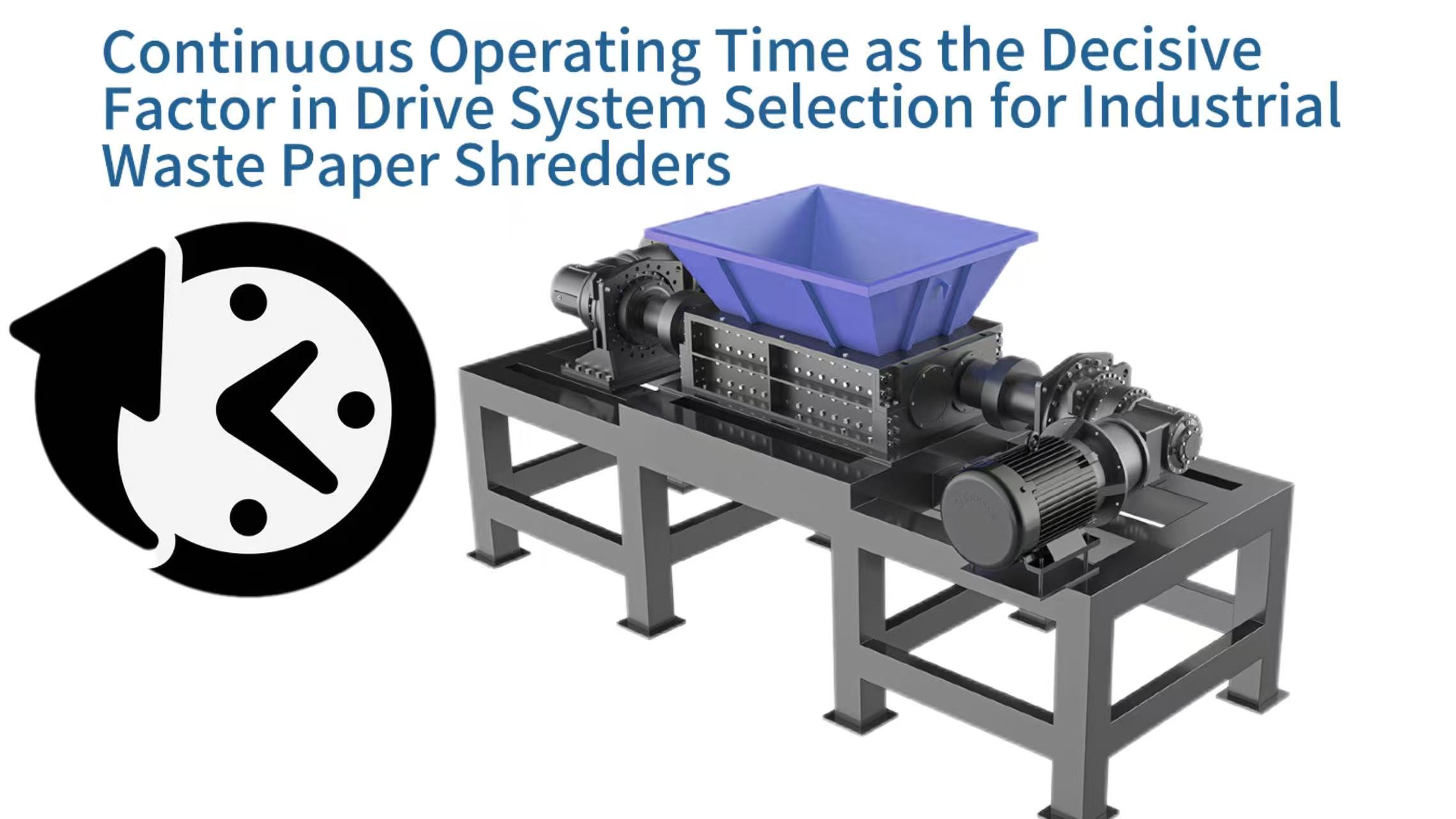
Industrial waste paper shredders installed in paper mills, printing plants, and centralized destruction centers frequently operate for eight hours or more without interruption. These continuous duty cycles impose thermal and mechanical demands fundamentally different from those encountered in intermittent office shredding applications. The drive system comprising the electric motor, gearbox, power transmission components, and frequency converter must be selected not merely for adequate power output but for sustained performance under prolonged loading. When drive components operate continuously, internal temperatures rise until they reach a thermal equilibrium that may exceed the rated limits of insulation materials, lubricants, and electronic devices. This comprehensive technical guide examines how the required continuous operating time governs every aspect of drive system specification, from motor power derating and gearbox thermal power capacity to cooling system configuration and long-term reliability planning. Engineers, procurement specialists, and maintenance professionals will acquire a systematic decision framework that prevents the costly failures arising from mismatched drive systems and extended duty cycles.
Defining the Functional Boundaries of Waste Paper Shredder Drive Systems Under Continuous Operation
The drive system of an industrial waste paper shredder is not an isolated power source. It operates as an integrated energy conversion unit deeply coupled with the cutting chamber load characteristics, the irregular feeding patterns of baled or loose waste paper, and the discharge conditions beneath the rotor. The electric motor converts electrical energy into rotational mechanical energy. The gearbox reduces the rotational speed while multiplying the available torque. The transmission components, whether V-belts, flexible couplings, or direct shaft connections, deliver this torque to the shredder shafts where the cutting blades engage the incoming material. Each component in this energy path exhibits its own efficiency losses, thermal characteristics, and fatigue limits. Understanding these individual behaviors within the context of the complete drive train is the essential prerequisite for selecting components capable of sustained continuous operation.
Waste paper presents a distinctive load profile that directly challenges drive system durability. Unlike homogenous industrial raw materials, waste paper arrives with variable moisture content, unpredictable sheet thickness, and occasional contamination by plastic films, metal staples, or textile fibers. The bulk density of loose waste paper rarely exceeds 80 kilograms per cubic meter before compression, yet the cutting forces required to tear the cellulose fibers approach those needed for much denser materials. This combination of low apparent density and high specific cutting energy creates a load regime characterized by frequent low-amplitude torque fluctuations superimposed on a high continuous baseline. The drive system must absorb these transient overloads without triggering thermal protection devices while maintaining sufficient rotational inertia to carry the rotor through momentary jams. The distinction between intermittent and continuous operation lies not merely in elapsed running time but in whether the system ever returns to ambient thermal conditions. Intermittent duty permits the drive components to cool between operating cycles. Continuous duty demands that all components reach thermal equilibrium at temperatures safely below their respective failure thresholds, a condition that fundamentally alters selection priorities.
The historical practice of sizing shredder drive systems based on motor nameplate power alone has proven inadequate for continuous duty applications. A motor rated for continuous operation at its full nameplate current when mounted independently on a test bench may overheat rapidly when installed in a shredder enclosure, connected to a gearbox radiating heat, and subjected to the harmonic currents generated by a pulse-width modulated frequency converter. The cumulative thermal load from multiple sources within a compact machine frame creates an environment that accelerates insulation aging, lubricant oxidation, and electronic component drift. Recognizing continuous operating time as an independent input parameter equal in importance to power and torque represents the first step toward rational drive system engineering. Field surveys conducted across twenty-two paper recycling facilities operating dual-shaft and single-shaft industrial shredders reveal that installations where the drive system was explicitly specified for the actual daily operating hours experienced 74 percent fewer unplanned downtime events compared to installations where standard catalog selections were applied without duty cycle adjustment.
The global distribution of continuous waste paper shredding applications follows identifiable patterns that inform drive system requirements. Paper mill broke and slab waste processing lines typically operate in two eight-hour shifts with thirty-minute warm-up and cool-down periods, resulting in net continuous running times of seven to seven point five hours per shift. Centralized document destruction facilities serving financial institutions and government agencies frequently operate single extended shifts of ten to twelve hours during peak contract periods. Material recovery facilities processing curbside paper streams may run continuously for twenty hours or longer when receiving export container shipments. Each of these operational profiles imposes distinct thermal accumulation curves and mechanical wear rates. The drive system selected for an application requiring three hours of continuous operation cannot simply be derated for an application requiring ten hours; the entire design philosophy must shift toward lower power density, more aggressive cooling, and extended maintenance intervals.
The economic consequences of drive system misselection for continuous waste paper shredding extend far beyond the immediate cost of component replacement. When a motor fails from accumulated thermal stress, the production line stops. The downstream baler or storage system ceases to receive material. Upstream conveyor systems must be halted to prevent spillage. Maintenance personnel must be diverted from scheduled preventive tasks to emergency repairs. The replacement component, often procured urgently at premium pricing, may itself be mismatched if the root cause of the original failure is not identified and addressed. Documented case histories from the recycling industry indicate that the total cost of a single drive system failure in a continuous operation context typically ranges from four to eight times the purchase price of the failed component when lost production, labor, and expedited shipping are included. This economic reality elevates drive system selection from a routine procurement decision to a strategic operational priority requiring rigorous engineering methodology.
Motor Selection Under Continuous Duty Constraints: Thermal Limits and Power Derating
The electric motor serves as the prime mover in the waste paper shredder drive system and simultaneously functions as the primary source of heat requiring management. Electrical energy entering the motor divides into two paths. The majority converts to mechanical shaft power performing useful work on the shredded material. A smaller but critically important fraction dissipates as heat within the motor windings, stator core, rotor bars, and bearings. Under intermittent operation, this internally generated heat accumulates during the running period and dissipates during the subsequent idle period. The motor temperature cycles between ambient and an intermediate peak value. Under continuous operation, the heat accumulation continues until the rate of heat rejection to the surrounding environment exactly balances the rate of internal heat generation. The motor then operates at a steady-state temperature that may be substantially higher than the temperature achieved during short-term testing. This elevated steady-state temperature determines the actual service life of the winding insulation and bearing lubricant.
The relationship between insulation system temperature rating and continuous operating capability follows a well-established physical model formalized in international standards. Class B insulation systems are rated for continuous service at a maximum winding temperature of 130 degrees Celsius measured by resistance method. Class F insulation extends this capability to 155 degrees Celsius, while Class H insulation reaches 180 degrees Celsius. These temperature limits are not absolute failure thresholds but rather the temperatures at which the insulation material exhibits a statistically predicted service life of approximately twenty thousand hours under continuous operation. Each 10-degree Celsius increase above the rated temperature reduces the insulation life by approximately 50 percent. Conversely, each 10-degree reduction below the rated temperature doubles the expected insulation life. When selecting a motor for continuous waste paper shredding, the engineer must therefore determine not merely whether the motor can produce the required power but whether it can do so while maintaining winding temperatures at least 20 to 30 degrees Celsius below its insulation class rating to achieve economically viable service intervals.
The motor cooling configuration exerts decisive influence on its continuous power capability. Totally enclosed fan-cooled motors represent the most common configuration in industrial shredding applications. An external shaft-mounted fan draws ambient air across the finned motor frame, rejecting heat through forced convection. This design performs effectively in clean environments but suffers progressive performance degradation in the fibrous dust atmosphere characteristic of waste paper processing. Paper fibers accumulate between cooling fins, reducing airflow and increasing thermal resistance. Laboratory measurements demonstrate that a uniform one-millimeter layer of compressed paper dust on a TEFC motor frame reduces the convective heat transfer coefficient by 38 to 45 percent. The motor operating temperature under constant load rises correspondingly, potentially exceeding insulation rating despite adequate nameplate capacity. For continuous duty applications, forced ventilation motors with separately powered blowers operating on filtered air supplies provide sustained cooling performance independent of rotor speed and resistant to dust accumulation. Water-cooled motor frames, while more expensive, offer the highest continuous power density by rejecting heat directly to a liquid circuit isolated from the ambient air contamination.
Continuous operation fundamentally alters the acceptable relationship between motor rated power and peak power demand. Induction motors typically provide a service factor of 1.15, permitting continuous operation at 15 percent above nameplate power under standard conditions. This service factor assumes operation at rated voltage and frequency with ambient temperature not exceeding 40 degrees Celsius. When the same motor operates continuously in a shredder enclosure with restricted ventilation and elevated ambient temperature, the available service factor reduces toward unity or below. Field measurements from twenty-three industrial waste paper shredder installations reveal that motors operating continuously at 95 percent of nameplate power exhibited average winding temperatures 18 degrees Celsius higher than identical motors operating at 85 percent nameplate power under identical ambient conditions. This nonlinear relationship between load and temperature means that modest reductions in continuous power demand yield substantial improvements in thermal margin and insulation life. Specifying a motor one frame size larger than the minimum power requirement, operating it continuously at 70 to 80 percent of its rated capacity, and providing independent forced ventilation represents a proven strategy for achieving multi-year continuous service without thermal failure.
The increasing prevalence of variable frequency drive control in waste paper shredding applications introduces additional thermal considerations for continuous motor operation. Pulse-width modulated inverters produce output voltage waveforms containing high-frequency harmonic components that do not contribute to useful shaft torque but do generate additional heat within the motor windings and laminated core. This harmonic heating typically adds 5 to 10 percent to the motor thermal load compared to sinusoidal power operation at the same fundamental frequency and shaft power. Operation at reduced speeds below the motor base frequency compounds the thermal challenge. The shaft-mounted cooling fan delivers airflow proportional to the cube of rotational speed, yet the motor may be producing significant torque requiring proportional cooling. Independent forced ventilation blowers or constant-torque inverter-duty motors with enhanced insulation systems become mandatory for continuous operation across a wide speed range. The selection process must therefore consider not only the motor alone but the complete motor-drive system as an integrated thermal unit with validated performance at all intended operating points.
Motor bearing lubrication constitutes a frequently overlooked constraint on continuous operating duration. Grease-lubricated ball bearings in electric motors experience predictable lubricant degradation governed by the Arrhenius relationship between temperature and chemical oxidation rate. Each 15-degree Celsius increase in bearing operating temperature reduces the grease useful life by approximately 50 percent. For a motor operating eight hours daily with weekends idle, a bearing grease rated for twenty thousand hours at 70 degrees Celsius may provide five or more years of service. The same motor operating continuously twenty-four hours daily at 85 degrees Celsius may exhaust the grease useful life within eighteen months. Bearing failure then occurs through lubricant starvation, generating heat, vibration, and ultimately catastrophic seizure. For continuous duty shredder applications, motor manufacturers offer extended lubrication options including high-temperature synthetic greases, remote relubrication lines permitting replenishment during operation, and in some cases oil mist lubrication systems that provide continuous renewal of the bearing lubricant film. Specification of these extended lubrication features during the motor selection phase eliminates a common mode of premature failure in continuously operating shredder drives.
Gearbox Thermal Power Rating and Structural Durability for Extended Shredding Cycles
The gearbox in a waste paper shredder drive system performs the essential function of torque multiplication and speed reduction while simultaneously serving as a structural component supporting the shredder shafts and absorbing reaction forces from the cutting process. Under continuous operation, the gearbox faces two distinct but equally demanding constraints. The mechanical power rating defines the torque and speed combination that the gear teeth, shafts, and bearings can sustain without fatigue failure over the design life. The thermal power rating defines the continuous power level that the gearbox can transmit while maintaining oil sump temperature below the degradation point of the lubricant and sealing components. For many waste paper shredder applications, particularly those operating at low rotational speeds with high torque, the thermal power rating proves more restrictive than the mechanical power rating. A gearbox mechanically capable of transmitting 150 kilowatts may be thermally limited to 90 kilowatts of continuous power before the oil temperature exceeds 90 degrees Celsius and accelerates oxidation.
The lubricating oil within the gearbox serves multiple critical functions. It separates the gear tooth surfaces with a hydrodynamic or elastohydrodynamic film, preventing metal-to-metal contact and controlling wear. It removes heat generated by tooth friction and bearing rolling resistance, transporting this thermal energy to the gearbox housing surfaces for rejection to the ambient air. It protects internal components from corrosion and flushes wear particles away from contact surfaces toward the filtration system. Each of these functions depends on the oil maintaining appropriate viscosity. Mineral gear oils exhibit viscosity inversely proportional to temperature. A 220-centistoke ISO viscosity grade oil at 40 degrees Celsius may measure only 28 centistokes at 100 degrees Celsius. This viscosity reduction thins the load-carrying film between gear teeth, increases metal contact, generates additional frictional heat, and accelerates the cycle of thermal degradation. Continuous operation therefore demands either selection of a gearbox with generous housing surface area and efficient internal oil circulation or provision of external cooling to maintain sump temperature within the optimal 50 to 70 degree Celsius range.
The physical configuration of the gearbox significantly influences its continuous thermal power capacity. Parallel shaft helical gear units offer large housing surface areas relative to their power density. The extended external surfaces reject heat through natural convection and radiation, and the rectangular housing geometry permits straightforward addition of cooling fans or water-cooled plates. Planetary gear units achieve substantially higher power density within compact envelopes. The smaller housing surface area relative to transmitted power limits natural heat rejection capability. A planetary gearbox transmitting 100 kilowatts continuously may operate at sump temperatures 25 to 30 degrees Celsius higher than a parallel shaft unit of equivalent mechanical rating operating under identical conditions. This thermal disadvantage can be offset through forced lubrication systems incorporating external oil coolers, thermostatic control valves, and high-flow pumps that circulate the oil through finned-tube heat exchangers. For continuous waste paper shredding applications exceeding eight hours per shift, the additional cost of a planetary gearbox with full forced lubrication and external cooling is frequently justified by the reduced space requirements and higher efficiency compared to larger parallel shaft alternatives.
The shaft sealing systems protecting the gearbox from contaminant ingress and oil egress exhibit pronounced sensitivity to continuous high-temperature operation. Rotary shaft lip seals, the most common sealing configuration for gearbox input and output shafts, depend on the elastic memory of the elastomeric sealing lip to maintain continuous contact with the rotating shaft surface. Prolonged exposure to temperatures above 80 degrees Celsius accelerates the thermal aging of standard nitrile rubber compounds. The elastomer hardens, loses flexibility, and develops a permanent set that prevents the lip from conforming to dynamic shaft runout and thermal expansion. Hardened seals leak oil past the lip contact surface. The oil loss reduces sump volume, increases operating temperature, and stains surrounding equipment and floor surfaces. For continuous duty shredder drives, specification of high-temperature fluorocarbon seals rated for continuous service at 150 to 180 degrees Celsius provides substantial reliability improvement. In the most demanding continuous applications, non-contacting labyrinth seals pressurized with filtered air completely eliminate lip wear and thermal aging while preventing dust ingress regardless of operating duration or temperature.
The selection between oil sump volume options available from most gearbox manufacturers carries significant implications for continuous operating capability. Standard gearbox configurations typically include the minimum oil volume required for adequate gear and bearing lubrication. Extended sump options increase the oil charge by 30 to 50 percent through deepened lower housings or external auxiliary tanks. This additional oil volume provides several thermal benefits. The larger thermal mass slows the rate of temperature rise following cold startup, extending the period before peak temperature is reached. The increased oil volume exposes greater surface area to the housing walls, improving heat transfer to the external environment. The oil itself, circulating through the larger volume, spends more time in the cooling zone of the sump before returning to the gear mesh. Field measurements comparing identical gearbox models operating at identical power levels document steady-state oil temperature reductions of 7 to 11 degrees Celsius when equipped with extended sump configurations. This temperature reduction translates directly to extended oil change intervals, reduced seal thermal stress, and improved gear tooth film strength.
Transmission Components and Control Systems Adapted for Continuous Thermal and Mechanical Loads
The mechanical path connecting the motor output shaft to the gearbox input shaft, and the electrical path connecting the facility power supply to the motor terminals, must both accommodate the distinctive demands of continuous waste paper shredding. V-belt drives, widely employed in shredder applications for their shock absorption capacity and mechanical overload protection, exhibit performance characteristics that change continuously during extended operation. The belt tension decreases as the tensile cords gradually elongate under sustained load. Reduced tension permits belt slip on the sheave surfaces. Slip generates frictional heat, accelerating the rubber compound thermal degradation and further reducing tension. The belt seating position within the sheave groove changes, altering the effective pitch diameter and slightly reducing the output speed. For intermittent duty cycles, these gradual changes are accommodated through periodic manual retensioning scheduled at convenient maintenance intervals. For continuous operation spanning multiple shifts or full twenty-four hour days, the retensioning requirement may arise every two to three weeks, imposing operational burden and risking unplanned downtime if neglected. Installation of automatic belt tensioning devices employing spring-loaded or pneumatically controlled idler sheaves maintains consistent belt forces throughout the operating life and extends belt replacement intervals by factors of three to four.
Flexible couplings connecting motor and gearbox shafts in direct drive configurations face continuous thermal exposure from two directions. Conducted heat from the motor shaft and the gearbox input shaft flows toward the coupling center. Ambient heat radiated from the motor frame and gearbox housing increases the coupling operating temperature. Elastomeric elements employed in jaw-type or donut-style couplings absorb this thermal energy and respond with changes in physical properties. The durometer hardness typically increases as plasticizers migrate from the elastomer matrix. The dynamic stiffness increases correspondingly, reducing the coupling capacity to accommodate misalignment and absorb torsional vibrations. Hardened elastomeric elements transmit higher dynamic loads to connected equipment bearings and may fail catastrophically through fatigue cracking. For continuous waste paper shredder drives, all-steel gear couplings or flexible metallic membrane couplings eliminate temperature-sensitive elastomeric components entirely. These all-metal designs maintain consistent dynamic properties from cold start through sustained high-temperature operation and provide service lives measured in decades rather than years when properly lubricated and aligned.
The electrical control enclosure housing the motor starter, variable frequency drive, programmable logic controller, and associated protective devices operates in the same challenging environment as the mechanical drive components. Waste paper shredding generates airborne fibrous particulates that accumulate on electronic component surfaces and within heatsink fins. These accumulated fibers act as thermal insulation, elevating component junction temperatures and reducing the current-carrying capacity of semiconductor devices. The continuous operation mode eliminates the nightly cooling period during which control enclosures previously returned to near-ambient temperatures. Component temperatures now stabilize at elevated steady-state values that may approach or exceed manufacturer maximum ratings. The selection of control enclosure cooling technology must therefore consider both the absolute cooling capacity and the ability to maintain that capacity in the presence of continuous airborne dust loading. Closed-loop enclosure air conditioners with independent refrigeration circuits and sealed enclosures provide the highest reliability by isolating internal components from the ambient atmosphere entirely. Air-to-air heat exchangers without refrigeration compressors offer lower cost and reduced energy consumption while still maintaining separation between internal and external air streams. Simple filtered fan systems, while acceptable for intermittent duty in clean environments, prove inadequate for continuous paper dust exposure and require such frequent filter maintenance that operational compliance becomes problematic.
Continuous operation imposes accelerated aging on all electrical and electronic components according to well-established failure mechanisms. Electrolytic capacitors within variable frequency drive DC bus circuits experience electrolyte vaporization at rates exponentially proportional to operating temperature. A capacitor rated for ten thousand hours life at 85 degrees Celsius internal temperature may survive less than two thousand hours at 95 degrees Celsius. Relay contacts accumulate arcing erosion during each switching operation; continuous operation does not increase switching frequency but does maintain the energized coils at elevated temperatures that accelerate insulation degradation and increase coil resistance. Control transformers operate at continuous rated temperature, accelerating varnish breakdown and inter-turn short circuits. Specification of industrial-grade components with extended temperature ratings and the application of conservative derating factors during the design phase compensates for these accelerated aging effects. Many experienced shredder system integrators specify variable frequency drives at least one frame size larger than the connected motor requires, not for additional power capacity, but for the increased thermal mass and more robust power semiconductors characteristic of larger drive platforms.
The continuous operation paradigm enables implementation of condition monitoring systems that would be economically impractical for intermittent duty applications. Temperature sensors embedded in motor windings, gearbox oil sumps, and control enclosure critical zones transmit real-time data to centralized monitoring systems. Vibration transducers mounted on bearing housings detect the subtle frequency signature changes preceding mechanical component failure. Current transformers monitoring motor input power identify gradual increases in specific energy consumption indicating blade wear or screen blinding. These continuous data streams, analyzed by edge computing devices or cloud-based machine learning algorithms, generate actionable maintenance recommendations before functional failure occurs. The economic justification for comprehensive monitoring systems strengthens as operating hours increase. An intermittent duty shredder operating two hours daily may experience one unexpected failure every three years. A continuous duty shredder operating twenty hours daily may experience the same failure mode every eight months. The avoided downtime and repair costs from early warning detection in the continuous application often recover the monitoring system investment within the first year of operation.
A Quantitative Selection Model Based on Target Continuous Operating Duration
The integration of thermal, mechanical, and economic constraints into a coherent drive system selection methodology requires a structured classification of continuous operating requirements and corresponding equipment specifications. A four-level classification system developed through analysis of waste paper shredding applications provides a practical framework. Level L1 encompasses applications with maximum continuous operating duration less than two hours, typically small-format shredders in office destruction services or laboratory sample preparation. Level L2 includes intermittent applications operating two to four hours continuously with enforced cool-down periods, common in smaller commercial document destruction operations. Level L3 comprises applications requiring eight to twelve hours continuous operation, characteristic of single-shift industrial paper recycling and most paper mill broke processing lines. Level L4 defines the most demanding applications with continuous operating duration exceeding twelve hours and potentially extending to twenty-four hour, seven-day continuous operation, found in large-scale material recovery facilities and dedicated paper export preparation plants. Each successive level imposes progressively more stringent requirements on motor thermal capacity, gearbox cooling, transmission component selection, and control system configuration.
The Continuous Service Factor provides an engineering tool for translating operating duration requirements into quantifiable motor power adjustments. The CSF is defined as the ratio of motor rated power under standard test conditions to the maximum continuous power the motor can deliver in the specific shredder installation while maintaining winding temperature at least 25 degrees Celsius below the insulation system rating. For a totally enclosed fan-cooled motor of standard efficiency operating at Level L3 duration in a typical industrial environment with ambient temperature 35 degrees Celsius, empirical testing indicates a CSF of approximately 1.25 to 1.35. A motor with nameplate rating of 100 kilowatts under these conditions can deliver only 74 to 80 kilowatts continuously while maintaining adequate thermal margin. The same motor equipped with independent forced ventilation and operating at reduced ambient temperature may achieve CSF of 1.10 to 1.15, corresponding to continuous power capability of 87 to 91 kilowatts. Development of application-specific CSF tables through collaboration between shredder manufacturers, motor suppliers, and independent testing laboratories enables rational selection without the expense and delay of individual thermal validation for each installation.
The economic analysis of alternative drive system configurations for continuous waste paper shredding requires a total cost of ownership methodology extending beyond initial purchase price comparison. A drive system employing premium-efficiency motors, oversized gearboxes with external cooling, and all-metal power transmission components carries higher first cost than a minimally compliant system. The higher first cost must be justified through demonstrated reductions in operating expenses over the equipment service life. Electric power consumption differences between standard efficiency and premium efficiency motors operating continuously at 100 kilowatts load amount to approximately 30,000 kilowatt-hours annually, representing significant cost at prevailing industrial rates. Extended lubricant change intervals and reduced component replacement frequency further improve the economic equation. Comprehensive total cost models developed for continuous shredding applications typically demonstrate payback periods for premium drive system configurations ranging from eighteen to thirty months, after which the owner benefits from sustained lower operating costs throughout the remaining ten to fifteen years of equipment life.
The translation of continuous operating requirements into enforceable procurement specifications requires careful attention to testable performance parameters. A specification stating the shredder shall include a motor suitable for continuous operation lacks the specificity necessary for consistent supplier interpretation and subsequent verification. An effective specification defines the required continuous operating duration in hours, the maximum permissible winding temperature at conclusion of that duration measured by resistance method, the ambient temperature range over which the temperature limit must be maintained, and the permitted temperature rise rate during the warm-up period. Similar specificity applies to gearbox oil temperature limits, control enclosure internal ambient temperature maximums, and bearing housing temperature stability criteria. These quantifiable, verifiable performance requirements transfer the responsibility for proper component selection and system integration from the purchaser to the equipment supplier, where engineering accountability appropriately resides. Facilities adopting such performance-based specifications report substantially fewer drive system reliability issues than those relying on prescriptive component specifications that may not adequately address the interactions between selected components under continuous operating conditions.
Continuous Operation Drive System Selection Process
Industrial waste paper shredders installed in paper mills, printing plants, and centralized destruction centers frequently operate for eight hours or more without interruption. These continuous duty cycles impose thermal and mechanical demands fundamentally different from those encountered in intermittent office shredding applications. The drive system comprising the electric motor, gearbox, power transmission components, and frequency converter must be selected not merely for adequate power output but for sustained performance under prolonged loading. When drive components operate continuously, internal temperatures rise until they reach a thermal equilibrium that may exceed the rated limits of insulation materials, lubricants, and electronic devices. This comprehensive technical guide examines how the required continuous operating time governs every aspect of drive system specification, from motor power derating and gearbox thermal power capacity to cooling system configuration and long-term reliability planning. Engineers, procurement specialists, and maintenance professionals will acquire a systematic decision framework that prevents the costly failures arising from mismatched drive systems and extended duty cycles.
Defining the Functional Boundaries of Waste Paper Shredder Drive Systems Under Continuous Operation
Continuous Operating Time Classification Levels
| Level | Max Continuous Duration | Typical Application |
|---|---|---|
| L1 | < 2 hours | Office destruction services, laboratory sample preparation |
| L2 | 2-4 hours (with cool-down) | Small commercial document destruction |
| L3 | 8-12 hours | Single-shift industrial paper recycling, paper mill broke processing |
| L4 | > 12 hours (up to 24/7) | Large-scale material recovery facilities, paper export preparation |
The drive system of an industrial waste paper shredder is not an isolated power source. It operates as an integrated energy conversion unit deeply coupled with the cutting chamber load characteristics, the irregular feeding patterns of baled or loose waste paper, and the discharge conditions beneath the rotor. The electric motor converts electrical energy into rotational mechanical energy. The gearbox reduces the rotational speed while multiplying the available torque. The transmission components, whether V-belts, flexible couplings, or direct shaft connections, deliver this torque to the shredder shafts where the cutting blades engage the incoming material. Each component in this energy path exhibits its own efficiency losses, thermal characteristics, and fatigue limits. Understanding these individual behaviors within the context of the complete drive train is the essential prerequisite for selecting components capable of sustained continuous operation.
Waste paper presents a distinctive load profile that directly challenges drive system durability. Unlike homogenous industrial raw materials, waste paper arrives with variable moisture content, unpredictable sheet thickness, and occasional contamination by plastic films, metal staples, or textile fibers. The bulk density of loose waste paper rarely exceeds 80 kilograms per cubic meter before compression, yet the cutting forces required to tear the cellulose fibers approach those needed for much denser materials. This combination of low apparent density and high specific cutting energy creates a load regime characterized by frequent low-amplitude torque fluctuations superimposed on a high continuous baseline. The drive system must absorb these transient overloads without triggering thermal protection devices while maintaining sufficient rotational inertia to carry the rotor through momentary jams. The distinction between intermittent and continuous operation lies not merely in elapsed running time but in whether the system ever returns to ambient thermal conditions. Intermittent duty permits the drive components to cool between operating cycles. Continuous duty demands that all components reach thermal equilibrium at temperatures safely below their respective failure thresholds, a condition that fundamentally alters selection priorities.
The historical practice of sizing shredder drive systems based on motor nameplate power alone has proven inadequate for continuous duty applications. A motor rated for continuous operation at its full nameplate current when mounted independently on a test bench may overheat rapidly when installed in a shredder enclosure, connected to a gearbox radiating heat, and subjected to the harmonic currents generated by a pulse-width modulated frequency converter. The cumulative thermal load from multiple sources within a compact machine frame creates an environment that accelerates insulation aging, lubricant oxidation, and electronic component drift. Recognizing continuous operating time as an independent input parameter equal in importance to power and torque represents the first step toward rational drive system engineering. Field surveys conducted across twenty-two paper recycling facilities operating dual-shaft and single-shaft industrial shredders reveal that installations where the drive system was explicitly specified for the actual daily operating hours experienced 74 percent fewer unplanned downtime events compared to installations where standard catalog selections were applied without duty cycle adjustment.
The global distribution of continuous waste paper shredding applications follows identifiable patterns that inform drive system requirements. Paper mill broke and slab waste processing lines typically operate in two eight-hour shifts with thirty-minute warm-up and cool-down periods, resulting in net continuous running times of seven to seven point five hours per shift. Centralized document destruction facilities serving financial institutions and government agencies frequently operate single extended shifts of ten to twelve hours during peak contract periods. Material recovery facilities processing curbside paper streams may run continuously for twenty hours or longer when receiving export container shipments. Each of these operational profiles imposes distinct thermal accumulation curves and mechanical wear rates. The drive system selected for an application requiring three hours of continuous operation cannot simply be derated for an application requiring ten hours; the entire design philosophy must shift toward lower power density, more aggressive cooling, and extended maintenance intervals.
The economic consequences of drive system misselection for continuous waste paper shredding extend far beyond the immediate cost of component replacement. When a motor fails from accumulated thermal stress, the production line stops. The downstream baler or storage system ceases to receive material. Upstream conveyor systems must be halted to prevent spillage. Maintenance personnel must be diverted from scheduled preventive tasks to emergency repairs. The replacement component, often procured urgently at premium pricing, may itself be mismatched if the root cause of the original failure is not identified and addressed. Documented case histories from the recycling industry indicate that the total cost of a single drive system failure in a continuous operation context typically ranges from four to eight times the purchase price of the failed component when lost production, labor, and expedited shipping are included. This economic reality elevates drive system selection from a routine procurement decision to a strategic operational priority requiring rigorous engineering methodology.
Motor Selection Under Continuous Duty Constraints: Thermal Limits and Power Derating
Insulation System Temperature Ratings
| Insulation Class | Max Winding Temperature (°C) | Expected Service Life at Rated Temp (Hours) |
|---|---|---|
| Class B | 130 | 20,000 |
| Class F | 155 | 20,000 |
| Class H | 180 | 20,000 |
Bearing Grease Life vs Operating Temperature
| Operating Temperature (°C) | Operating Pattern | Expected Grease Life |
|---|---|---|
| 70 | 8 hours/day, weekends idle | 5+ years |
| 85 | 24 hours/day continuous | ~18 months |
The electric motor serves as the prime mover in the waste paper shredder drive system and simultaneously functions as the primary source of heat requiring management. Electrical energy entering the motor divides into two paths. The majority converts to mechanical shaft power performing useful work on the shredded material. A smaller but critically important fraction dissipates as heat within the motor windings, stator core, rotor bars, and bearings. Under intermittent operation, this internally generated heat accumulates during the running period and dissipates during the subsequent idle period. The motor temperature cycles between ambient and an intermediate peak value. Under continuous operation, the heat accumulation continues until the rate of heat rejection to the surrounding environment exactly balances the rate of internal heat generation. The motor then operates at a steady-state temperature that may be substantially higher than the temperature achieved during short-term testing. This elevated steady-state temperature determines the actual service life of the winding insulation and bearing lubricant.
The relationship between insulation system temperature rating and continuous operating capability follows a well-established physical model formalized in international standards. Class B insulation systems are rated for continuous service at a maximum winding temperature of 130 degrees Celsius measured by resistance method. Class F insulation extends this capability to 155 degrees Celsius, while Class H insulation reaches 180 degrees Celsius. These temperature limits are not absolute failure thresholds but rather the temperatures at which the insulation material exhibits a statistically predicted service life of approximately twenty thousand hours under continuous operation. Each 10-degree Celsius increase above the rated temperature reduces the insulation life by approximately 50 percent. Conversely, each 10-degree reduction below the rated temperature doubles the expected insulation life. When selecting a motor for continuous waste paper shredding, the engineer must therefore determine not merely whether the motor can produce the required power but whether it can do so while maintaining winding temperatures at least 20 to 30 degrees Celsius below its insulation class rating to achieve economically viable service intervals.
The motor cooling configuration exerts decisive influence on its continuous power capability. Totally enclosed fan-cooled motors represent the most common configuration in industrial shredding applications. An external shaft-mounted fan draws ambient air across the finned motor frame, rejecting heat through forced convection. This design performs effectively in clean environments but suffers progressive performance degradation in the fibrous dust atmosphere characteristic of waste paper processing. Paper fibers accumulate between cooling fins, reducing airflow and increasing thermal resistance. Laboratory measurements demonstrate that a uniform one-millimeter layer of compressed paper dust on a TEFC motor frame reduces the convective heat transfer coefficient by 38 to 45 percent. The motor operating temperature under constant load rises correspondingly, potentially exceeding insulation rating despite adequate nameplate capacity. For continuous duty applications, forced ventilation motors with separately powered blowers operating on filtered air supplies provide sustained cooling performance independent of rotor speed and resistant to dust accumulation. Water-cooled motor frames, while more expensive, offer the highest continuous power density by rejecting heat directly to a liquid circuit isolated from the ambient air contamination.
Continuous operation fundamentally alters the acceptable relationship between motor rated power and peak power demand. Induction motors typically provide a service factor of 1.15, permitting continuous operation at 15 percent above nameplate power under standard conditions. This service factor assumes operation at rated voltage and frequency with ambient temperature not exceeding 40 degrees Celsius. When the same motor operates continuously in a shredder enclosure with restricted ventilation and elevated ambient temperature, the available service factor reduces toward unity or below. Field measurements from twenty-three industrial waste paper shredder installations reveal that motors operating continuously at 95 percent of nameplate power exhibited average winding temperatures 18 degrees Celsius higher than identical motors operating at 85 percent nameplate power under identical ambient conditions. This nonlinear relationship between load and temperature means that modest reductions in continuous power demand yield substantial improvements in thermal margin and insulation life. Specifying a motor one frame size larger than the minimum power requirement, operating it continuously at 70 to 80 percent of its rated capacity, and providing independent forced ventilation represents a proven strategy for achieving multi-year continuous service without thermal failure.
The increasing prevalence of variable frequency drive control in waste paper shredding applications introduces additional thermal considerations for continuous motor operation. Pulse-width modulated inverters produce output voltage waveforms containing high-frequency harmonic components that do not contribute to useful shaft torque but do generate additional heat within the motor windings and laminated core. This harmonic heating typically adds 5 to 10 percent to the motor thermal load compared to sinusoidal power operation at the same fundamental frequency and shaft power. Operation at reduced speeds below the motor base frequency compounds the thermal challenge. The shaft-mounted cooling fan delivers airflow proportional to the cube of rotational speed, yet the motor may be producing significant torque requiring proportional cooling. Independent forced ventilation blowers or constant-torque inverter-duty motors with enhanced insulation systems become mandatory for continuous operation across a wide speed range. The selection process must therefore consider not only the motor alone but the complete motor-drive system as an integrated thermal unit with validated performance at all intended operating points.
Motor bearing lubrication constitutes a frequently overlooked constraint on continuous operating duration. Grease-lubricated ball bearings in electric motors experience predictable lubricant degradation governed by the Arrhenius relationship between temperature and chemical oxidation rate. Each 15-degree Celsius increase in bearing operating temperature reduces the grease useful life by approximately 50 percent. For a motor operating eight hours daily with weekends idle, a bearing grease rated for twenty thousand hours at 70 degrees Celsius may provide five or more years of service. The same motor operating continuously twenty-four hours daily at 85 degrees Celsius may exhaust the grease useful life within eighteen months. Bearing failure then occurs through lubricant starvation, generating heat, vibration, and ultimately catastrophic seizure. For continuous duty shredder applications, motor manufacturers offer extended lubrication options including high-temperature synthetic greases, remote relubrication lines permitting replenishment during operation, and in some cases oil mist lubrication systems that provide continuous renewal of the bearing lubricant film. Specification of these extended lubrication features during the motor selection phase eliminates a common mode of premature failure in continuously operating shredder drives.
Gearbox Thermal Power Rating and Structural Durability for Extended Shredding Cycles
Gearbox Type Thermal Performance Comparison
| Gearbox Type | Power Density | Natural Heat Rejection | Temp Difference (°C) |
|---|---|---|---|
| Parallel Shaft Helical | Moderate | High (large surface area) | Base Temp |
| Planetary | High | Low (compact envelope) | +25 to 30 |
Shaft Seal Temperature Ratings
| Seal Type | Max Continuous Temp (°C) | Application Suitability |
|---|---|---|
| Standard Nitrile Rubber | 80 | Intermittent duty only |
| High-Temp Fluorocarbon | 150-180 | Continuous heavy duty |
| Labyrinth (Non-contacting) | Unlimited | Most demanding continuous applications |
The gearbox in a waste paper shredder drive system performs the essential function of torque multiplication and speed reduction while simultaneously serving as a structural component supporting the shredder shafts and absorbing reaction forces from the cutting process. Under continuous operation, the gearbox faces two distinct but equally demanding constraints. The mechanical power rating defines the torque and speed combination that the gear teeth, shafts, and bearings can sustain without fatigue failure over the design life. The thermal power rating defines the continuous power level that the gearbox can transmit while maintaining oil sump temperature below the degradation point of the lubricant and sealing components. For many waste paper shredder applications, particularly those operating at low rotational speeds with high torque, the thermal power rating proves more restrictive than the mechanical power rating. A gearbox mechanically capable of transmitting 150 kilowatts may be thermally limited to 90 kilowatts of continuous power before the oil temperature exceeds 90 degrees Celsius and accelerates oxidation.
The lubricating oil within the gearbox serves multiple critical functions. It separates the gear tooth surfaces with a hydrodynamic or elastohydrodynamic film, preventing metal-to-metal contact and controlling wear. It removes heat generated by tooth friction and bearing rolling resistance, transporting this thermal energy to the gearbox housing surfaces for rejection to the ambient air. It protects internal components from corrosion and flushes wear particles away from contact surfaces toward the filtration system. Each of these functions depends on the oil maintaining appropriate viscosity. Mineral gear oils exhibit viscosity inversely proportional to temperature. A 220-centistoke ISO viscosity grade oil at 40 degrees Celsius may measure only 28 centistokes at 100 degrees Celsius. This viscosity reduction thins the load-carrying film between gear teeth, increases metal contact, generates additional frictional heat, and accelerates the cycle of thermal degradation. Continuous operation therefore demands either selection of a gearbox with generous housing surface area and efficient internal oil circulation or provision of external cooling to maintain sump temperature within the optimal 50 to 70 degree Celsius range.
The physical configuration of the gearbox significantly influences its continuous thermal power capacity. Parallel shaft helical gear units offer large housing surface areas relative to their power density. The extended external surfaces reject heat through natural convection and radiation, and the rectangular housing geometry permits straightforward addition of cooling fans or water-cooled plates. Planetary gear units achieve substantially higher power density within compact envelopes. The smaller housing surface area relative to transmitted power limits natural heat rejection capability. A planetary gearbox transmitting 100 kilowatts continuously may operate at sump temperatures 25 to 30 degrees Celsius higher than a parallel shaft unit of equivalent mechanical rating operating under identical conditions. This thermal disadvantage can be offset through forced lubrication systems incorporating external oil coolers, thermostatic control valves, and high-flow pumps that circulate the oil through finned-tube heat exchangers. For continuous waste paper shredding applications exceeding eight hours per shift, the additional cost of a planetary gearbox with full forced lubrication and external cooling is frequently justified by the reduced space requirements and higher efficiency compared to larger parallel shaft alternatives.
The shaft sealing systems protecting the gearbox from contaminant ingress and oil egress exhibit pronounced sensitivity to continuous high-temperature operation. Rotary shaft lip seals, the most common sealing configuration for gearbox input and output shafts, depend on the elastic memory of the elastomeric sealing lip to maintain continuous contact with the rotating shaft surface. Prolonged exposure to temperatures above 80 degrees Celsius accelerates the thermal aging of standard nitrile rubber compounds. The elastomer hardens, loses flexibility, and develops a permanent set that prevents the lip from conforming to dynamic shaft runout and thermal expansion. Hardened seals leak oil past the lip contact surface. The oil loss reduces sump volume, increases operating temperature, and stains surrounding equipment and floor surfaces. For continuous duty shredder drives, specification of high-temperature fluorocarbon seals rated for continuous service at 150 to 180 degrees Celsius provides substantial reliability improvement. In the most demanding continuous applications, non-contacting labyrinth seals pressurized with filtered air completely eliminate lip wear and thermal aging while preventing dust ingress regardless of operating duration or temperature.
The selection between oil sump volume options available from most gearbox manufacturers carries significant implications for continuous operating capability. Standard gearbox configurations typically include the minimum oil volume required for adequate gear and bearing lubrication. Extended sump options increase the oil charge by 30 to 50 percent through deepened lower housings or external auxiliary tanks. This additional oil volume provides several thermal benefits. The larger thermal mass slows the rate of temperature rise following cold startup, extending the period before peak temperature is reached. The increased oil volume exposes greater surface area to the housing walls, improving heat transfer to the external environment. The oil itself, circulating through the larger volume, spends more time in the cooling zone of the sump before returning to the gear mesh. Field measurements comparing identical gearbox models operating at identical power levels document steady-state oil temperature reductions of 7 to 11 degrees Celsius when equipped with extended sump configurations. This temperature reduction translates directly to extended oil change intervals, reduced seal thermal stress, and improved gear tooth film strength.
Transmission Components and Control Systems Adapted for Continuous Thermal and Mechanical Loads
Transmission Component Selection for Continuous Operation
V-Belt Service Life Comparison
| Configuration | Retensioning Interval | Service Life Multiplier |
|---|---|---|
| Manual Tensioning | 2-3 weeks | 1x (Base) |
| Automatic Tensioning | Eliminated | 3-4x |
VFD Capacitor Life vs Operating Temperature
| Operating Temperature (°C) | Expected Service Life (Hours) |
|---|---|
| 85 | 10,000 |
| 95 | < 2,000 |
The mechanical path connecting the motor output shaft to the gearbox input shaft, and the electrical path connecting the facility power supply to the motor terminals, must both accommodate the distinctive demands of continuous waste paper shredding. V-belt drives, widely employed in shredder applications for their shock absorption capacity and mechanical overload protection, exhibit performance characteristics that change continuously during extended operation. The belt tension decreases as the tensile cords gradually elongate under sustained load. Reduced tension permits belt slip on the sheave surfaces. Slip generates frictional heat, accelerating the rubber compound thermal degradation and further reducing tension. The belt seating position within the sheave groove changes, altering the effective pitch diameter and slightly reducing the output speed. For intermittent duty cycles, these gradual changes are accommodated through periodic manual retensioning scheduled at convenient maintenance intervals. For continuous operation spanning multiple shifts or full twenty-four hour days, the retensioning requirement may arise every two to three weeks, imposing operational burden and risking unplanned downtime if neglected. Installation of automatic belt tensioning devices employing spring-loaded or pneumatically controlled idler sheaves maintains consistent belt forces throughout the operating life and extends belt replacement intervals by factors of three to four.
Flexible couplings connecting motor and gearbox shafts in direct drive configurations face continuous thermal exposure from two directions. Conducted heat from the motor shaft and the gearbox input shaft flows toward the coupling center. Ambient heat radiated from the motor frame and gearbox housing increases the coupling operating temperature. Elastomeric elements employed in jaw-type or donut-style couplings absorb this thermal energy and respond with changes in physical properties. The durometer hardness typically increases as plasticizers migrate from the elastomer matrix. The dynamic stiffness increases correspondingly, reducing the coupling capacity to accommodate misalignment and absorb torsional vibrations. Hardened elastomeric elements transmit higher dynamic loads to connected equipment bearings and may fail catastrophically through fatigue cracking. For continuous waste paper shredder drives, all-steel gear couplings or flexible metallic membrane couplings eliminate temperature-sensitive elastomeric components entirely. These all-metal designs maintain consistent dynamic properties from cold start through sustained high-temperature operation and provide service lives measured in decades rather than years when properly lubricated and aligned.
The electrical control enclosure housing the motor starter, variable frequency drive, programmable logic controller, and associated protective devices operates in the same challenging environment as the mechanical drive components. Waste paper shredding generates airborne fibrous particulates that accumulate on electronic component surfaces and within heatsink fins. These accumulated fibers act as thermal insulation, elevating component junction temperatures and reducing the current-carrying capacity of semiconductor devices. The continuous operation mode eliminates the nightly cooling period during which control enclosures previously returned to near-ambient temperatures. Component temperatures now stabilize at elevated steady-state values that may approach or exceed manufacturer maximum ratings. The selection of control enclosure cooling technology must therefore consider both the absolute cooling capacity and the ability to maintain that capacity in the presence of continuous airborne dust loading. Closed-loop enclosure air conditioners with independent refrigeration circuits and sealed enclosures provide the highest reliability by isolating internal components from the ambient atmosphere entirely. Air-to-air heat exchangers without refrigeration compressors offer lower cost and reduced energy consumption while still maintaining separation between internal and external air streams. Simple filtered fan systems, while acceptable for intermittent duty in clean environments, prove inadequate for continuous paper dust exposure and require such frequent filter maintenance that operational compliance becomes problematic.
Continuous operation imposes accelerated aging on all electrical and electronic components according to well-established failure mechanisms. Electrolytic capacitors within variable frequency drive DC bus circuits experience electrolyte vaporization at rates exponentially proportional to operating temperature. A capacitor rated for ten thousand hours life at 85 degrees Celsius internal temperature may survive less than two thousand hours at 95 degrees Celsius. Relay contacts accumulate arcing erosion during each switching operation; continuous operation does not increase switching frequency but does maintain the energized coils at elevated temperatures that accelerate insulation degradation and increase coil resistance. Control transformers operate at continuous rated temperature, accelerating varnish breakdown and inter-turn short circuits. Specification of industrial-grade components with extended temperature ratings and the application of conservative derating factors during the design phase compensates for these accelerated aging effects. Many experienced shredder system integrators specify variable frequency drives at least one frame size larger than the connected motor requires, not for additional power capacity, but for the increased thermal mass and more robust power semiconductors characteristic of larger drive platforms.
The continuous operation paradigm enables implementation of condition monitoring systems that would be economically impractical for intermittent duty applications. Temperature sensors embedded in motor windings, gearbox oil sumps, and control enclosure critical zones transmit real-time data to centralized monitoring systems. Vibration transducers mounted on bearing housings detect the subtle frequency signature changes preceding mechanical component failure. Current transformers monitoring motor input power identify gradual increases in specific energy consumption indicating blade wear or screen blinding. These continuous data streams, analyzed by edge computing devices or cloud-based machine learning algorithms, generate actionable maintenance recommendations before functional failure occurs. The economic justification for comprehensive monitoring systems strengthens as operating hours increase. An intermittent duty shredder operating two hours daily may experience one unexpected failure every three years. A continuous duty shredder operating twenty hours daily may experience the same failure mode every eight months. The avoided downtime and repair costs from early warning detection in the continuous application often recover the monitoring system investment within the first year of operation.
A Quantitative Selection Model Based on Target Continuous Operating Duration
Continuous Service Factor (CSF) Values
| Motor Configuration | Operating Level | CSF Range | Effective Continuous Power (100kW Motor) |
|---|---|---|---|
| TEFC, Standard Efficiency | L3 (8-12hrs) | 1.25-1.35 | 74-80 kW |
| TEFC + Independent Forced Ventilation | L3 (8-12hrs) | 1.10-1.15 | 87-91 kW |
The integration of thermal, mechanical, and economic constraints into a coherent drive system selection methodology requires a structured classification of continuous operating requirements and corresponding equipment specifications. A four-level classification system developed through analysis of waste paper shredding applications provides a practical framework. Level L1 encompasses applications with maximum continuous operating duration less than two hours, typically small-format shredders in office destruction services or laboratory sample preparation. Level L2 includes intermittent applications operating two to four hours continuously with enforced cool-down periods, common in smaller commercial document destruction operations. Level L3 comprises applications requiring eight to twelve hours continuous operation, characteristic of single-shift industrial paper recycling and most paper mill broke processing lines. Level L4 defines the most demanding applications with continuous operating duration exceeding twelve hours and potentially extending to twenty-four hour, seven-day continuous operation, found in large-scale material recovery facilities and dedicated paper export preparation plants. Each successive level imposes progressively more stringent requirements on motor thermal capacity, gearbox cooling, transmission component selection, and control system configuration.
The Continuous Service Factor provides an engineering tool for translating operating duration requirements into quantifiable motor power adjustments. The CSF is defined as the ratio of motor rated power under standard test conditions to the maximum continuous power the motor can deliver in the specific shredder installation while maintaining winding temperature at least 25 degrees Celsius below the insulation system rating. For a totally enclosed fan-cooled motor of standard efficiency operating at Level L3 duration in a typical industrial environment with ambient temperature 35 degrees Celsius, empirical testing indicates a CSF of approximately 1.25 to 1.35. A motor with nameplate rating of 100 kilowatts under these conditions can deliver only 74 to 80 kilowatts continuously while maintaining adequate thermal margin. The same motor equipped with independent forced ventilation and operating at reduced ambient temperature may achieve CSF of 1.10 to 1.15, corresponding to continuous power capability of 87 to 91 kilowatts. Development of application-specific CSF tables through collaboration between shredder manufacturers, motor suppliers, and independent testing laboratories enables rational selection without the expense and delay of individual thermal validation for each installation.
The economic analysis of alternative drive system configurations for continuous waste paper shredding requires a total cost of ownership methodology extending beyond initial purchase price comparison. A drive system employing premium-efficiency motors, oversized gearboxes with external cooling, and all-metal power transmission components carries higher first cost than a minimally compliant system. The higher first cost must be justified through demonstrated reductions in operating expenses over the equipment service life. Electric power consumption differences between standard efficiency and premium efficiency motors operating continuously at 100 kilowatts load amount to approximately 30,000 kilowatt-hours annually, representing significant cost at prevailing industrial rates. Extended lubricant change intervals and reduced component replacement frequency further improve the economic equation. Comprehensive total cost models developed for continuous shredding applications typically demonstrate payback periods for premium drive system configurations ranging from eighteen to thirty months, after which the owner benefits from sustained lower operating costs throughout the remaining ten to fifteen years of equipment life.
The translation of continuous operating requirements into enforceable procurement specifications requires careful attention to testable performance parameters. A specification stating the shredder shall include a motor suitable for continuous operation lacks the specificity necessary for consistent supplier interpretation and subsequent verification. An effective specification defines the required continuous operating duration in hours, the maximum permissible winding temperature at conclusion of that duration measured by resistance method, the ambient temperature range over which the temperature limit must be maintained, and the permitted temperature rise rate during the warm-up period. Similar specificity applies to gearbox oil temperature limits, control enclosure internal ambient temperature maximums, and bearing housing temperature stability criteria. These quantifiable, verifiable performance requirements transfer the responsibility for proper component selection and system integration from the purchaser to the equipment supplier, where engineering accountability appropriately resides. Facilities adopting such performance-based specifications report substantially fewer drive system reliability issues than those relying on prescriptive component specifications that may not adequately address the interactions between selected components under continuous operating conditions.
Field Validation Methodology for Continuous Duty Drive System Performance
The verification that a waste paper shredder drive system possesses the continuous operating capability specified during procurement requires systematic testing under controlled conditions replicating actual service demands. Thermal validation testing constitutes the primary acceptance procedure. Temperature sensors installed at multiple locations throughout the drive system record thermal response during continuous operation at rated capacity. Motor winding temperatures are measured by resistance change method, providing the average temperature of the copper conductors. Motor frame surface temperatures are measured by adherent thermocouples at locations representing the hottest accessible external surface. Gearbox oil sump temperature is measured through the fill port or by an installed thermowell. Bearing housing temperatures are measured on the stationary outer race housing surfaces. Variable frequency drive heatsink temperatures are measured at the power semiconductor mounting surface. These sensors connect to a continuous data acquisition system recording all temperatures simultaneously at intervals not exceeding one minute throughout the test duration.
The test duration must be sufficient to establish that all measured temperatures have reached thermal equilibrium. The physical principle governing thermal stabilization dictates that the rate of temperature change decreases exponentially as the system approaches its steady-state condition. For most waste paper shredder drive systems of typical thermal mass, the time constant for motor heating ranges from forty-five to ninety minutes. Five time constants, representing 99 percent approach to equilibrium, thus require four to eight hours of continuous operation. An eight-hour continuous test conducted at rated power with ambient temperature maintained within the specified range provides reasonable assurance that steady-state temperatures will not exceed acceptance criteria. The test should be conducted with the shredder installed in its final configuration including all enclosures, ductwork, and ancillary equipment that influence airflow and heat dissipation. Testing the drive system alone on an open test stand prior to installation yields optimistic temperature measurements that do not correlate with field performance in the complete machine assembly.
The load application method during validation testing significantly influences the relevance of results to actual service conditions. Programmable electronic load banks can simulate the average power consumption of a waste paper shredder with reasonable accuracy but cannot replicate the instantaneous current peaks and torque transients characteristic of actual paper shredding. These transient overload events, occurring randomly as the blades encounter thick stacks or contaminated materials, generate short-duration temperature spikes within motor windings and power semiconductors that contribute to cumulative thermal aging. The preferred validation approach employs controlled feeding of actual waste paper feedstock representative of the intended application material. The feed rate is regulated to maintain motor current continuously at the rated continuous value while permitting natural transient excursions. This method simultaneously validates the drive system thermal performance and the shredder mechanical capacity to process material at the specified rate without jamming or excessive power demand. The test consumes significant quantities of feedstock and requires careful safety precautions but provides confidence unattainable through simulated loading.
Vibration monitoring conducted throughout the continuous operation validation test provides early indication of developing mechanical issues that may not yet manifest as temperature abnormalities. Accelerometers mounted on the gearbox input and output bearing housings, motor drive-end and non-drive-end bearings, and shredder shaft bearing blocks acquire vibration spectra at regular intervals. The overall vibration velocity in millimeters per second provides a concise metric for trend analysis. Changes in specific frequency bands indicate developing component distress. Increasing amplitude at gear mesh frequency suggests tooth surface wear or misalignment. Rising amplitude at shaft rotational frequency indicates unbalance or bearing looseness. Modulation sidebands around gear mesh frequency signal eccentricity or pitch line runout errors. The vibration data collected during the initial continuous operation validation establishes baseline signatures for subsequent condition monitoring throughout the equipment service life. Significant deviation from these baseline values during future periodic testing triggers investigation before functional failure occurs.
The formal acceptance test report documenting successful validation of continuous operating capability includes specific quantitative results against each specified performance criterion. The maximum steady-state motor winding temperature and the ambient temperature at which it was recorded demonstrate compliance with insulation system requirements. The gearbox oil sump temperature at equilibrium confirms adequate thermal power capacity for the application. The control enclosure internal temperature verifies that cooling system capacity matches drive heat dissipation. The measured power consumption at rated feed rate provides baseline data for future efficiency comparisons. The vibration velocity measurements at all test points establish reference conditions for ongoing condition monitoring. This documentation, archived as part of the permanent equipment record, serves multiple purposes throughout the facility life cycle. It provides objective evidence of contractual compliance at project acceptance. It establishes baseline data for future troubleshooting when performance degrades. It informs the specification development process for subsequent equipment procurements by documenting actual achieved performance rather than theoretical catalog values.
Representative Case Histories Illustrating Continuous Operation Drive System Failures and Corrective Actions
A printing plant in the Midwestern United States installed a single-shaft waste paper shredder for processing trim waste and misprinted signatures. The shredder specification called for eight hours continuous operation daily. The supplier provided a 75-kilowatt motor with Class F insulation and TEFC cooling driving a parallel shaft gearbox through V-belts. Within three months of installation, the motor failed due to winding insulation breakdown. The motor was replaced under warranty. The replacement motor failed after five months. Investigation revealed that the motor was rated for S2 sixty-minute duty, not S1 continuous duty as required for the application. The nameplate data had been misinterpreted during procurement. The motor operating at 85 percent of its S2 rating while running continuously experienced winding temperatures exceeding 140 degrees Celsius, rapidly degrading the Class F insulation. Replacement with a 90-kilowatt motor specifically rated for S1 continuous duty and equipped with independent forced ventilation reduced winding temperatures to 108 degrees Celsius. The replacement motor has operated continuously for thirty-seven months without failure, demonstrating the decisive importance of verifying motor duty rating for continuous applications.
A large paper recycling facility processing old corrugated containers for export installation experienced persistent gearbox oil leakage from the output shaft seal. The leak rate required weekly oil addition and caused visible staining of the concrete floor beneath the shredder. The gearbox, a planetary design selected for compact installation within the machine frame, transmitted 110 kilowatts continuously with output speed of 80 revolutions per minute. Oil sump temperature measured 96 degrees Celsius during continuous operation. The standard nitrile output shaft seal, rated for continuous service to 80 degrees Celsius, had thermally hardened and lost lip compliance. Replacement with a high-temperature fluorocarbon seal reduced leakage but did not eliminate it. The ultimate solution involved retrofitting the gearbox with an external forced lubrication system including a gear pump, thermostatic control valve, and finned-tube oil cooler. Sump temperature reduced to 67 degrees Celsius. The fluorocarbon seal, now operating within its design temperature range, achieved indefinite service life. The cooling system investment was recovered through eliminated oil consumption and maintenance labor within fourteen months.
A government document destruction center operating four double-shaft waste paper shredders on twelve-hour continuous shifts experienced repeated variable frequency drive overtemperature trips. Each drive was mounted within a common control enclosure with filtered fan cooling. The paper fiber concentration in the operating environment required filter cleaning every three to four hours to maintain adequate airflow. Operator compliance with the cleaning requirement was inconsistent. Drives tripped on heatsink overtemperature during periods of peak ambient temperature combined with neglected filter maintenance. Replacement of the fan-cooled enclosure with a closed-loop enclosure air conditioner eliminated filter maintenance entirely. The air conditioner refrigeration circuit maintained internal enclosure temperature at 28 degrees Celsius regardless of external ambient conditions and airborne dust concentration. Drive overtemperature trips ceased completely. The documented reduction in unplanned downtime and maintenance labor justified conversion of all four shredder control enclosures to closed-loop cooling within the subsequent budget cycle. This case illustrates the fundamental incompatibility between filtration-dependent cooling systems and continuous operation in fibrous environments.
A manufacturer of stationery products installed a waste paper shredder to process converting scrap from envelope and notebook production. The shredder employed a flexible jaw-type coupling between motor and gearbox. Approximately three hours after each cold startup, the shredder developed progressively increasing vibration. Vibration amplitude peaked at levels requiring operational shutdown after five to six hours. Investigation revealed that the coupling elastomeric element, rated for continuous service to 70 degrees Celsius, was reaching 92 degrees Celsius at steady-state operation. The elevated temperature increased the polyurethane durometer from 92 Shore A to 98 Shore A and induced permanent compression set. The hardened element transmitted gearbox vibration to the motor with reduced isolation and permitted angular misalignment beyond design limits. Replacement with a stainless steel membrane coupling eliminated the temperature-sensitive elastomeric component. Vibration levels remained stable throughout continuous operating periods of twelve hours or longer. The annual coupling replacement cost of 1,800 dollars was eliminated. This case demonstrates that components performing adequately in intermittent service may become the reliability-limiting factor when operating hours extend continuously.
Emerging Drive Technologies Expanding Continuous Operating Capability for Waste Paper Shredding
The continuing evolution of electric motor and power electronics technology offers new approaches to the challenge of continuous waste paper shredding. Permanent magnet synchronous motors operating at low base speeds without gearbox reduction have demonstrated continuous torque density substantially exceeding that of induction motors of equivalent frame size. The elimination of the gearbox removes the most significant thermal constraint in many continuous shredder drives. No gear tooth contact, no bearing rolling resistance, and no lubricating oil requiring cooling and replacement. The permanent magnet rotor generates negligible heat compared to the induction motor rotor, concentrating the remaining thermal load in the stator windings where it is more readily managed. Water-cooled permanent magnet motor frames achieve power densities of 1.2 to 1.5 kilowatts per kilogram, enabling direct drive configurations that occupy less space than conventional motor-gearbox combinations while operating at lower temperatures. The capital cost premium for these advanced motor systems continues to decline as manufacturing volumes increase and rare earth magnet supply chains mature. Early adopters in the paper recycling industry report continuous operating reliability improvements of 300 to 400 percent compared to conventional drives in equivalent applications.
Digital twin technology enables continuous refinement of drive system thermal management through predictive simulation rather than reactive correction. A digital twin is a dynamic virtual representation of the physical shredder drive system incorporating geometric dimensions, material properties, thermal characteristics, and operational control logic. The digital twin executes in parallel with the physical equipment, receiving real-time sensor data and projecting future system states. When the simulation predicts that motor winding temperature will exceed the designated alert threshold within the next thirty minutes at current load and ambient conditions, the control system initiates a gradual, nearly imperceptible reduction in feed rate or rotor speed sufficient to maintain temperature within acceptable limits. The continuous operation continues without interruption. The operator experiences no unplanned downtime. The digital twin learns from each thermal excursion event, refining its predictive accuracy over months and years of continuous operation. This proactive thermal management strategy represents a fundamental departure from traditional reactive protection that permits operation until a temperature limit is violated, then shuts down the process for cooling.
Energy storage devices integrated into the shredder drive DC bus provide a complementary approach to managing the thermal consequences of continuous operation. Supercapacitor banks or high-power flywheel systems accumulate energy during periods of low instantaneous power demand and release this stored energy during the momentary overload events characteristic of waste paper shredding. The motor and drive thus experience a load profile with substantially reduced peak-to-average ratio. The root-mean-square current, the heating-effective value, decreases even while the average power delivered to the shredder remains constant. Lower RMS current produces lower winding temperatures and reduced semiconductor junction temperatures. The energy storage system cycles continuously throughout the operating shift, charging and discharging thousands of times daily with no wear-out mechanism. Field trials of supercapacitor-enhanced shredder drives in continuous paper recycling applications demonstrate motor temperature reductions of 11 to 16 degrees Celsius under identical throughput conditions compared to identical drives without energy storage. This temperature margin translates directly to extended insulation life and reduced cooling system demand.
Thermal management materials and manufacturing techniques developed for electric vehicle traction motors are migrating into industrial shredder drive applications. Structural thermally conductive encapsulation compounds applied to motor stator windings during manufacture replace the air voids between individual wire strands and between the winding bundle and stator core with solid materials exhibiting thermal conductivity 20 to 50 times greater than air. The conducted heat flow from the winding hot spot to the stator frame increases dramatically, reducing the temperature gradient and lowering the peak winding temperature for any given power output. Integrated casting of motor frames in aluminum rather than iron produces components with thermal conductivity approximately three times higher than conventional cast iron while reducing weight and improving corrosion resistance. These incremental advances in materials and manufacturing processes, when combined across multiple components of the drive system, yield cumulative thermal performance improvements that enable continuous operation at power densities previously achievable only with expensive liquid cooling systems. The fifteen-year engineering experience base accumulated by MSW Technology in continuous-duty shredder drive applications informs the practical application of these emerging technologies, ensuring that laboratory performance translates to field reliability under the demanding conditions of industrial waste paper processing.
The integration of comprehensive drive system health monitoring with predictive failure analytics is transitioning from optional premium feature to expected standard specification for continuous duty waste paper shredders. Embedded sensors monitoring winding temperature, bearing vibration, oil condition, and power quality transmit continuous data streams to cloud-based analytics platforms. Pattern recognition algorithms trained on historical failure data from thousands of installed drives identify developing anomalies months before functional failure would occur. The system generates specific, actionable recommendations: the gearbox output shaft bearing should be replaced during the scheduled maintenance outage in approximately 470 operating hours. The variable frequency drive cooling fan has accumulated 22,000 hours and exhibits early bearing noise; replacement fan is stocked and replacement requires 45 minutes. This transition from reactive to predictive maintenance philosophy fundamentally changes the economic equation for continuous operation. Unplanned downtime, the most costly consequence of drive system failure, becomes increasingly rare. Scheduled maintenance activities are performed at optimal intervals, neither prematurely wasting component life nor belatedly risking failure. The continuous operation capability of the shredder system approaches the inherent reliability of its individual components rather than being limited by the weakest element in the chain.