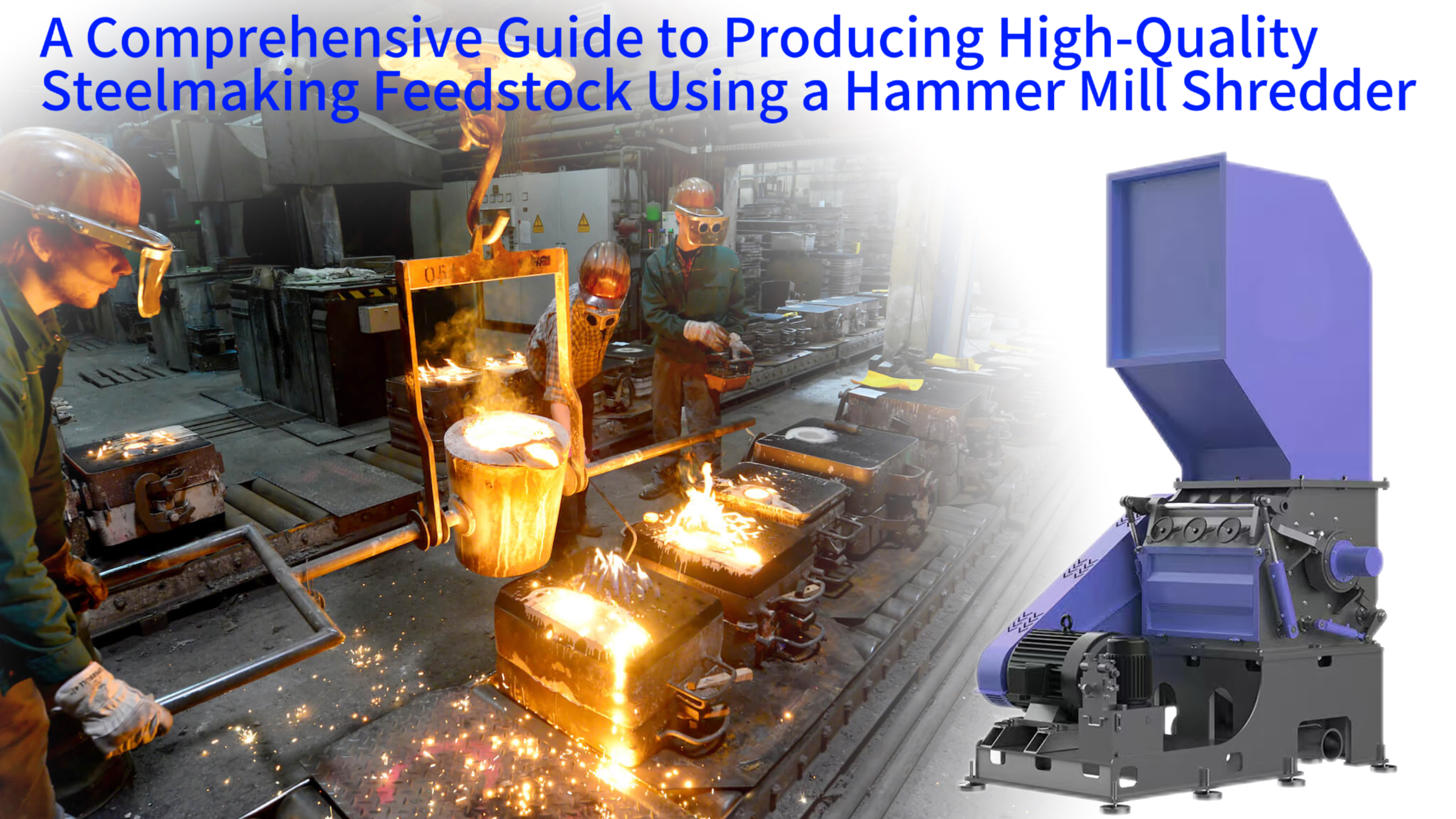
The production of premium shredded scrap, known as furnace-ready feedstock, represents a critical process within the modern metals recycling chain. A hammer mill shredder serves as the central apparatus for transforming heterogeneous ferrous scrap into a dense, clean, and chemically suitable material for steel mills. This guide systematically details the operational protocols necessary to optimize a hammer mill shredder for this purpose. The focus extends beyond mere size reduction to encompass the deliberate engineering of material properties that directly enhance the efficiency of Electric Arc Furnace and Basic Oxygen Furnace operations. Mastery of this process converts a standard recycling activity into a high-value material production line, meeting stringent industrial specifications for metallic yield, impurity levels, and predictable melting behavior.
Core Process for Premium Steelmaking Feedstock Production
The Defining Role of the Hammer Mill in Feedstock Preparation
Critical Quality Metrics for Steelmaking Shredded Scrap
Comparison of Scrap Processing Technologies
Hammer Mill Shredding
High bulk density (>0.8 t/m³)
Effective contaminant removal
Uniform particle size
Higher market value
Shear-Type Shredding
Lower bulk density
More attached contaminants
Coarser, inconsistent output
Better for bulky items
Baled Scrap
High transport efficiency
Significant voids/impurities
Uneven melting characteristics
Basic commodity value
Hammer mill shredders employ a distinct size-reduction mechanism based on impact and attrition. A high-speed rotor fitted with freely swinging hammers repeatedly strikes and grinds incoming scrap metal against breaker plates and sizing grates. This mechanical action does more than fracture the metal. It effectively liberates and removes non-metallic contaminants such as dirt, paint, light plastics, and rubber attached to the scrap surface. The simultaneous compaction of the material during processing results in a final product with a significantly increased bulk density, a paramount metric for steelmakers. The consistent output from a properly configured hammer mill provides a predictable charge material that promotes stable arc conditions and efficient heat transfer within the furnace.
Critical Quality Metrics for Steelmaking Shredded Scrap
Premium shredded scrap is defined by a specific set of physical and chemical characteristics. The bulk density must typically exceed 0.8 metric tons per cubic meter to ensure efficient furnace loading and melting. Metallic purity is essential, with strict limits on residual copper, tin, and other non-ferrous metals that can detrimentally alloy with steel. The presence of non-metallic impurities like plastics and rubber must be minimized to reduce slag volume and harmful emissions. Finally, a controlled particle size distribution, often categorized as "Shredded 1" or "Shredded 2," ensures uniform melting and predictable chemical analysis in the final steel product.
Comparative Advantage Over Shear-Type Shredding and Baling
Hammer mill processing offers distinct benefits compared to alternative pre-treatment methods. While dual-shaft shear shredders excel at coarse reduction of bulky items, they often produce a fluffier, lower-density output with more attached contaminants. Baled scrap, though transport-efficient, introduces significant voids and encapsulated impurities into the furnace. The hammer mill's aggressive impact and grinding action systematically clean the metal and compress it, yielding a feedstock with superior density and purity that commands a higher market price and improves downstream steelmaking economics.
Impact of Feedstock Quality on Electric Arc Furnace Performance
The quality of shredded scrap directly correlates with key performance indicators in an Electric Arc Furnace. Clean, dense scrap melts faster due to better electrical conductivity and arc stability. This reduces tap-to-tap time, lowering specific energy consumption, often measured in kilowatt-hours per ton. Reduced electrode consumption and lower flux addition for slag formation are additional direct economic benefits. Consistent feedstock quality minimizes operational variability, allowing for tighter process control and higher-quality steel output.
Strategic Feedstock Selection and Pre-Processing Protocols
Feedstock Selection & Pre-Processing Workflow
Ideal Scrap Identification
Light iron scrap (automobile bodies, white goods), industrial punchings/stampings
Prohibited Material Removal
Sealed containers, unstripped wire, high-manganese steel, large cast iron sections
Primary Shredding/Shearing
Oversize items reduction via primary shredding
Final Contamination Check
Verification of impurity levels before hammer mill infeed
The quality of the final shredded product is intrinsically linked to the composition and condition of the input material. Not all metallic scrap is suitable for producing high-grade furnace feedstock. Implementing a rigorous selection and preparation stage is a non-negotiable prerequisite for optimal shredder performance and output quality. This phase involves both the identification of ideal feed materials and the systematic removal or preparation of undesirable elements. A disciplined approach to feedstock management prevents equipment damage, ensures product consistency, and protects the value of the final output.
Ideal Ferrous Scrap Streams for Premium Shredded Output
Certain scrap categories are exceptionally well-suited for hammer mill processing into high-quality feedstock. Light iron scrap, such as obsolete automobile bodies and white goods appliances, provides an excellent blend of malleability and volume. Industrial production scrap like punchings, stampings, and tangled turnings can also be ideal. These materials are typically free of excessive contaminants and shred efficiently into a dense, granular product. The selection of feed material forms the first and most critical variable in the overall quality equation for the recycling operation.
Prohibited Materials and Mandatory Pre-Treatment Measures
Several material types must be excluded or processed before introduction to the hammer mill to ensure safety and product integrity. Sealed containers pose explosion risks. Unstripped insulated wire introduces excessive copper contamination. High-manganese steel components or large cast iron sections can cause excessive wear or damage to the hammers and grates. A comprehensive primary shredding or shearing stage is often required for oversize items to ensure they are suitably reduced for the hammer mill's infeed. Implementing strict gatekeeping protocols at this stage is essential for operational safety and cost control.
Optimizing Key Operational Parameters for Quality Output
Key Operational Parameters & Their Impacts
Hammer Configuration & Rotor Speed
New/Sharp Hammers: Uniform, chunkier product
Worn Hammers: Increased fines generation
Higher Rotor Speed: Higher throughput (lighter materials), increased wear/power use
Optimal Speed: Balanced breakage pattern & density
Sizing Grate Management
Grate Aperture: 50mm typical for Shredded 1/2 classification
Wear Inspection: Critical to prevent oversized material
Rotation Schedule: Extends service life (applied to hard material shredding solutions)
Replacement: Maintains product consistency
The transformation of prepared scrap into specification-grade feedstock requires precise adjustment and control of the hammer mill's operational parameters. These machine settings directly govern the interplay between throughput rate, particle size distribution, energy consumption, and final product density. A deep understanding of these variables allows operators to tune the shredder for specific market requirements, balancing productivity with the stringent quality demands of steel mills. Optimal configuration is not a fixed state but a dynamic adjustment informed by feed material and desired output specifications.
Hammer Configuration, Rotor Speed, and Kinetic Energy Management
The physical condition and arrangement of the hammers on the rotor are paramount. New, sharp hammers produce a cutting action resulting in a more uniform, chunkier product. As hammers wear, the process shifts towards more grinding and pulverization, increasing fines generation. Rotor speed directly influences the kinetic energy of each hammer strike. Higher speeds can increase throughput for lighter materials but may also elevate wear rates and power consumption. The strategic management of hammer mass, profile, and rotational velocity is central to achieving the desired breakage pattern and product density.
Sizing Grate Selection and Maintenance for Controlled Discharge
The sizing grate or screen at the mill's discharge point is the final arbiter of maximum particle size. The aperture diameter of this grate must be selected to match the target product grade, such as a 50mm grate for a specific shredded scrap classification. Regular inspection for wear and perforation is critical. A worn-out grate will allow oversized, poorly processed material to pass through, degrading the entire batch's quality. A systematic schedule for grate inspection and rotation extends service life and maintains product consistency, which is a principle applied across various hard material shredding solutions.
Implementing Rigorous Quality Control and In-Process Monitoring
Dual-Tier Quality Control Framework
Online Operational Monitoring
Audio analysis (rhythmic pounding = normal operation)
Main drive motor amperage monitoring
Infrared temperature checks (main bearings)
Real-time load fluctuation detection
Immediate corrective action capability
Offline Laboratory Analysis
Bulk density measurement (>0.8 t/m³ verification)
Non-ferrous metal percentage quantification
Non-metallic residue analysis
Sieve analysis (particle size distribution)
Historical quality record maintenance
Integration with overband magnet separation
Sustained production of high-grade feedstock necessitates a robust quality assurance framework that operates in real-time and through scheduled sampling. Reliance on periodic end-product testing alone is insufficient to prevent the generation of off-spec material. Effective monitoring integrates direct sensory observation of the operating machine with structured offline laboratory analysis. This dual approach enables immediate corrective action during production and provides verifiable data for product certification, building trust with steel mill customers who require guaranteed material specifications.
Online Operational Monitoring and Sensory Diagnostics
Skilled operators continuously assess the shredder's performance through direct observation and instrument readings. The sound of the mill—a steady, rhythmic pounding—indicates normal operation; abrupt changes suggest feed issues or component failure. Monitoring the amperage draw of the main drive motor provides a direct indicator of load; significant fluctuations can signal bridging in the hopper or an overload condition. Regular infrared temperature checks on main bearings prevent catastrophic failures. This hands-on vigilance forms the first line of defense against quality deviations and unplanned downtime.
Offline Sampling and Laboratory Analysis Protocols
Complementing online checks, a formalized sampling regimen provides objective quality data. Bulk density is measured using a standard container to ensure it meets the contractual minimum, often above 0.8 t/m³. Manual sorting of samples quantifies the percentage of non-ferrous metals and non-metallic residues. Sieve analysis determines the particle size distribution, confirming adherence to "fines" content limits. These analytical results create a historical quality record, essential for process optimization and customer reporting. The integration of downstream separation technologies, such as an overband magnet for ferrous recovery and an eddy current separator for non-ferrous metals, further enhances purity and is part of a complete system view.
Preventive Maintenance Focused on Feedstock Production Consistency
Preventive Maintenance Prioritization
The economic viability of producing premium feedstock hinges on the hammer mill's reliability and consistent output. A reactive maintenance philosophy, addressing failures only after they occur, leads to costly downtime and product variability. A proactive, preventive maintenance schedule is therefore imperative. This schedule must be specifically tailored to the extreme wear environment of metal shredding, prioritizing components whose condition directly influences product size, shape, and system throughput. The goal is to preserve the machine's engineered performance parameters over extended operational campaigns.
Lifecycle Management for High-Wear Components
The hammer tips, sizing grates, and interior liner plates constitute the primary wear parts. A regimented program for hammer rotation, replacement, and balancing is necessary to maintain crushing efficiency and rotor stability. Grates must be inspected for wear and rotated or replaced before aperture integrity is compromised. Liner wear is monitored to protect the mill's structural housing. This component management is not merely a cost center but a direct investment in product uniformity. The expertise required to implement such a program effectively is often cultivated through extensive field experience, such as the fifteen-year operational history applied by engineering teams at MSW Technology when advising on system longevity.
Rotor Dynamics and System Alignment Checks
The high-speed rotor assembly is the heart of the hammer mill. Any imbalance or misalignment translates into excessive vibration, accelerating bearing wear, causing structural fatigue, and adversely affecting product uniformity. Periodic dynamic balancing checks, especially after major hammer changes, are essential. Furthermore, alignment between the rotor, drive motor, and associated couplings must be meticulously maintained to prevent power transmission losses and mechanical failure. These precision maintenance tasks require specialized tools and protocols to execute correctly.
Economic and Strategic Advantages of Optimized Feedstock Production
Economic Benefits of Optimized Operations
Revenue Enhancement
Price premiums for certified high-quality feedstock
Higher market demand for specification-grade material
Long-term customer contracts (quality guarantees)
Increased tonnage value (not just volume)
Cost Reduction
Lower specific energy consumption per ton
Reduced unplanned maintenance downtime
Optimized labor efficiency (automation integration)
Minimized off-spec material waste
Automation & Traceability Benefits
PLC-controlled feed sequences (consistent processing)
Real-time power consumption monitoring
Metal detection systems (equipment protection)
Reduced operator variability
Enhanced production data traceability
Predictive maintenance capability
Investing in the optimization of a hammer mill operation yields returns that extend far beyond the basic sale of shredded scrap. The production of certified, high-quality furnace feedstock transforms a commodity product into a value-added material with superior market positioning. This strategic shift impacts revenue through price premiums, reduces operational costs via improved efficiency, and enhances the sustainability profile of the recycling business. The process embodies the principles of industrial ecology, closing the material loop with maximum efficiency and minimal waste.
Market Premiums and Total Operational Cost Analysis
Steel mills demonstrate a willingness to pay significant price premiums for shredded scrap that reliably meets strict density and chemistry specifications. This premium directly improves the profit margin per ton processed. Concurrently, an optimized shredding process operates at a lower specific energy cost per ton and experiences less unplanned downtime. A comprehensive total cost analysis, factoring in these premium revenues alongside savings in energy, maintenance, and downtime, reveals the full financial benefit of quality-focused operations, justifying investments in superior technology and skilled labor.
Integration of Automation for Enhanced Stability and Traceability
Modern control systems elevate shredding from a manual operation to a precise industrial process. Programmable Logic Controller systems can automate feed sequences, monitor power consumption, and adjust parameters in real-time to maintain product consistency. Metal detection systems prevent damaging non-ferrous infeed. These technologies reduce operator variability, enhance safety, and generate valuable production data for traceability and continuous improvement analysis. The data collected facilitates a predictive approach to maintenance and quality control, moving the entire operation towards a higher level of industrial maturity.