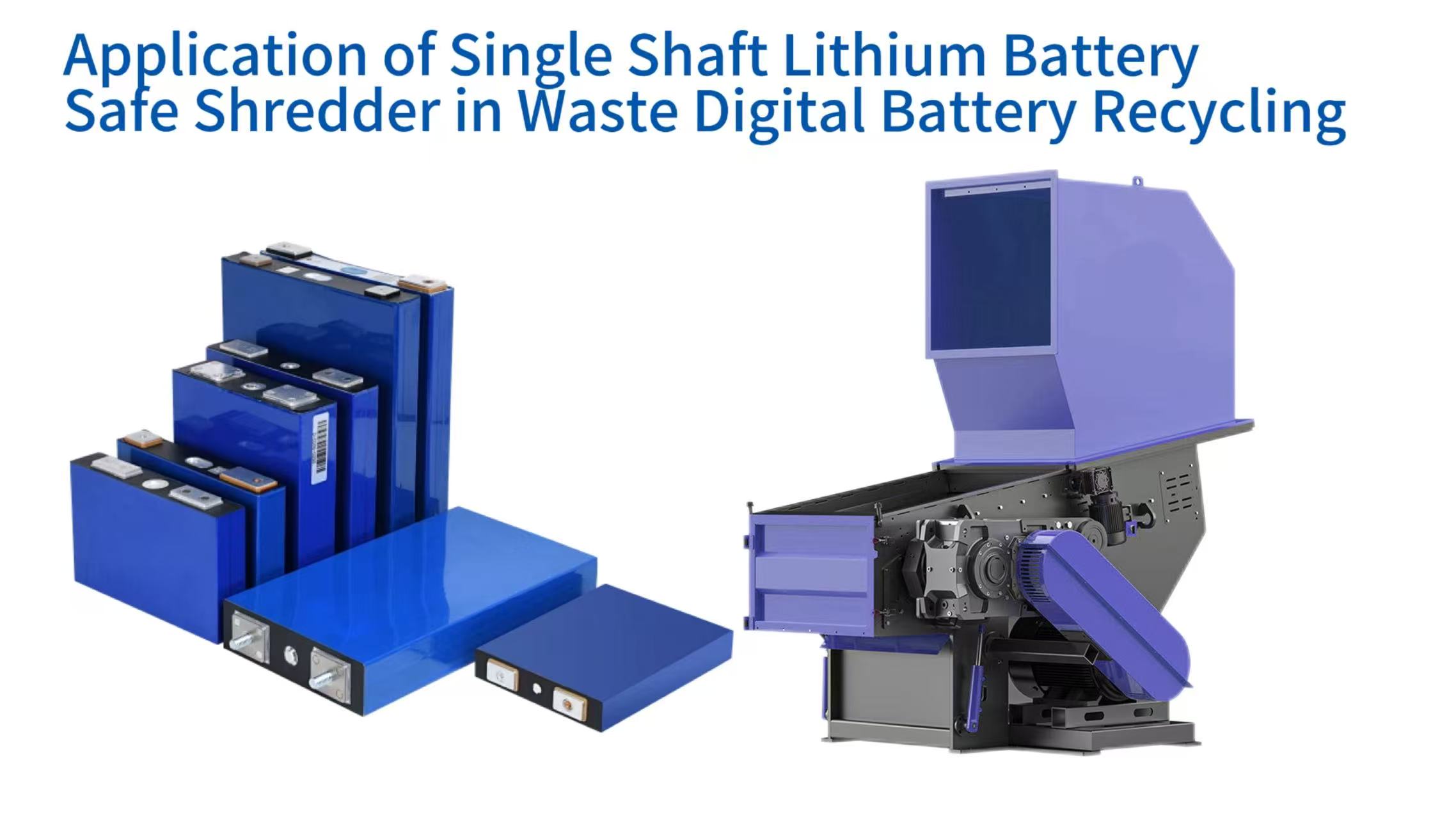
The global proliferation of digital devices has led to an unprecedented increase in waste digital batteries. These batteries come from mobile phones, tablets, wireless headphones, smartwatches, and countless other portable electronic products. When these devices reach their end of life, their batteries present a unique challenge for the recycling industry. Unlike general industrial waste, digital batteries contain highly reactive chemical compounds and retain residual electrical charge, making them dangerous to process with conventional equipment. A specialized category of industrial shredding equipment has emerged to address this challenge. The single shaft lithium battery safe shredder represents a dedicated solution engineered specifically for the safe and efficient processing of waste digital batteries. This equipment operates on principles fundamentally different from traditional crushers or通用粉碎设备. It employs low-speed, high-torque shear forces to tear and separate battery components without triggering thermal runaway or explosive reactions. The technology has become essential for recycling facilities that must comply with increasingly stringent environmental regulations while maximizing the recovery of valuable materials. This article provides a comprehensive examination of how this shredding technology functions, its core design features, the specific battery types it can process, and the substantial benefits it delivers to recycling operations.
The waste digital battery problem continues to grow in scale and complexity. Modern digital batteries are not uniform in construction. Some use hard metal casings, while others employ flexible pouch designs. Their chemical compositions vary significantly, with some utilizing lithium cobalt oxide, others lithium iron phosphate, and still others nickel manganese cobalt formulations. Each type responds differently to mechanical stress. The single shaft lithium battery safe shredder must accommodate all these variations while maintaining consistent output quality and, above all, absolute operational safety. Industry research has demonstrated that the quality of materials recovered from mechanical recycling depends critically on the parameters employed during the shredding process. Modifications to shredder settings significantly impact particle size distribution, the liberation of composite materials, and the de-coating efficiency of electrode foils. A well-designed single shaft shredder provides the precise control needed to optimize these outcomes. The following sections explore the technology in detail, from basic operating principles to real-world application scenarios and investment considerations.
Industry Background: The Growing Challenge of Waste Digital Battery Recycling
The consumer electronics industry releases new products at an accelerating pace. Each new smartphone, tablet, or laptop eventually becomes waste, and each contains a battery that must be managed responsibly. Global estimates indicate that billions of portable electronic devices reach end-of-life annually. The batteries within these devices contain materials of significant value, including lithium, cobalt, nickel, copper, and aluminum. However, these same batteries present serious hazards if handled incorrectly. Lithium-ion cells store substantial electrical energy even when declared "dead" by consumers. A seemingly discharged battery can deliver enough current to cause a short circuit, generate intense heat, and ignite surrounding materials. The European Union has classified cobalt, lithium, and natural graphite as critical raw materials. Recycling these materials from waste digital batteries reduces dependence on mining and strengthens supply chain security. Legislation now mandates aggressive recovery targets. By 2031, European regulations require 95% recovery of cobalt, nickel, and copper, along with 80% recovery of lithium from battery waste. These targets cannot be achieved with outdated processing methods.
The recycling industry has undergone a fundamental transformation over the past decade. Small-scale, informal operations using manual disassembly and basic crushing equipment are no longer viable. Environmental regulators have closed facilities that cannot demonstrate safe handling procedures and proper emissions control. Major recycling jurisdictions, including the European Union, North America, and parts of Asia, now require documented compliance with strict safety and environmental standards. Licensed recyclers must implement engineered solutions for every step of the process, from incoming material triage to final material separation. The single shaft lithium battery safe shredder occupies a critical position in this workflow. It serves as the primary size reduction step that prepares materials for downstream separation processes such as magnetic separation, eddy current separation, air classification, and hydrometallurgical processing. Without reliable shredding equipment, the entire recycling chain breaks down. Recycling facilities that invest in proper shredding technology gain competitive advantages through higher material recovery rates, lower operating costs, and reduced regulatory risk.
Market Growth and Escalating Processing Demands
The waste digital battery stream expands at a compound annual rate that outpaces many other waste categories. Consumers replace mobile phones every two to three years on average. Wireless earbuds, which contain small but highly reactive lithium batteries, have become ubiquitous. The rise of the Internet of Things has placed batteries in countless devices, from smart home sensors to wearable health monitors. Each of these products eventually requires disposal. Industry projections suggest that the volume of end-of-life lithium-ion batteries in Europe alone will reach 1500 kilotons by 2040. Processing this volume demands industrial-scale equipment capable of continuous, reliable operation. Manual disassembly cannot handle these quantities economically. Traditional shredding equipment, designed for inert materials like plastic or wood, fails when confronted with the reactive chemistry of lithium batteries. The single shaft lithium battery safe shredder fills this gap by combining high throughput capacity with the specialized safety features that battery processing requires. Facilities equipped with this technology can process tons of material daily while maintaining safe working conditions and producing consistent output for downstream separation.
Economic pressures further drive the need for efficient processing equipment. The value of recovered materials from waste digital batteries fluctuates with commodity markets, but the long-term trend favors recycling over virgin mining. Cobalt prices have seen significant volatility due to supply chain concerns. Lithium demand continues to rise as electric vehicle production expands, putting pressure on all lithium sources, including recycled material from consumer batteries. Recycling facilities that maximize their recovery rates capture more value from each ton of incoming material. Research has demonstrated that shredder parameter selection directly influences black mass yield and purity. Black mass refers to the fine material containing lithium, nickel, cobalt, and manganese after shredding. Higher quality black mass commands better prices from downstream refineries. Therefore, the shredding step is not merely a preparatory operation. It actively determines the economic outcome of the entire recycling process. Facilities using optimized single shaft shredders achieve superior financial results compared to those using generic equipment.
Environmental Compliance and Regulatory Drivers
Environmental regulations have become the primary catalyst for equipment upgrades across the recycling industry. Governments worldwide recognize that improper battery disposal causes fires in waste facilities, contaminates soil and groundwater with heavy metals, and squanders valuable resources. The European Union Battery Regulation (2023/1542) establishes comprehensive requirements for battery collection, treatment, and recycling. Similar legislation exists in other major economies. Compliance requires documented proof that recycling processes meet safety and environmental standards. Shredding equipment must demonstrate features such as containment of electrolyte vapors, prevention of spark generation, and integration with dust and fume extraction systems. The single shaft lithium battery safe shredder, when properly configured, satisfies these requirements. Its enclosed design captures volatile organic compounds released during shredding. Its low-speed operation minimizes friction heating and spark formation. These features are not optional extras but mandatory requirements for licensed recycling facilities.
The trend toward greater regulatory oversight shows no sign of reversing. Future regulations will likely impose even stricter requirements on battery recyclers. Authorities are increasingly interested in the concept of extended producer responsibility, which holds battery manufacturers accountable for end-of-life management. This framework creates economic incentives for designing batteries that are easier to recycle. It also encourages the development of digital battery passports that provide recyclers with detailed information about battery construction and material composition. These digital tools will enable more sophisticated shredding operations where equipment parameters adjust automatically based on the specific battery type being processed. The single shaft lithium battery safe shredder, with its PLC control systems and sensor integration capabilities, is well-positioned to take advantage of these advances. Recycling facilities that invest in modern, connected shredding equipment now will find it easier to comply with future regulations compared to those relying on older, less capable machines.
Core Technology: Principles of Single Shaft Lithium Battery Safe Shredding
The single shaft lithium battery safe shredder operates on mechanical principles that differ fundamentally from those of conventional shredding equipment. Traditional industrial shredders often rely on high-speed impact or compression to fracture materials. These approaches work well for brittle materials like glass or for tough materials like tires. However, they are dangerous when applied to lithium batteries. High-speed impact can puncture battery casings violently, causing internal short circuits and immediate thermal events. The single shaft design takes a different approach. It uses low rotational speed combined with extremely high torque to apply controlled shear and tearing forces. The rotating shaft carries cutting blades that pass against a fixed counter-knife. Material fed into the machine is caught between these cutting elements and pulled through a screen. This action tears battery components apart gradually rather than shattering them explosively. The result is a controlled size reduction process that dramatically reduces fire and explosion risks.
Understanding the mechanical operation of the single shaft shredder requires examination of its key components. The rotor assembly forms the heart of the machine. This is a large diameter steel shaft fitted with multiple cutting blades arranged in a specific pattern. The blades are typically made from tool steel or carbide alloys to withstand the abrasive nature of battery materials. The rotor turns at speeds typically ranging from 60 to 120 revolutions per minute. This slow speed stands in stark contrast to hammer mills that may operate at 1000 RPM or more. The hydraulic pusher system forces material against the rotating cutter. This ensures consistent feeding even when processing irregularly shaped battery packs. The screen mesh located beneath the rotor determines the maximum particle size that can exit the cutting chamber. Operators can select different screen sizes depending on downstream processing requirements. A 20mm screen might be appropriate for initial size reduction, while a 10mm screen produces finer material suitable for direct separation processes. The entire assembly is enclosed within a heavy-duty housing designed to contain any potential incidents and to integrate with ventilation systems.
Low-Speed High-Torque Shear Action
The low-speed, high-torque operating principle provides multiple safety advantages when processing lithium batteries. Speed reduction directly reduces the kinetic energy available to cause damage during unexpected events. If a battery experiences an internal short circuit during shredding, the energy released is proportional to the speed at which the cell is deformed. Slower deformation gives the cell's internal safety mechanisms time to respond. It also reduces the severity of any thermal event that does occur. The high torque characteristic ensures that the machine can still cut through tough materials despite the low speed. Metal casings, copper foil, and aluminum components all yield to the sustained shearing force applied by the cutter. This combination of attributes makes the single shaft design uniquely suited to battery applications. Double shaft shredders, while capable of high throughput, typically operate at higher speeds and produce more impact forces. Single shaft designs provide gentler, more controlled size reduction that aligns with the safety requirements of lithium battery processing.
The shear-dominated fracture mechanism also produces different particle characteristics compared to impact-dominated crushing. Shear tends to separate materials along interfaces rather than fracturing them through the bulk. This is highly beneficial for battery recycling. The goal of shredding is not to reduce everything to fine powder but to liberate different material types from each other. A properly shredded battery should have the metal casing separated from the electrode jelly roll. The copper and aluminum current collector foils should be exposed. The electrode coatings should be detached from the foils to the greatest extent possible. Shear forces applied by a single shaft shredder promote this type of selective liberation. Impact forces, by contrast, tend to fracture everything indiscriminately, potentially embedding valuable coating materials into less valuable substrates. Research has shown that low-speed rotary shears with medium discharge grids (20 to 30 mm) represent the preferred approach for the initial comminution step in lithium battery recycling. The single shaft design embodies these preferred characteristics.
PLC Intelligent Control and Parameter Optimization
Modern single shaft lithium battery safe shredders incorporate programmable logic controller (PLC) systems that provide precise control over all machine functions. The PLC manages motor speed, hydraulic pusher pressure, material feed rate, and safety interlocks. Operators interact with the system through a human-machine interface (HMI) touchscreen that displays real-time operating data and accepts parameter adjustments. The PLC continuously monitors critical variables including motor current draw, temperature at multiple points within the cutting chamber, hydraulic pressure, and rotor speed. When any parameter moves outside acceptable limits, the system responds automatically. For example, if motor current exceeds the setpoint due to material overload, the PLC can reduce the feed rate or reverse the rotor direction briefly to clear the jam. These automated responses keep the machine operating within safe parameters without requiring constant operator attention. The control system also maintains logs of operating conditions that can be used for process optimization and regulatory reporting.
Parameter optimization plays a crucial role in achieving desired shredding outcomes. Research has demonstrated that shredder and mill settings significantly influence black mass yield and composition. The discharge grid size selected for the shredding step affects downstream separation behavior for casing materials and separator foils. Smaller grid openings produce finer particles but may reduce recovery of certain material fractions. Mill speed during subsequent comminution steps determines the separation achieved between cathode and anode materials. These relationships are not always linear or intuitive. Optimal parameter combinations depend on the specific battery chemistry and construction being processed. Advanced PLC systems address this complexity by storing multiple parameter sets for different battery types. Operators can select the appropriate recipe based on the incoming material stream. Some facilities are beginning to implement machine learning systems that analyze shredding outcomes and automatically recommend parameter adjustments. This represents the frontier of intelligent battery recycling, where data-driven optimization continuously improves recovery rates and product quality.
Safety Systems for Lithium Battery Processing
Safety features distinguish battery shredders from general-purpose industrial shredders. The single shaft lithium battery safe shredder incorporates multiple layers of protection designed specifically for reactive materials. Temperature monitoring sensors are placed at strategic locations within the cutting chamber. These sensors detect abnormal heat buildup that might indicate a battery entering thermal runaway. If temperature exceeds the alarm threshold, the PLC initiates a controlled shutdown sequence. The nitrogen inerting system, when installed, floods the cutting chamber with nitrogen gas to displace oxygen. Without oxygen, combustion cannot occur even if a battery experiences an internal short circuit and reaches elevated temperatures. Explosion-proof electrical components eliminate potential ignition sources from the machine's own systems. The enclosed design prevents flaming materials from being ejected from the machine, confining any incident to the protected chamber. These features collectively reduce the risk of fire and explosion to acceptable levels for industrial operations.
The secondary safety systems address operational hazards that arise from the nature of waste digital batteries. These materials are not uniform. Some batteries may be damaged or swollen before they reach the shredder. Others may have been subjected to improper storage conditions. The shredder must handle this variability without compromising safety. The anti-jamming system detects when material is not feeding properly and automatically reverses the rotor to clear the obstruction. This prevents operators from having to open the machine manually to clear jams, a dangerous activity when processing reactive materials. The emergency stop system provides multiple activation points around the machine. The dust extraction connection ensures that fine particles generated during shredding are captured rather than accumulating where they could form explosive mixtures. These features work together to create a processing environment that can handle the inherent risks of lithium battery recycling while protecting both personnel and equipment.
Equipment Types and Application Scenarios
The single shaft lithium battery safe shredder is available in several configurations optimized for different operational contexts. The fixed standard model represents the most common configuration for dedicated recycling facilities. This machine mounts permanently to a concrete foundation and integrates with upstream and downstream material handling equipment. Fixed models typically feature the largest motor options and highest throughput capacities. They are designed for continuous operation, running eight, twelve, or twenty-four hours per day depending on facility requirements. The robust construction of fixed models withstands the sustained loads of industrial production. These machines often incorporate features such as automatic lubrication systems and remote monitoring capabilities to maximize uptime. For facilities processing consistent volumes of waste digital batteries on a daily basis, the fixed standard model provides the optimal balance of capacity, reliability, and cost-effectiveness.
Mobile and semi-mobile configurations serve different market needs. The mobile model mounts the shredder on a trailer chassis with its own power source and material handling equipment. This configuration suits operations that process batteries at multiple locations. A mobile shredder can travel to collection points, process batteries on-site, and transport the shredded material to a central refining facility. This approach reduces the safety risks and costs associated with transporting whole batteries, which are hazardous materials. The mobile configuration also serves temporary projects or facilities that have not yet committed to permanent installation. Small laboratory-scale models complete the product line. These compact machines incorporate the same safety features and operating principles as full-sized units but with reduced throughput. Research institutions and battery manufacturers use laboratory shredders to test new materials and develop recycling processes. The data generated by laboratory-scale testing informs the design of full-scale production systems.
Fixed Standard Configuration for Production Facilities
The fixed standard single shaft shredder serves as the workhorse of dedicated battery recycling plants. These machines are typically installed in line with other processing equipment including conveyors, magnetic separators, eddy current separators, and air classification systems. The shredder receives material from a feed hopper that may be loaded by conveyor or by a wheeled loader. After shredding, the material discharges onto another conveyor that transports it to downstream separation equipment. The fixed configuration allows for optimization of the entire material flow path. Infeed and discharge heights can be set to match adjacent equipment. The shredder foundation incorporates vibration isolation mounts to prevent transmission of mechanical forces to the building structure. Utilities including electrical power, compressed air, and cooling water are permanently connected. This integration minimizes material handling labor and maximizes throughput. A well-designed fixed installation can process several tons of waste digital batteries per hour with minimal operator intervention.
The economic case for fixed standard shredders in production facilities rests on throughput and operating cost advantages. Larger motors, typically ranging from 45 kW to 160 kW or more, provide the torque needed to process material continuously without slowdowns. The heavy-duty construction of fixed models extends component life, reducing maintenance costs over the machine's operational lifetime. Fixed models also accommodate larger feed openings, allowing them to accept whole battery packs without pre-disassembly. This eliminates a labor-intensive step from the recycling process. The capital cost of a fixed standard shredder is higher than smaller or mobile options, but the per-ton processing cost is lower when utilization is high. Facilities processing more than 500 tons of waste digital batteries annually typically find that fixed standard models provide the lowest total cost of ownership. The shredder becomes the central element of a production line that generates revenue from recovered materials while controlling operating expenses.
Laboratory and Research Configurations
Laboratory-scale single shaft shredders fill an essential role in battery recycling research and development. These machines process small batches of material, typically kilograms rather than tons, while replicating the mechanical action of full-sized production units. Researchers use laboratory shredders to evaluate how different process parameters affect material liberation and recovery outcomes. A typical experiment might involve shredding a batch of identical batteries using different screen sizes or rotor speeds, then analyzing the particle size distribution and composition of the resulting fractions. The results guide the selection of operating parameters for production-scale equipment. Laboratory shredders also support the development of new recycling processes for emerging battery chemistries. Before a new battery type enters widespread use, researchers can determine optimal recycling conditions using laboratory equipment. This proactive approach ensures that recycling infrastructure can keep pace with evolving battery technology.
Academic institutions and corporate research centers operate most laboratory-scale shredders. The Technical University Bergakademie Freiberg in Germany, for example, maintains a research shredder system specifically for battery recycling studies. This system includes sensors and data logging capabilities that capture detailed information about each shredding run. Researchers have used this equipment to investigate the influence of shredder and mill settings on material recoveries and product qualities. Their findings have advanced the understanding of how comminution parameters affect black mass yield, copper contamination levels, and separation behavior of different battery components. Laboratory shredders also support the development of digital process models and artificial intelligence systems for recycling optimization. The data generated by controlled experiments trains machine learning algorithms that can predict optimal operating parameters for new material streams. This research ecosystem, built around laboratory-scale equipment, continuously improves the performance of production-scale recycling facilities.
Functional Capabilities of the Single Shaft Battery Shredder
The single shaft lithium battery safe shredder delivers a range of functional capabilities that address the specific requirements of battery recycling. Primary size reduction stands as the most obvious function. The shredder accepts whole digital batteries, including those with hard metal casings or flexible pouch constructions, and reduces them to particles typically ranging from 10 to 50 millimeters in size. This size reduction serves multiple purposes. Smaller particles are easier to transport through subsequent processing steps. The shredding action liberates different material types from each other, allowing separators to function effectively. The mechanical stress of shredding also helps detach electrode coatings from current collector foils, a prerequisite for recovering valuable lithium and transition metal compounds. Without effective size reduction, downstream separation processes cannot achieve high recovery rates. The shredder therefore functions as the gateway to the entire recovery process.
Material liberation represents a more sophisticated capability than simple size reduction. The goal of battery recycling is not merely to make pieces smaller but to separate the battery into its constituent material streams. These streams include ferrous metals from casings, non-ferrous metals from current collectors, plastics from separators and insulators, and the black mass containing electrode materials. Each stream requires different downstream processing. Effective liberation means that shredding produces particles that are enriched in specific material types rather than mixed composites. The single shaft shredder's shear-dominant fracture mechanism promotes this type of selective liberation. The machine tears along material interfaces rather than fracturing through material cross-sections. Research has demonstrated that the combination of low-speed shredding followed by high-speed milling achieves the best liberation results. The single shaft shredder serves as the first stage in this two-stage comminution approach, preparing material without over-grinding or creating excessive fines.
Particle Size Control and Uniformity
Particle size control directly affects the efficiency of downstream separation processes. Different separation technologies work best with specific particle size ranges. Air classification, which separates materials based on their aerodynamic behavior, requires relatively uniform feed material for optimal performance. Sieving operations separate particles based on size, so the distribution of particle sizes affects how material splits between fractions. The single shaft shredder controls particle size through the discharge screen. Material remains in the cutting chamber until it is small enough to pass through the screen openings. This ensures that the output has a maximum particle size determined by the screen selection. Operators can choose from screens with different opening sizes depending on their downstream requirements. A typical sequence might use a coarse screen of 30 mm for initial size reduction, followed by a finer screen of 10 mm for secondary shredding after intermediate material classification. This staged approach optimizes both throughput and final particle uniformity.
The relationship between shredder parameters and particle size is well-documented in the literature. Reducing the grid size in the initial shredding stage increases black mass yield but diminishes casing material recovery. This occurs because finer shredding liberates more electrode material from the casing but also breaks casing material into smaller pieces that may be lost in fine fractions. The optimal grid size depends on the specific goals of the recycling operation. A facility focused on maximizing lithium and cobalt recovery might favor finer shredding to liberate electrode materials more completely. A facility focused on recovering clean metal fractions for direct smelting might prefer coarser shredding that preserves metal particle size. The single shaft shredder's adjustable screens allow operators to select the trade-off that best matches their economic model. Research continues to refine understanding of how shredding parameters affect downstream recovery outcomes, enabling increasingly sophisticated process optimization.
Integration with Downstream Separation Systems
The single shaft shredder does not operate in isolation. It functions as part of an integrated recycling system that includes multiple separation steps following size reduction. Material exiting the shredder typically passes through a magnetic separator that removes ferrous metals. Steel casings and other iron-containing components are captured at this stage. The material then may pass through an eddy current separator that ejects non-ferrous metals including aluminum and copper. Air classification systems separate light materials, primarily separator foils and plastic components, from heavier materials including electrode fragments. Finally, sieving operations separate fine black mass from larger particles that may undergo secondary shredding or further separation. Each of these downstream steps performs best when the incoming material has consistent particle size and liberation characteristics. The shredder's role is to produce this consistent feed stock day after day, batch after batch.
Facility design must account for the interconnection between shredding and subsequent processing. Conveyor systems transport material between unit operations. Dust collection points must be located at transfer points where material could become airborne. Safety systems must coordinate across equipment boundaries, so that a fault at any point triggers appropriate responses throughout the line. Modern recycling facilities implement programmable logic controller networks that link all major equipment. When the shredder experiences a jam or overload, the control system can stop upstream feed conveyors automatically. If a fire is detected anywhere in the system, all equipment can be shut down and suppression systems activated. This integrated approach maximizes both safety and productivity. The single shaft shredder, equipped with appropriate communication interfaces, integrates seamlessly into these networked control architectures. Facilities can therefore build complete recycling systems around the shredder as the central processing unit.
Waste Digital Battery Types and Material Characteristics
Waste digital batteries arrive at recycling facilities in many forms. Mobile phone batteries are typically small, flat pouches with aluminum-laminate casings. These batteries contain a single cell and have relatively simple construction. Tablet batteries are larger but similar in construction, often using multiple cells connected in parallel. Laptop batteries present greater complexity. A typical laptop battery pack contains multiple cylindrical 18650 cells or a series of pouch cells arranged in a plastic housing with integrated protection circuitry. Wireless earbud batteries are tiny, often weighing just a few grams, but contain the same reactive chemistry as larger cells. Smartwatch batteries are curved or shaped to fit within compact enclosures. Each of these form factors requires the shredder to handle different physical characteristics. The pouch cells deform easily and may wrap around cutting elements. Cylindrical cells are rigid and require more force to rupture. Protection circuit boards contain copper, fiberglass, and small amounts of precious metals that are valuable but must be managed to avoid contamination of other fractions.
The chemical composition of waste digital batteries varies widely by manufacturer, age, and intended application. Lithium cobalt oxide (LCO) batteries dominate mobile phone and laptop applications because of their high energy density. These batteries contain significant cobalt, making them particularly valuable for recycling. Lithium nickel manganese cobalt oxide (NMC) batteries appear in some portable electronics and offer a different balance of cost, energy density, and cycle life. Lithium iron phosphate (LFP) batteries are less common in consumer electronics but appear in some applications. Each chemistry responds differently to mechanical processing. LCO batteries have relatively robust electrode coatings that may require more aggressive milling to liberate. LFP batteries have different material properties that affect separation behavior. The single shaft shredder must accommodate this chemical diversity while maintaining consistent output quality. Advanced facilities sort incoming batteries by chemistry to optimize shredding parameters for each type. This approach maximizes recovery rates and product purity.
Hard Casing versus Soft Pouch Construction
Hard casing batteries present specific challenges for shredding equipment. The metal enclosure, typically aluminum or steel, protects the internal cell from mechanical damage. This same protection must be overcome during shredding. The shredder's cutters must penetrate or tear the casing to access the electrode materials inside. Single shaft shredders accomplish this through sustained shearing force. The low-speed, high-torque rotor pulls the casing against the fixed counter-knife, progressively tearing it open. Once the casing is breached, the internal jelly roll or stack of electrode layers is exposed and can be shredded in turn. The metal casing fragments become a valuable material stream for recovery. Aluminum and steel are both readily recyclable. The key requirement is that casing fragments be separated from electrode materials effectively. This is achieved through the particle size differences created during shredding combined with downstream separation processes such as magnetic separation for steel and eddy current separation for aluminum.
Soft pouch batteries use a flexible aluminum-laminate casing rather than rigid metal. These batteries lack the mechanical protection of hard casings but present different handling challenges. The flexible casing can wrap around shredder cutters, potentially causing material accumulation and jamming. The single shaft shredder addresses this through its cutting geometry and the hydraulic pusher system that forces material into the cutting zone. The anti-jamming feature can reverse the rotor to clear wrapped material if accumulation occurs. The shear forces applied to pouch batteries tend to tear the laminate casing and liberate the electrode stack without the explosive rupture that might occur with impact crushing. This controlled liberation is particularly important for pouch batteries, which have high surface area relative to their volume and can react rapidly if damaged violently. The single shaft shredder's gentle but forceful tearing action provides appropriate processing for these sensitive materials.
Handling Damaged and High-Risk Batteries
Not all waste digital batteries arrive at recycling facilities in good condition. Some are swollen due to gas generation from electrolyte decomposition. Others have visible punctures or crushed casings from rough handling. Still others may have experienced thermal events, evidenced by discoloration or melting. These damaged batteries present elevated safety risks during processing. A swollen battery has internal pressure that could be released suddenly if the casing is breached. A punctured battery may have exposed reactive materials. The single shaft lithium battery safe shredder is designed to handle these challenging materials through multiple safety features. The enclosed cutting chamber contains any sudden release of gas or particulates. The temperature monitoring system detects abnormal heat generation that could indicate a thermal event beginning. The nitrogen inerting system, when installed, suppresses combustion potential. These features allow facilities to process damaged batteries safely rather than rejecting them as unacceptable for recycling.
The operational protocol for high-risk batteries differs from standard processing. Facilities typically isolate damaged batteries and process them in smaller batches with enhanced monitoring. The shredder may be operated at reduced feed rates to maintain maximum control. Temperature sensors are monitored more frequently, and operators maintain heightened awareness for any signs of abnormal conditions. After processing high-risk batches, the shredder may undergo inspection and cleaning before resuming normal operations. While this approach reduces throughput temporarily, it allows facilities to accept the full range of waste digital batteries rather than cherry-picking only the safest, most easily processed materials. This comprehensive acceptance capability provides competitive advantages in markets where disposal options for damaged batteries are limited. The single shaft shredder's robust safety design enables this capability without compromising the safety of personnel or equipment.