E-Waste Shredder Selection Process
Material Analysis
Deconstruct E-Waste Stream
Machine Engineering
Match Design to Material
Configuration
Optimize for E-Waste Profile
Procurement
Test & Select Optimal Unit
The process of choosing industrial machinery for electronic waste recycling demands a systematic and analytical approach. A double shaft shredder represents a significant capital investment, and its performance directly dictates the economic viability and material output quality of the entire recycling operation. The fundamental challenge stems from the heterogeneous nature of e-waste, which is a complex amalgamation of materials with divergent physical properties. This guide provides a methodological framework for analyzing your specific e-waste feedstock and translating that analysis into precise technical specifications for a double shaft shredder. The goal is to achieve a perfect alignment between the machine's capabilities and the material's behavior under shear forces, thereby maximizing throughput, minimizing wear, and ensuring high-purity material streams for subsequent separation processes. Companies like MSW Technology, with 15 years of sector-specific engineering experience, leverage such detailed feedstock profiling to engineer shredding solutions that deliver predictable, long-term operational results.
The Critical First Step: Deconstructing Your E-Waste Stream
| Material Category | Key Physical Properties | Shredding Challenges | Wear Impact |
|---|---|---|---|
| Ferrous Metals | High hardness, density, brittleness | High impact shocks, peak torque requirements | Moderate (self-sharpening effect) |
| Non-Ferrous Metals | Ductile, high tensile strength | Resists shearing, wrapping around shafts | Low to Moderate |
| Plastics | Variable tensile strength, viscoelastic | Softening/melting, clogging, entanglement | Low |
| PCBs | Laminated, abrasive, composite structure | Rapid wear, fine particle generation | Extremely High |
A profound understanding of the physical composition of the incoming e-waste stream forms the non-negotiable foundation for all subsequent equipment decisions. Treating e-waste as a monolithic substance leads to suboptimal machine selection, resulting in chronic inefficiencies. The material mix dictates the magnitude and type of mechanical stress imposed on the shredder. A scientific assessment moves beyond simple categorization, quantifying the percentage by weight or volume of each material category present in a representative sample. This quantitative profile, often developed over time through careful sampling, becomes the primary document for technical discussions with equipment suppliers.
Different material classes interact within the shredding chamber in complex ways. Ferrous metals like steel from appliance cabinets introduce high-impact shocks and possess a degree of brittleness. Non-ferrous metals such as copper wires and aluminum heat sinks are ductile, requiring sustained shear force to cut rather than bend. Various plastics, from the brittle housing of old electronics to the tough polycarbonate in modern devices, exhibit a wide range of tensile strengths and melting points. Printed circuit boards (PCBs) are composite materials, embedding fibrous glass reinforcement and metals within a resin matrix, creating an extremely abrasive mixture.
Primary Material Categories and Their Physical Properties
Each category within the e-waste stream possesses distinct characteristics that challenge the shredder differently. Ferrous metals are characterized by high hardness and density, which can help in breaking other materials but generate immense instantaneous forces on the cutter shafts and bearings. The ductility of metals like copper and aluminum means they resist clean shearing, often deforming before fracturing, which can lead to wrapping around shafts if the machine lacks sufficient torque and proper knife geometry. Thermo-plastics add a layer of complexity due to their viscoelastic nature; under mechanical stress and the heat generated from friction, they can soften, melt, and readhere, causing chamber clogging and requiring specialized air conveying systems for cooling and evacuation.
Printed circuit boards represent one of the most demanding components. They are neither fully brittle nor fully ductile but are instead a laminated structure. The glass-epoxy layers act as a relentless abrasive agent, accelerating wear on all contact surfaces. The recovery of precious metals from PCBs is a primary economic driver, necessitating a shred size that liberates these metals from the board substrate without creating excessive, hard-to-separate fines. This requires a carefully calibrated balance between shear force and controlled particle size reduction.
Influence of Composition Ratios on Shredding Dynamics
Material Composition Impact on Shredder Requirements
The proportional mix of materials dictates the dominant mode of wear and the required machine resilience. A stream dominated by large, bulky ferrous metals, such as from white goods recycling, prioritizes the need for a machine with exceptional structural integrity and high momentary torque to handle impact loads. In such a stream, the metal acts as a "self-sharpening" medium for the cutters but transfers tremendous energy to the gearbox and frame. Conversely, a stream rich in plastics and cables shifts the challenge towards managing tensile strength and preventing entanglement.
Here, the properties of the plastic dictate the machine configuration. Thin, film-like plastics may require a different pre-treatment or a specialized plastic film shredder approach, while rigid plastic shells from IT equipment demand strong shear forces. The presence of even a small percentage of highly abrasive materials, such as PCB fragments within a mixed stream, can become the limiting factor for wear part life. Therefore, equipment selection must be driven by the "worst-case" components in the mix, not just the average.
Value of Pre-Sorting and Pre-Processing Stages
Pre-Processing Workflow
Depollution
Remove batteries/capacitors
Magnetic Separation
Extract ferrous metals
Size Reduction
Pre-shred large items
Homogenization
Consistent feedstock
Upstream processing stages can dramatically alter the feedstock profile presented to the primary shredder, simplifying its task. Manual depollution, where hazardous components like batteries and capacitors are removed, is essential for safety and process stability. Implementing a magnetic separation stage before shredding, using an overband magnet, can extract a significant portion of ferrous metals. This pre-sorting reduces the load and wear on the primary e-waste double shaft shredder, allowing it to be optimized for the remaining non-ferrous and non-magnetic materials.
Such preprocessing steps transform a complex, variable feed into a more homogeneous and predictable stream. This homogeneity allows engineers to select a shredder with a configuration laser-focused on the specific remaining materials, enhancing efficiency and reducing the need for an oversized, over-engineered primary unit. The overall system design becomes more elegant and cost-effective when the shredder is not forced to act as a catch-all for unprepared material.
Developing a Quantitative Feedstock Profile
The transition from a qualitative understanding to a quantitative specification requires the creation of a formal feedstock profile. This involves collecting representative samples of the incoming e-waste over a defined period. These samples are then manually or mechanically sorted into the key material categories: ferrous metals, non-ferrous metals, different plastic types, printed circuit boards, and residual fractions. Each category is weighed, and its percentage contribution to the total mass is calculated.
This profile should also note physical attributes such as the maximum incoming particle size, the presence of whole items like hard drives for secure data destruction, or large, dense metal pieces. Documenting this information provides an objective basis for dialogue with technology providers. It moves the conversation from subjective descriptions to engineering parameters, enabling suppliers to perform meaningful calculations for power requirements, wear rates, and expected throughput.
Core Shredder Engineering: Matching Design to Material Behavior
Cutter Design
D2/H13 tool steel for general e-waste
Tungsten carbide for high PCB content
Acute angle: ductile materials
Obtuse angle: impact resistance
Staggered/helical pattern for feed control
Drive System
Electric + heavy-duty gearbox (efficiency)
Hydraulic (variable speed, jam clearing)
Low-speed/high-torque for metal processing
Torque > kW rating for material fracturing
Discharge Grates
Round holes: general applications
Slotted/finger: cables/wires
30-80mm: metal-plastic separation
2mm: secure data destruction
Hardened steel for abrasion resistance
Structural Durability
High-yield steel plate construction
Spherical roller bearings (radial/axial load)
Labyrinth seals + air purge systems
Internal ribbing for structural rigidity
Dust extraction integration
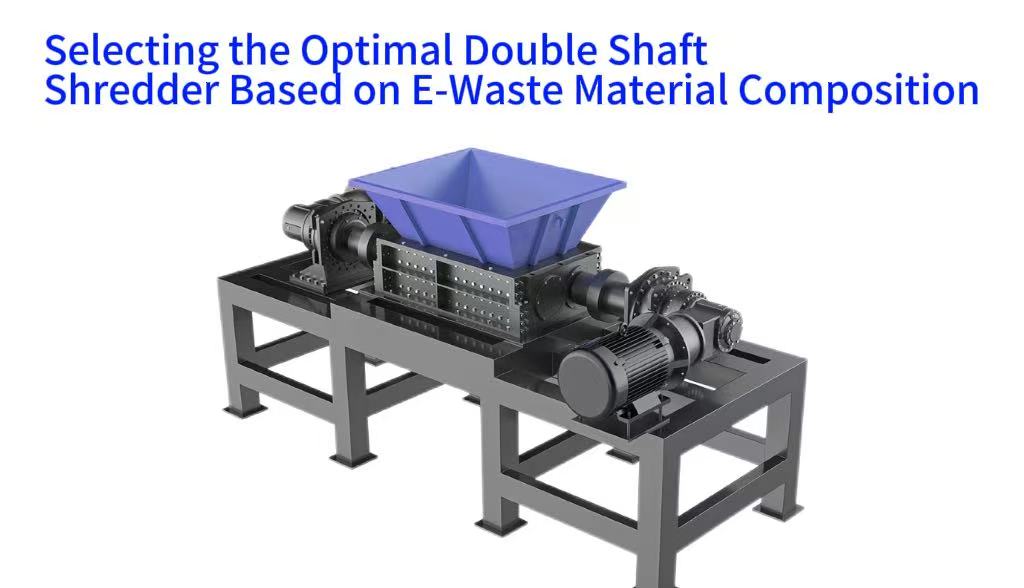
The double shaft shredder is not a monolithic product but a configurable system. Its key components are variables that must be engineered in response to the anticipated material challenges defined in the feedstock profile. The synergy between the cutting mechanism, drive system, and discharge controls determines success. Every design element, from the metallurgy of the cutters to the thickness of the sidewalls, serves a purpose in managing specific material properties like abrasiveness, impact, and tensile strength.
The operating principle revolves around two parallel, counter-rotating shafts fitted with intermeshing cutters. This geometry creates a powerful scissor-like shearing and tearing action. The precise nature of this action is fine-tuned through component selection. The goal is to select a configuration where the machine's inherent strengths are perfectly aligned with the dominant forces it will encounter, whether they be shock, abrasion, or strain. This alignment minimizes parasitic energy loss, directs power into productive fracturing of the material, and extends the service life of all consumable parts.
Cutter Design: Metallurgy, Geometry, and Configuration
Cutter selection is the most direct interface with the material. The choice of steel alloy is paramount. For general mixed e-waste with moderate metal content, tool steels like D2 or H13 offer a good balance of toughness and wear resistance. For streams with extreme abrasiveness, such as those high in PCB content, cutters tipped with tungsten carbide provide a dramatic increase in service life, though at a higher initial cost. The geometry of the cutting edge is equally critical; a sharp, acute angle is excellent for cleanly shearing ductile metals and plastics, while a more robust, obtuse angle better withstands the impact of crushing brittle metals or dense electronic components.
The arrangement of these cutters on the shaft further refines performance. A staggered or helical pattern ensures a progressive feed and a consistent load on the drive system, preventing the simultaneous engagement of too much material which can cause jamming. The clearance between the cutter tips and the machine's anvil or counter-knife is a precise setting that influences output size and energy consumption. A smaller clearance yields a finer product but increases power demand and wear rates, a trade-off that must be evaluated against downstream separation needs.
Drive System: The Interplay of Power and Torque
The powertrain must deliver sufficient force to the cutter shafts to initiate and complete the fracturing process. Electrical motors are commonly used, often paired with a heavy-duty gearbox to multiply torque. The key specification is not merely motor power in kilowatts, but the torque available at the cutter shafts at operating speed. Processing large, dense metal items requires very high momentary torque to overcome the yield strength of the material. This often necessitates a low-speed, high-torque design that can deliver tremendous force without stalling.
Hydraulic drive systems offer an alternative, providing infinitely variable speed control and exceptional torque at near-zero shaft speeds, which is highly effective for clearing jams or starting under full load. However, they may have lower overall energy efficiency compared to a well-matched electric system. The choice hinges on the nature of the feed material's resistance. A stream with predictable, consistent density may be well-served by a high-efficiency electric drive, while a highly variable feed with frequent potential for shock loads might benefit from the adaptive power delivery of a hydraulic system.
The Function and Selection of Discharge Grates
Discharge grates, or screens, are the primary determinant of final particle size. They act as a gauge, allowing sufficiently reduced material to exit the cutting chamber while retaining oversized pieces for further reduction. The opening size and shape are selected based on the requirements of the next process stage, such as magnetic separation, eddy current separation, or fine grinding. Smaller openings produce a more uniform, finer output but reduce throughput and increase the residence time and wear inside the chamber.
Grate design must also consider material flow. For streams containing stringy or fibrous elements like cables and wires, standard round-hole grates can become blinded. In these cases, slotted or "finger" grates are employed to allow the elongated materials to pass through without tangling. The grate itself is a wear item, especially when processing abrasive materials, and is often fabricated from hardened steel or with replaceable wear segments to facilitate maintenance and control long-term operating costs.
Structural Durability: Frame, Bearings, and Sealing
The shredder's structure must serve as an immovable foundation for the intense forces generated within. The sidewalls and main frame are typically constructed from thick, high-yield-strength steel plate, often with extensive internal ribbing. This robust construction prevents flexing and misalignment under asymmetric loading, which is common when processing irregularly shaped items. The integrity of this structure is non-negotiable for processing metal-dominated streams where impact forces are high.
Equally critical are the bearings that support the cutter shafts and the sealing systems that protect them. High-capacity, spherical roller bearings are standard to handle both radial and axial thrust loads. In e-waste applications, the ingress of fine, abrasive dust from plastics and fiberglass is a major threat. Advanced labyrinth seals, often supplemented with positive-pressure air purge systems, are essential to prevent this dust from contaminating the bearing housings and gearbox, ensuring long-term reliability and minimizing unplanned maintenance intervals.
Configuration Recommendations for Common E-Waste Profiles
| E-Waste Profile | Key Characteristics | Recommended Configuration | Output Size |
|---|---|---|---|
| Profile A: White Goods | Ferrous metal dominant, bulky items, high impact | Robust frame, large shafts, high torque drive, obtuse cutters | Large openings (80+ mm) |
| Profile B: IT Equipment | Plastic-metal composite, moderate abrasion | Medium-speed electric drive, wear-resistant cutters, mixed grate design | 30-80 mm |
| Profile C: PCBs | High abrasion, precious metal recovery | Tungsten carbide cutters, dust extraction, sealed bearings | Controlled coarse (20-50 mm) |
| Profile D: Data Devices | Secure destruction, metal casings | Sharp cutters, small clearance, fine grate, ram feeder | ≤ 2 mm |
Translating theoretical principles into practical machine specifications requires concrete examples. While every operation's feedstock is unique, common patterns emerge in the industry. These archetypal profiles allow for the formulation of baseline configuration recommendations. These recommendations serve as a starting point for detailed engineering discussions, which must always be validated with actual material testing. The expertise of a seasoned provider like MSW Technology is crucial here, as their 15-year portfolio contains proven solutions for these common and complex scenarios.
The following configurations illustrate how the core components—cutters, drive, grates, and structure—are assembled to meet specific challenges. It is important to recognize that these are specialized applications of the double shaft shredder principle. The versatility of this machine type allows it to be tuned across a wide spectrum, from coarse fragmentation of bulk items to the precise, secure destruction of sensitive components, making it the backbone of many modern e-waste recycling lines.
Profile A: White Goods and Bulky Ferrous Metal Dominant Streams
Refrigerators, washing machines, and oven cabinets present a challenge of scale and density. The primary objective is the volumetric reduction of large, hollow items constructed from sheet steel, often accompanied by motors, compressors, and wires. The configuration for this profile prioritizes structural strength and shock absorption. The machine requires an extremely robust frame, larger diameter cutter shafts, and cutters with a stout geometry designed for crushing and ripping as much as fine shearing.
High torque is essential to handle the intermittent peak loads when engaging dense motor blocks or thick metal corners. The drive system must be sized with ample reserve capacity. Discharge grates with larger openings are typically used initially to achieve high throughput for the bulky material, with potential secondary shredding for further size reduction if needed. Integration with a powerful overband magnet on the discharge conveyor is a logical addition to immediately extract the liberated ferrous fraction.
Profile B: Mixed IT and Office Equipment (Plastic-Metal Composite)
This stream consists of computers, printers, copiers, and telecommunication devices. It is characterized by an intimate mixture of plastic housings, internal metal frames, printed circuit boards, and various cables. The shredder must be a versatile performer, capable of shearing tough plastics, cutting thin sheet metal, and granulating PCBs. Cutter geometry often incorporates hooks or ripping teeth to aggressively grab and tear apart the composite structures, preventing whole items from riding on top of the rotors.
A medium-speed, high-torque electric drive system is commonly effective, providing consistent power for the sustained shearing action required. To manage the abrasive component from PCBs, cutters made from premium wear-resistant materials are recommended. The discharge grate size is selected to produce a fragment size that effectively liberates metals from plastics, typically in the range of 30mm to 80mm, optimizing the efficiency of downstream separation technologies like eddy current separators and air classifiers.
Profile C: Focused Printed Circuit Board (PCB) and Component Processing
Dedicated PCB recycling is driven by the high value of recovered precious and base metals. The shredding process here has a dual purpose: to break the boards into pieces small enough to liberate the embedded metals and to produce a consistent feed for subsequent fine grinding and chemical processing. Abrasion resistance is the paramount concern. The configuration mandates the use of the most wear-resistant materials available, such as tungsten carbide for cutters and specialized liners for the chamber walls.
The shredder acts as a primary PCB shredding unit, often set with a relatively small discharge grate to achieve a controlled, coarse output. Dust generation is significant due to the fiberglass content, making an integrated, high-efficiency dust extraction system a critical auxiliary component. The entire machine's sealing must be engineered to an exceptional standard to protect bearings and hydraulics from the invasive, abrasive dust, a design consideration refined through extensive operational experience.
Profile D: Secure Destruction of Data-Bearing Devices
Hard disk drives, solid-state drives, and servers containing sensitive data require physical destruction beyond recovery. The performance metric shifts from liberation efficiency to particle size guarantee. The shredder must be configured to achieve a specified maximum particle dimension, often as small as 2mm, to meet stringent standards like NSA/CSS 02-01 or DIN 66399. This requires a machine capable of very fine shredding, often achieved with a small cutter-to-anvil clearance, specialized, sharp cutter profiles, and a discharge screen with precise, small apertures.
The construction still needs to be robust to handle the metal casings and internal platters of the drives. The process is less about throughput and more about guaranteed results. The configuration may include features to ensure no whole components bypass the cutting zone, such as a ram feeder or a sealed cutting chamber. The output is a homogenized mix of metal and plastic particles from which data reconstruction is practically impossible, providing a secure, audit-trail-compliant disposal solution.
The Selection and Procurement Process: From Analysis to Acquisition
Procurement Process Flow
Formal Requirement Specification
Document feedstock profile, throughput needs, particle size requirements, site constraints
Supplier Engagement & RFP
Shortlist qualified suppliers, request detailed proposals with configuration rationale and performance metrics
Technical Evaluation
Compare cutter materials, torque ratings, structural design, control systems, and component quality
Material Testing
Conduct empirical testing with actual feedstock to verify throughput, particle size, and operational behavior
Total Cost of Ownership Analysis
Evaluate capital cost, energy consumption, wear parts, maintenance, and downtime costs over machine lifetime
Equipped with a detailed feedstock profile and an understanding of machine engineering, the next phase is the structured evaluation and procurement of the equipment. This process should be treated as a technical project, not a simple purchase. The goal is to gather comparable, validated performance data from potential suppliers to make an informed capital investment decision. Rushing this phase often leads to costly operational compromises. A methodical approach, involving clear communication of requirements and empirical testing, mitigates risk and aligns expectations between the recycler and the technology provider.
The output of this process should be a comprehensive technical and commercial proposal from the supplier that directly addresses the unique challenges outlined in the feedstock profile. Generic brochures or off-the-shelf models are insufficient for the complexities of e-waste. The proposal must detail how each component of the recommended shredder has been selected to meet the specific demands of the material, supported by calculations and, where possible, references from similar applications.
Phase One: Compiling the Formal Requirement Specification
All procurement activity must originate from a clear, written document. This Requirement Specification consolidates the quantitative feedstock profile with the operational goals of the plant. It should state the required average and peak hourly throughput in tonnes or kilograms. It must define the target output particle size range, referencing the needs of the downstream sorting or separation equipment. Other critical parameters include the maximum feed dimensions, the available power supply, and any site-specific constraints like space or noise limitations.
This document becomes the objective benchmark against which all supplier proposals are measured. It forces internal clarity and prevents scope creep during negotiations. Distributing this detailed specification to potential suppliers signals a serious, professional intent and encourages them to invest time in preparing a tailored solution rather than offering a standard catalog item. It forms the basis for a like-for-like comparison later in the process.
Phase Two: Supplier Engagement and Request for Proposal
With a specification in hand, the next step is identifying and engaging with qualified equipment manufacturers. Qualifications should include proven experience in the e-waste sector, the ability to provide local support and service, and financial stability. The Requirement Specification is formally issued to these shortlisted companies as part of a Request for Proposal. The request should explicitly ask for a configuration explanation, detailing the rationale behind the chosen cutter type, motor power, gearbox rating, structural design, and any optional systems.
Suppliers should be asked to provide expected performance metrics, such as throughput under the defined conditions and projected wear part consumption rates for the given feedstock. They should also submit a detailed bill of materials and clarify the scope of supply, specifying what is included in their offer. This stage separates suppliers who provide engineering solutions from those who simply sell machinery. A competent response will demonstrate a clear understanding of the material challenges described in the profile.
Phase Three: Technical Evaluation and Comparison
Evaluating the returned proposals requires a disciplined, point-by-point review against the original specification. Key technical indicators should be compared across all bids. These include the grade and proven performance of the cutter material, the calculated torque at the shaft, the diameter and type of bearings, the thickness of the structural steel in the sidewalls and frame, and the sophistication of the sealing system. The quality of the drive components, such as the motor and gearbox brand and model, should be scrutinized.
The control system description is also vital. A modern shredder should be managed by a Programmable Logic Controller (PLC) with a Human-Machine Interface (HMI). The PLC should offer functionalities like automatic load-based feed control, reversal sequences for clearing jams, and comprehensive fault diagnostics. The evaluation must look beyond the headline price to assess the inherent quality and longevity engineered into the machine, factors that directly impact total cost of ownership.
Phase Four: The Imperative of Material Testing
No theoretical evaluation can substitute for empirical evidence. Arranging a material test run with the preferred supplier's machine is the single most effective risk mitigation step. The test should use a representative sample of the actual e-waste feedstock. The goals are to observe the machine's feeding behavior, measure its throughput under controlled conditions, verify the consistency and size of the output material, and monitor key operating parameters like power consumption, noise, and vibration.
The test reveals practical issues that specifications may miss, such as a tendency for certain materials to wrap, the effectiveness of the dust containment, or the ease of accessing the cutting chamber for inspection. It provides a tangible demonstration of performance and builds confidence in the supplier's claims. A reputable supplier will be eager to conduct such a test, as it validates their engineering recommendations and fosters trust. This collaborative step is standard practice in the industry for deploying robust hard material shredding solutions.
Phase Five: Comprehensive Total Cost of Ownership Analysis
Total Cost of Ownership Components
Initial purchase price, installation, commissioning
Electricity costs over operational lifetime
Cutters, grates, bearings, seals replacement
Labor, lubricants, routine service costs
Lost production during repairs/unplanned stops
Technical support, spare parts logistics
The final decision must be grounded in a financial analysis that extends far beyond the initial purchase price. Total Cost of Ownership encompasses all expenses associated with the machine over its operational life. This includes the capital investment, the cost of electrical power consumption, the periodic replacement cost of wear parts like cutters and grates, regular maintenance labor and materials, and potential costs associated with unplanned downtime.
A machine with a lower initial price but higher energy consumption and rapid wear part degradation may prove far more expensive over five years than a higher-quality, more efficient alternative. The analysis should incorporate the supplier's projected wear part life and their unit costs. Furthermore, the value of reliable after-sales support, readily available spare parts, and knowledgeable technical assistance must be factored in as these services directly impact production uptime and long-term operational stability.